


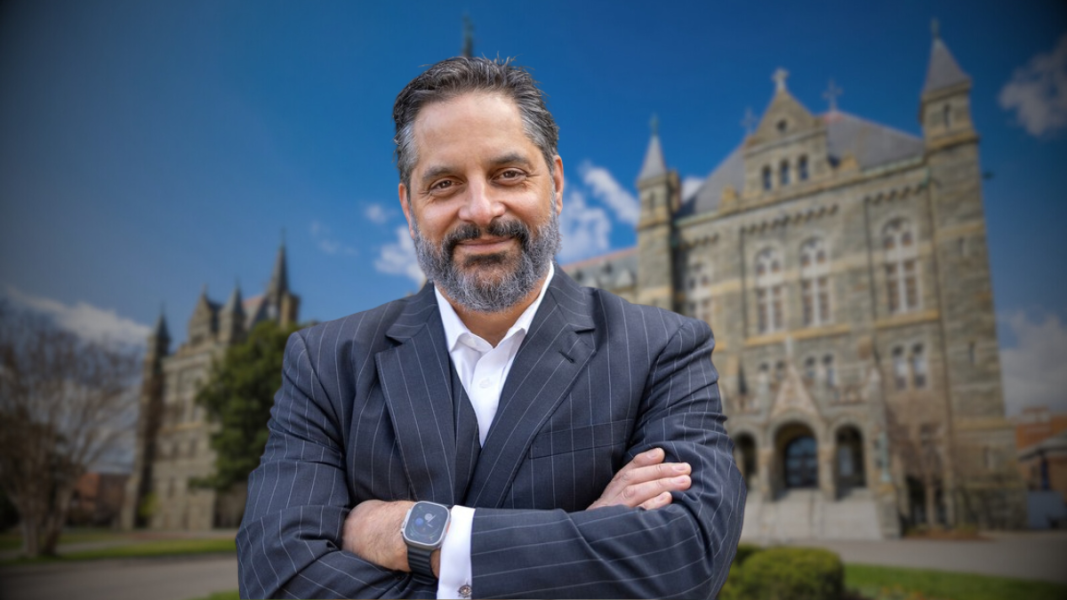
The prestigious American Jesuit university Georgetown University has taken a worrying turn: its new rector, Eduardo Peñalver, has publicly declared that he rejects the Catholic Church’s teaching on homosexuality. This statement, reported by LifeSiteNews, raises a serious question about the coherence and Catholic identity of an institution founded precisely to train leaders in service to the faith.
A Statement that Contradicts the Magisterium
During a recent interview, the rector not only expressed his disagreement with the Church’s moral doctrine, but also publicly defended the need to “review and overcome traditional teachings” on sexuality and human relationships, alluding to the fact that “the Church must adapt to contemporary values”.
With those statements, the president of a Jesuit university —an institution that officially defines itself as “Catholic”— not only distances himself from the Magisterium, but contradicts it explicitly. The Church’s teaching, expressed in the Catechism, is clear: homosexual acts “cannot be approved” (n. 2357) and the inclination itself “must be welcomed with respect, compassion, and sensitivity, without unjust discrimination”.
Accepting a position that denies this teaching is not a matter of theological interpretation: it is a direct rejection of Catholic doctrine.
An Institutional Decline
Founded in 1789, Georgetown is the oldest Catholic university in the United States and for decades was a benchmark for the Jesuit academic tradition. However, over the years it has gradually diluted its Catholic identity under the influence of cultural progressivism. Peñalver’s recent statements only confirm a process of secularization that has accelerated in recent years.
The Church’s teaching is clear: homosexual acts are objectively disordered according to natural law and Catholic morality, and the inclination itself requires respect and accompaniment, not approval or legitimization. When the highest authority of a university that claims to be Catholic openly rejects this teaching, it ceases to be a mere academic debate: an institutional break with the Magisterium is consummated.
Silence and Confusion
To date, no ecclesiastical authority has officially reacted to the rector’s statements. However, numerous faithful and Catholic alumni have asked the Archbishop of Washington to speak out, reminding that a university that publicly contradicts the Church’s doctrine cannot continue to present itself as Catholic without incurring incoherence.
The confusion among the faithful is evident: if a world-renowned Jesuit institution legitimizes the rejection of the Magisterium’s moral teachings, what message does it send to students and society about what it means to be Catholic?
A Crisis of Identity in Catholic Universities
The case of Georgetown is not an isolated incident. It is a symptom of a crisis affecting many Catholic institutions in the West, which attempt to reconcile their Christian heritage with the dominant ideology of the moment. In the name of “inclusion” or “modernity,” positions openly contrary to the Gospel are accepted, diluting the moral principles that should guide academic and pastoral life.
When a Jesuit or Catholic university bends to political correctness and relegates the Church’s doctrine to the private sphere, it renounces being what it claims to be. And what is lost is not only fidelity to Rome: the trust of believers, the integrity of the witness, and the very soul of the institution are also lost.