


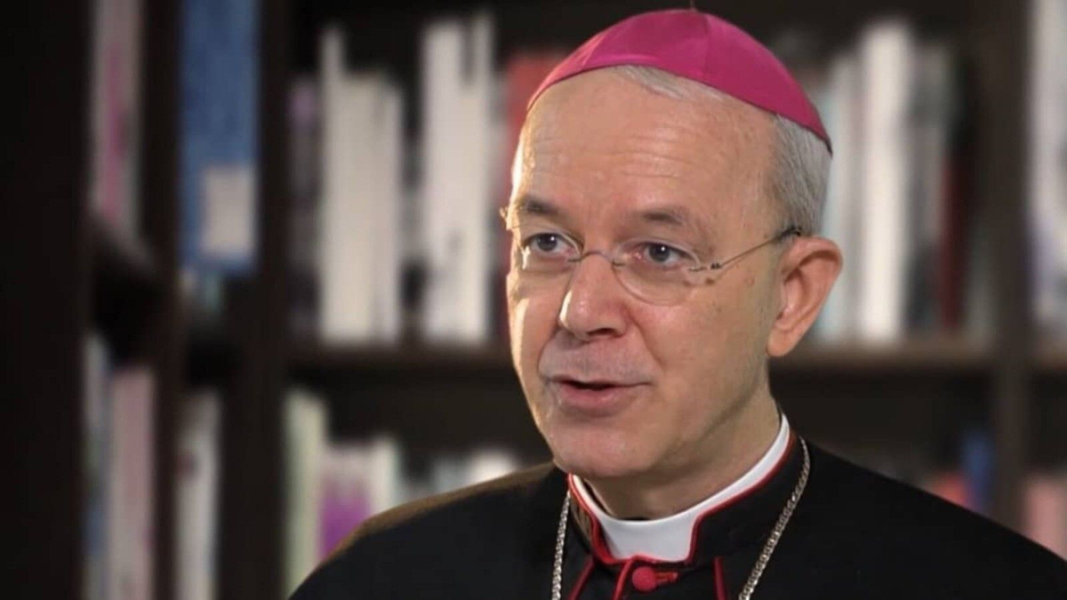
En an exclusive interview granted to Per Mariam, Bishop Athanasius Schneider warned that the Catholic Church is experiencing “an unprecedented confusion of faith” and called on Pope Leo XIV for a magisterial act that reaffirms the doctrine and restores the clarity lost in recent decades.
“The Pope must strengthen the entire Church in the faith; that is his primary task,” Schneider recalled, “a mission that God Himself entrusted to Peter and his successors.”
The prelate, auxiliary of Astana (Kazakhstan), pointed out that the Church finds itself “immersed in a doctrinal fog” that affects the faith, morals, and liturgy, weakening Catholic identity. “We cannot continue advancing into more confusion. That goes against Christ Himself and against the Gospel. Christ came to bring us the truth, and truth means clarity,” he stated firmly.
For Schneider, the solution lies in a public gesture from the Pope that reaffirms the Catholic faith in its integrity. He proposed, in that regard, a document similar to the Credo of the People of God promulgated by St. Paul VI in 1968, in the midst of the post-conciliar crisis.
“After more than fifty years, the confusion has increased, not decreased, especially during the last pontificate. Such an act would be one of the greatest gestures of charity from the Pope toward his spiritual children and toward his brother bishops.”
“Fiducia Supplicans” and the Confusion over Blessings for Same-Sex Couples
Asked about the document Fiducia Supplicans and the recent statements by Pope Leo XIV about “accepting people,” Schneider was categorical. In his view, the text from the Dicastery for the Doctrine of the Faith “must be abolished,” as it introduces ambiguity into a central moral issue for the life of the Church.
“The document expressly speaks of ‘same-sex couples.’ Even if it is said that their relationship is not being blessed but the persons, that is inseparable. It is a play on words that confuses and suggests that the Church approves of those unions.”
The bishop recalled that the Church has always blessed sinners who sincerely seek conversion, but has never blessed a situation contrary to God’s law. “We cannot bless something that contradicts creation and the divine will,” he emphasized.
“God accepts everyone, but calls for repentance. Accepting the sinner without inviting him to change is not God’s method nor that of the Gospel.”
The prelate explained that true Christian welcome consists in accompanying with charity those who wish to leave sin, not in confirming people in error. “We must tell them: ‘You are welcome, but what you live does not correspond to God’s will. We will help you to get out of evil, even if it takes time.’ That is true love,” he stated.
Finally, he warned against the participation of clerics or faithful in movements that seek to alter revealed morals:
“We cannot participate in organizations whose aim is to change God’s commandments. Confirming their objectives would be a betrayal of the Gospel and of the Church’s mission to save souls.”
“Walking Together” Means Pilgriming Toward Christ, Not Adapting to the World
On the concept of “walking together,” so repeated in the synodal process, Schneider warned that its authentic meaning has been distorted and must return to its Christological roots.
“Synodality means walking toward Christ, who is the Way, the Truth, and the Life. The Church cannot speak for itself, but must faithfully transmit what Christ revealed.”
The bishop explained that the Church is militant, called to combat error, sin, and spiritual confusion. “The Church on earth is a fighting Church. We fight against our bad inclinations, against the devil, and against the spirit of the world,” he recalled, citing St. Paul and St. John.
For Schneider, the meaning of “walking together” does not consist in sociological listening or adaptation to the world, but in the communion of the faithful who pilgrimage toward the heavenly Jerusalem.
“Walking together means advancing as a procession of believers who know in whom they have believed, who profess the truth with clarity and express it in the beauty of the liturgy.”
The prelate also warned against the presence of “false prophets within the ecclesial community,” who divert the faithful from the true path. For that reason, he called for vigilance and doctrinal firmness.
“Synodality must serve to proclaim with greater clarity the beauty of Christ’s truth and avoid all ambiguity. The Church must worship God with a worthy and sacred liturgy, a visible witness to its faith,” he insisted.
“The Lord did not say: ‘Listen to the people and ask for their opinion.’ He said: ‘Go and proclaim the truth.’ The Pope and the bishops have the grave task of announcing the truth with love and firmness, to free humanity from evil.”
We leave below the full interview:
Monsignor Schneider spoke with Per Mariam about the need for Leo XIV to address the current crisis of “confusion” in the Church, the issue of LGBT acceptance, and “walking together.”
Analyzing the first months of Leo XIV’s pontificate, Monsignor Athanasius Schneider has urged the Pope to respond to the “unprecedented confusion of faith” that the Church is going through.
In an exclusive interview granted to Per Mariam in early October, Schneider answered questions about the current state of the Catholic Church, the contemporary push toward LGBT acceptance, and the future of the ecclesial hierarchy in light of the Synod on Synodality.
“We cannot continue as a Church delving into more confusion,” he warned, asking Pope Leo to carry out a clarifying action to “strengthen the entire Church in the faith.”
Schneider also spoke about the Catholic way of “accepting” people, developing the Pope’s comments about accepting others “who are different from us.”
Now that the Church begins the long preparation process toward the 2028 Synodal Assembly, the theme of “walking together” is widely used but little explained. Schneider offers his interpretation of the term and how the Catholic Church pilgrimages on earth, always oriented toward heaven.
The full interview is presented below. It has been slightly edited for greater clarity, as the conversation was conducted in English, which is not Bishop Schneider’s native language.
Haynes — In the last days of Pope Francis’s life, and then in the first days of Leo XIV’s pontificate, you identified several issues that required fairly quick action. We are now approaching five months of Leo XIV’s pontificate, and it has been a fairly quiet period. What would you say are the Church’s most urgent needs today?
Monsignor Athanasius Schneider: I would say that the most pressing need is that the Pope must strengthen the entire Church in the faith, which is his primary task, one of the main functions of the pontiff that God Himself entrusted to Peter and his successors.
It is evident to all that the life of the Church is immersed in an unprecedented confusion of faith, with regard to the faith, morals, and liturgy. The Church is really enveloped in a kind of dust or fog of confusion.
We cannot continue as a Church advancing toward more confusion. This goes against Christ Himself, against the Gospel itself. Christ came to bring us the truth, and truth means clarity. Therefore, the most urgent task is for the Pope to carry out an act of his magisterium that strengthens everyone in the faith.
It could be done through a kind of profession of faith, similar, for example, to what Paul VI did in 1968, called the “Credo of the People of God,” where he expressed in the form of a profession of faith the issues that were then being denied or confused in the Church.
This is even more urgent after nearly fifty years; the confusion has increased, not decreased, especially during the last pontificate. Therefore, this would be the most urgent task, which at the same time would constitute one of the greatest acts of charity from the Pope toward his spiritual children, the faithful, and toward his brother bishops.
Haynes — Recently, in his extensive interview with Crux, Pope Leo spoke about Fiducia Supplicans and about “accepting” people. In one passage he said: “Fiducia Supplicans basically says that, of course, we can bless all people, but it does not seek to ritualize some kind of blessing because that is not what the Church teaches. That does not mean that those people are bad, but I think it is very important, once again, to understand how to accept others who are different from us, how to accept people who make choices in their lives and respect them.”
So, in terms of Catholic understanding, how do we “accept” someone and, at the same time, remain faithful to the Church’s teaching and to the fullness of the doctrine?
Monsignor Schneider: The first thing is that, however, Fiducia Supplicans expressly uses the words “same-sex couples.” That is what the document says. And that already causes enormous confusion, because it is about a blessing. Even if it is said “we do not bless their relationship, but the couple,” this is impossible, it is inseparable. They present themselves precisely as same-sex couples. So it is only a play on words that confuses people and that, for a normal person who reads the text, is understood as permission to bless same-sex unions or couples, or other extramarital couples who live publicly in a state of sin.
Therefore, this document must be abolished, because it is evident—since it is drafted with great ambiguity on a matter of utmost importance for the Church and also for those outside it—that even Catholics read it as a text that blesses same-sex couples.
We cannot continue with this game. Moreover, to bless a person, there is no need to issue a document. The Church has always blessed even a sinner who approaches and asks for a blessing. Of course, the blessing is given under the condition that he sincerely asks for God’s help for his conversion. We cannot always bless something according to the motive the person asks for. For example, we cannot bless someone who says: “Father, give me a blessing to abort” or “bless me so I can steal something.” Evidently, that is not possible. But these couples live in a stable situation of sin, whose union itself is already contrary to God’s will and command.
What do they base their union on? On doing works of charity or on erotic attraction to the same sex? This goes against God’s creation, against His will. Therefore, we cannot bless it.
The second part of the question refers to “accepting” people. Of course, God accepts everyone, but God calls for repentance. This is the first word that the incarnate God, Jesus Christ, uttered when He began His public teaching mission: “Repent.”
And when the risen Lord appeared to the Apostles before ascending to heaven, at the end of St. Luke’s Gospel, He said that the Church was to preach penance to all peoples. And this was the first: penance, conversion from evil to good with God’s help. This is the Church’s task. Therefore, God accepts all sinners, provided they have a sincere desire to convert, to accept God’s will, and to abandon evil.
Accepting sinners without conveying to them—even with love—the need for conversion is not God’s method. It is not the method of the Gospel, nor has it been that of the Church throughout two thousand years. Otherwise, it would be a failure: confirming people in evil.
Of course, we must say:
“You are welcome, but we invite you to seriously reflect on what you are doing and living, because it does not correspond to God’s will. For your own salvation, we must express this to you as an act of love toward you. You are always welcome and we will help you to leave evil and everything that is contrary to God’s will, even if it takes time.”
However, the important thing is that these people decide to abandon the sinful lifestyle and accept God’s will. In any case, the Church must avoid complicity with evil or connivance with it. That is not Jesus Christ, nor the apostles, nor the entire Church. It would be a completely foreign method: collaborating and giving them the signal that their lifestyle is fine. We must avoid that.
We must say: “We love you as a person, even if you are not yet willing to convert, but we love you and pray that you accept God’s will and convert.” It is the only way to eternal salvation; there is no other without conversion.
We must convey this to them, but not participate in public organizations like LGBT ones, which by their official objective seek to change God’s commandments. These organizations pretend that their sinful lifestyle be confirmed by the Church.
This is a betrayal of the Gospel: the Church would betray its mission to save souls and to call everyone to repentance.
I repeat, the method must be with love, but we must avoid confirming the objectives of these organizations to change God’s will, the commandments of God, or the immutable teaching of the Church. That is the true meaning of acceptance.
Haynes — Now we have the 2028 Synodal Assembly, after the Synod on Synodality. One of the big themes is “walking together.” As a bishop and pastor of souls, what is the meaning of “walking together” in relation to maintaining the hierarchical structure of the Church as Christ instituted it?
Monsignor Schneider: Yes, “walking together,” or in Greek synodus, is the only way the Church has and knows. As Our Lord said: “I am the way, the truth, and the life.” That is the program.
We know clearly that Jesus said: “I myself am the way, I am the truth, and I reveal to you all the truth that the Father gave me to reveal. That is why I send you the Holy Spirit, who will remind you of what I told you. He will lead you into the fullness of the truth. The Holy Spirit will not speak on His own, but only of what He heard from me, Jesus Christ, the truth, the Word of God.”
This is the Church’s permanent task: not to speak for itself, but, like the Holy Spirit, to faithfully transmit what Christ revealed.
The Church must proclaim it with greater clarity, not with less, but with more clarity.
That is the vision of the Holy Spirit in the Church: to guide it toward a clearer and deeper understanding, not to diminish it or make it ambiguous. St. Paul also says that no one can run in the arena without knowing the goal, for he will not reach the objective. St. Paul writes that we, the Church, must know clearly where we are going.
He also says that one who fights cannot simply throw punches in the air without knowing how to fight. The Church on earth is a militant Church, a fighting Church. That is the earthly reality. We are continually fighting—first against ourselves, our bad inclinations, sin, the flesh, and the devil in the world—as the apostles St. Paul and St. John wrote, and the Lord Jesus Christ Himself.
Therefore, we must be aware of walking together toward Christ, who is our only goal. We walk toward eternity. This is the pilgrim Church on earth. Where are we pilgriming to? Toward heaven, toward the heavenly Jerusalem that awaits us. The Church must always present this to the faithful: that this is the goal of our walking together, the heavenly Jerusalem.
That is our goal and our reality. In this walking, as Jesus Christ predicted, there will be many temptations and attacks from the spirit of the father of lies, as well as attacks from false prophets.
Our Lord warned us about false christs and false prophets, and so did St. Paul and St. John in the New Testament. They warned about false prophets within the community.
Therefore, in our walking we unfortunately have false prophets in our midst, and we must be vigilant so that they do not confuse or pervert others.
We must walk as in a pilgrim procession, with joy and conviction, and all who walk together must be able to say with St. Paul: “I know in whom I have believed,” and we must be deeply convinced of the Catholic truth.
That is the goal of the synodal journey: to proclaim and present with greater clarity the beauty of Christ’s revealed truth, avoiding confusion and ambiguity, and showing the beauty of prayer. The Church’s first task is to worship God, as all creation does, and that will be our end in heaven. That is the end of the triumphant Church: to praise God for all eternity. Therefore, in our walking together we must express it also in a sacred, beautiful, and worthy liturgy.
This is a powerful instrument of evangelization: inviting non-Catholics, non-believers who, metaphorically, watch our procession. When they see that we know in whom we believe, that we present the truth with beauty and clarity, that we pray and worship God with dignity and sacrality, that will strongly attract them to join our beautiful procession and this joint walking of the Church.
That is why our Lord said: “Go and proclaim my truth. Go and announce the Gospel. Teach all peoples what I have commanded them and teach them to live it.” He did not say: “Go and listen to the people, go and ask for their opinion.” That is not Christ. That is a worldly method, not the method of Jesus Christ or His Church.
Therefore, the Church, the Pope, and the bishops have the gravest task of proclaiming the truth, of ensuring that the entire earthly existence of the Church proclaims the Truth.
The Church is the only one that has received from God this mission on earth: to proclaim with love the beauty and clarity of all divine truth, and to guide the way toward the worship of God with dignity. And also to show the world that we truly believe in Christ, that we have the mission to free humanity from evil: first of all, from the mortal evil that destroys the spiritual life of the soul, sin against God; and furthermore, to free humanity from the chains of sin and from the organizations of sin against the First Commandment, like idolatry, and then fornication and all sins against love.
We must show this to the world with our life. Of course, love is the first and fundamental commandment, but we must also be good doctors who free humanity from the mortal spiritual diseases of vices and from structures of sin contrary to God’s will.
That is the task and the true meaning of “walking together.”
Original interview published on www.permariam.com