


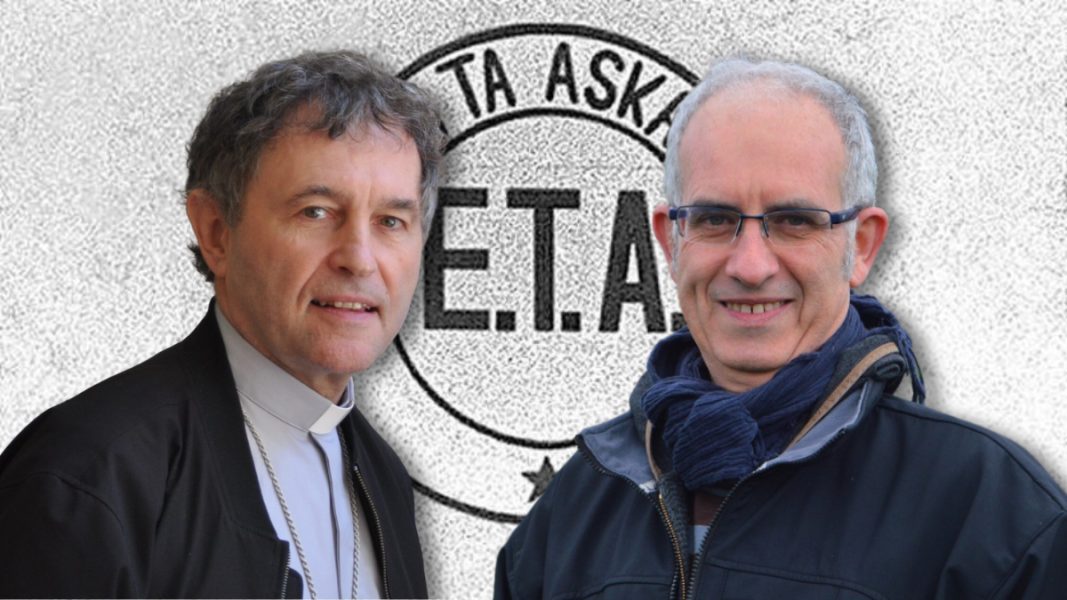
Outrage has ignited in the Basque Country after the Collective of Victims of Terrorism (COVITE) denounced that Bizkaia Irratia, a station linked to the Diocese of Bilbao, broadcasts a cultural program directed by Mikel Albisu, alias Mikel Antza, former political chief of ETA. The news has fallen like a bomb in public opinion because, far from being a neutral or private space, it is a platform associated with the Church, whose mission should be the defense of truth, justice, and the memory of the victims.
A terrorist with a microphone and public funds
The program is titled Irakurrieran and is presented as a literary initiative in collaboration with the Association of Writers in Basque. According to what has come to light, it also has funding from the Provincial Council of Bizkaia, which has allocated 53,000 euros to cultural activities of this type for the year 2025. The problem, however, goes far beyond the economic aspect. The controversy arises because the person hosting this space is not an ordinary citizen, but someone who for years was one of the top leaders of a terrorist organization that murdered nearly 900 people, kidnapped dozens, and left a trail of pain in thousands of Spanish families.
The moral scandal for the diocese
That this figure now appears directing a cultural program is not only offensive to the victims, but takes on shades of an ecclesial scandal by taking place on a station linked to the Diocese of Bilbao. The Church, whose mission is the defense of life and the dignity of every human being, should be a guarantor of the memory of those who suffered ETA’s violence. Instead, with this decision, it appears as a complacent institution that offers its own communication space to publicly rehabilitate the image of a former terrorist who has never shown remorse or asked for forgiveness from the victims.
The pain of the victims: silenced memory
COVITE has been clear in its denunciation. They recall that Mikel Antza has never carried out a critical review of his past nor shown any empathy toward the victims. However, he is now presented as an “intellectual committed to culture,” as if his criminal biography could be erased through a microphone and a literary program. For the victims of terrorism, who still suffer the weight of institutional forgetfulness and social abandonment, this gesture is an intolerable affront: they see how the memory of their loved ones is relativized and how their executioners are inserted into public life without a minimum gesture of remorse.
Normalization of terror and cultural whitewashing
The problem is not limited to the specific case of Mikel Antza. The participation of a former ETA chief in a cultural space funded with public money and broadcast from a diocesan medium reflects a broader process of whitewashing. Those who represented the strategy of terror are normalized, presenting them as respectable cultural agents, when in reality their past is marked by blood and violence. In this way, the narrative of terrorism is distorted: the victims are relegated, and the perpetrators find spaces to reposition their image.
A pastoral error and institutional incoherence
From the Church’s perspective, this case is a demonstration of serious incoherence. The Diocese of Bilbao, by allowing its station to serve as a platform for a former ETA leader, not only commits a pastoral error but also undermines the trust of the faithful. The Church’s mission is to bear witness to the truth and accompany those who suffer, not to collaborate—even indirectly—in the cultural legitimization of those who have never repented of having destroyed human lives in the name of hatred.
Conclusion
COVITE’s denunciation reminds us of something elemental: without truth, justice, and memory, there is no possible reconciliation. It is not about denying the possibility of a terrorist’s conversion, but that conversion requires remorse and a request for forgiveness. None of that has occurred in this case. For a diocesan station to lend its platform to someone who has never publicly renounced violence is a betrayal of the victims and a scandal for the faithful. The Diocese of Bilbao has a moral duty to rectify, because culture cannot be built on the silence of the murdered innocents.