


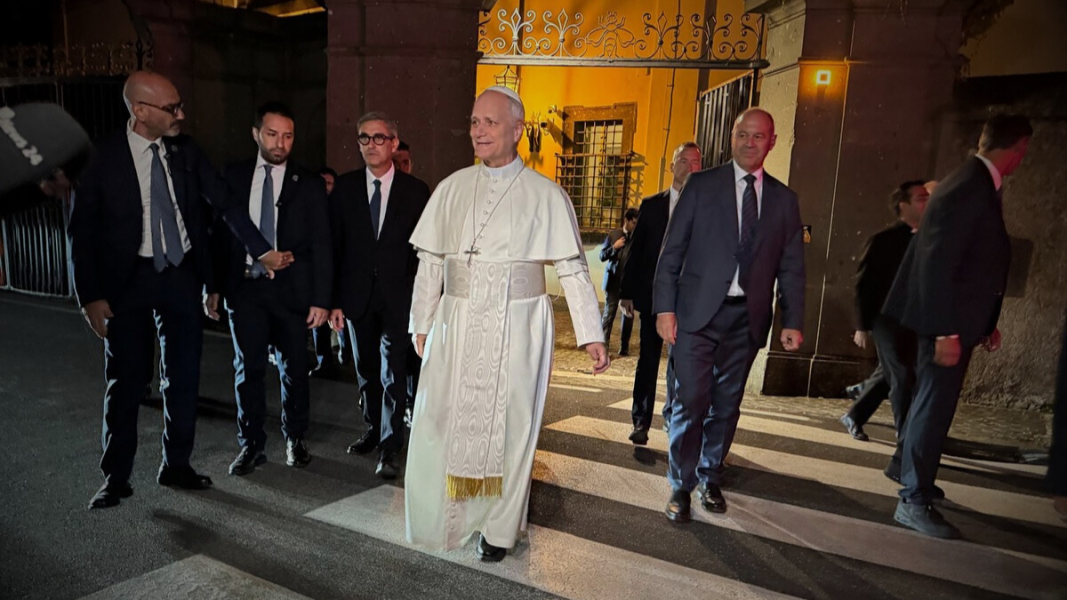
After several weeks in which his brief statements to the press upon leaving Castel Gandolfo generated controversy, Pope Leo XIV has decided to change strategy. This Tuesday, upon leaving the pontifical residence, he did not stop before the journalists nor answer questions, opting for a silence that many interpret as a gesture of prudence and clarity.
End of the “headline Tuesdays”
Until now, each departure of the Pontiff from Castel Gandolfo had become a habitual appointment for the media. Reporters and Vatican correspondents awaited his brief comments, often informal, which were quickly amplified. The Pope’s spontaneous phrases—sometimes pastoral, others personal—ended up occupying headlines that had little to do with the Magisterium of the Church.
In the face of this dynamic, Leo XIV seems to have understood that silence is, at times, the best way to speak with authority. Instead of improvising responses to questions of the moment, the Pontiff preferred to address the faithful directly, greet them, and continue on his way, leaving the journalists without statements, but with a clear message: the Pope is not a media figure, but the Vicar of Christ
Silence as a form of authority
According to Silere non possum, one of the media outlets that disseminated the scene, “the Pope has no obligation to satisfy anyone’s curiosity.” He is not a showbiz figure or a social media character, but “a man who acts according to his conscience and freedom.” Leo XIV’s silence, interpreted as a gesture of serenity and inner governance, seeks to recover the sense of the pontifical word as guidance, not as spectacle.
In times that demand immediacy and reaction, the Pope has chosen the most countercultural path: that of reflection and restraint. Speak less to be heard better. Be silent, not out of calculation, but out of prudence.
Silence, a change of method, not of mission
Paradoxically, the most newsworthy thing was not a phrase, but the absence of one. And few gestures irritate a pack of microphones as much as a Pope who decides not to improvise. Precisely: he speaks when he wants and is silent when it suits; and, when he is silent, he avoids the press turning a pastoral appreciation into “doctrine in 30 seconds.”
The move does not imply less transparency, but more care: reserving the word for moments and formats that ensure clarity, avoiding headlines that stray from the Church’s constant teaching, and protecting the authority of the See of Peter from the volatility of the news cycle. In sum: fewer “corridors” and more magisterium.