


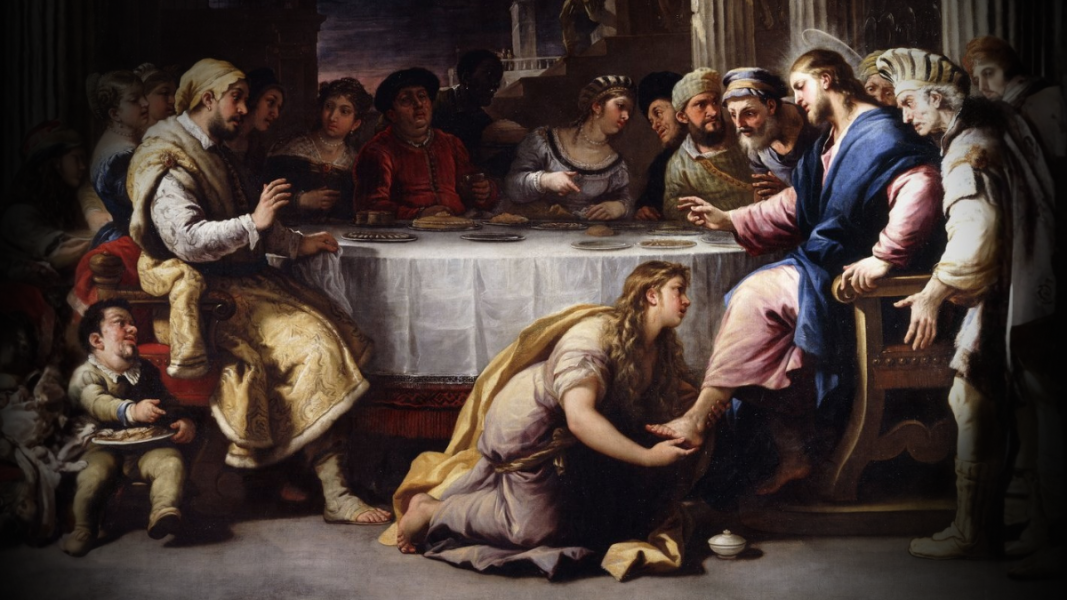
Thus read points 4 and 5 of the exhortation Dilexi Te.
4. Jesus’ disciples criticized the woman who had poured a very valuable perfume over his head: «What a waste! —they said— The perfume could have been sold at a good price to give the money to the poor.» But the Lord said to them: «The poor you will always have with you, but you will not always have me» (Mt 26:8-9.11). That woman had understood that Jesus was the humble and suffering Messiah upon whom she was to pour out her love. What consolation that ointment on that head which a few days later would be tormented by thorns! It was an insignificant gesture, certainly, but those who suffer know how important a small gesture of affection is and how much relief it can bring. Jesus understands it and sanctions its perpetuity: «Wherever this Good News is proclaimed in the whole world, what she has done will also be told in her memory» (Mt 26:13). The simplicity of this gesture reveals something great. No gesture of affection, not even the smallest one, will be forgotten, especially if it is directed toward someone who lives in pain, in loneliness, or in need, as the Lord was at that moment.
5. And it is precisely in this perspective that affection for the Lord is united with affection for the poor. That Jesus who says: «The poor you will always have with you» (Mt 26:11) expresses the same concept as when he promises the disciples: «I will be with you always» (Mt 28:20). And at the same time, those words of the Lord come to mind: «Whatever you did for one of the least of these brothers of mine, you did for me» (Mt 25:40). We are not in the horizon of charity, but of Revelation; contact with those who have no power or greatness is a fundamental way of encountering the Lord of history. In the poor, He continues to have something to say to us.
An Inverted Scene
The text is impeccable in its prose and bland in its theology. At first glance, it seems like a pious meditation on the woman who anoints Jesus’ head in Bethany. But if one pauses for a moment, one perceives that the scene has been turned inside out like a glove: where the Gospel shows adoration, Dilexi te reads compassion; where there is recognition of the Son of God going to his death, the Pope sees a gesture of tenderness toward a suffering man.
In the biblical account, that woman is ahead of everyone in understanding the mystery of the Passion: she pours out the perfume as one who anoints the Lamb before the sacrifice. It is a theological action, not therapeutic. Jesus himself interprets it: «She has done it to prepare me for burial.» Instead, here it is said that «those who suffer know how important a small gesture of affection is.» The Christ of redemption fades away, replaced by the Christ of empathy.
From Adoration to Welfare
The next step, in number 5, consummates the slip. It equates «The poor you will always have with you» with «I will be with you always.» That is, it identifies the real presence of Christ with the moral presence of the poor. The Incarnation is liquefied into sociology. Christ is no longer substantially in the Eucharist, but symbolically in the needy.
Tradition had always read those phrases in tension: the poor will always be there, but Christ—the Bridegroom—will go to the Cross. That is why the woman’s gesture was so urgent: to adore while he was still with them. Turning that opposition into equivalence is, simply, to empty the meaning of the Gospel. It is not an open denial of Christ’s divinity, but a form of forgetting. Jesus ceases to be the Word made flesh to become the metaphor of the marginalized.
The Horizontal Christ
In Dilexi te, the Redeemer has been replaced by the model. He who once saved now inspires; he who redeemed now accompanies; he who forgave sins now listens and identifies with the victims. Theology has become emotional. One is not invited to contemplate the glory of the Crucified, but to learn to care. And thus, what in the Gospel was an act of worship becomes a lesson in humanity.
There is nothing wrong with speaking of care or remembering the dignity of the poor. The problem arises when that language takes the place of the divine. Because if Christ is only «the one who suffers,» what remains of the one who reigns? If he is «in the poor,» where does his real presence, his lordship, his power to forgive remain?
The Drama of a Perfume Without an Altar
The woman of the Gospel poured her perfume over the head of God made man. In Dilexi te, that perfume falls on a symbol. Where there was once liturgy, now there is spiritual sociology; where there was redemption, now there is tenderness. The final phrase of number 5 sums it all up: «In the poor He continues to have something to say to us.» Yes, but before that he said much more: he said «This is my Body,» he said «Your sins are forgiven.» That voice, in the document, is barely heard.
There is no need to be indignant. It is enough to read it with the same gesture of the father who attends his adult son’s recital dressed as a little shepherd: with affection, with sadness, and with a bit of secondhand embarrassment. Because one knows that this is no longer faith, but its well-intentioned parody. And the problem is not the perfume—it’s that the altar has disappeared.