


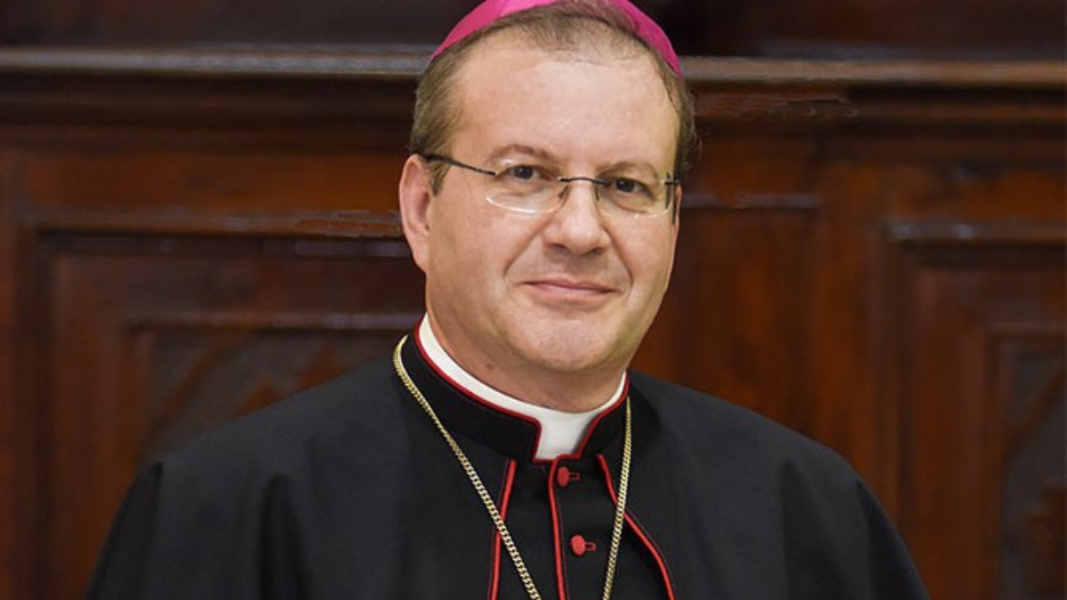
On October 22, the Vatican announced the resignation of Mons. George Bugeja, apostolic vicar of Tripoli (Libya), a decision that has caused surprise both due to the discretion with which it was communicated and the age of the prelate: just 63 years, twelve less than established by canon law for presenting resignation. Without an official explanation—as is usual—the gesture leaves a void in one of the most difficult and forgotten missions in the Catholic world.
A Franciscan on borderland
Mons. Bugeja, born in Gozo (Malta) in 1962, belongs to the Order of Friars Minor. He professed solemn vows in 1983 and was ordained a priest three years later. For decades, he exercised a ministry marked by Franciscan simplicity and missionary availability.
In 2015, he was appointed coadjutor bishop of the Apostolic Vicariate of Tripoli, amid Libya’s full political and social crisis, and assumed the role as titular two years later, succeeding the veteran Mons. Giovanni Innocenzo Martinelli, an emblematic figure of the Church in North Africa. Since then, Mons. Bugeja has sustained an almost heroic pastoral presence, in the midst of a country torn by civil war, Islamic fundamentalism, and the exodus of Christians.
Despite the risks, he remained faithful to his mission. On various occasions, he expressed his pain over the violence and natural disasters ravaging Libya, such as the 2023 floods, but also his conviction that the Church must remain there, even in conditions of extreme precariousness.
An early resignation
Precisely because of that missionary profile and strength of spirit, the news of his resignation has caused bewilderment. At 63 years, Mons. Bugeja is in full pastoral maturity and far from the usual retirement age. The Vatican statement merely indicates that the Holy Father “has accepted his resignation from pastoral government,” without adding any reason.
In a normal context, an early resignation by a bishop could be due to health reasons or a transfer to another mission. But in the case of Libya—a land without consolidated ecclesiastical structures, with few priests and a climate of permanent insecurity—the decision raises more questions than certainties. Physical and spiritual exhaustion after years of isolation? Internal problems or political pressures? Or a missionary strategy that the Holy See prefers not to explain?
In an era that demands transparency, the official silence is uncomfortable. One cannot treat the resignation of a bishop from a European diocese in the same way as that of a pastor who has lived practically in a state of permanent mission.
The Church in oblivion
The vicariate of Tripoli, like that of Benghazi, represents what the Church calls “border territories”: enclaves where the Catholic presence barely survives among foreign minorities, migrants, and refugees. There are no full temples or material resources, but there is a silent faith sustained by religious, missionaries, and volunteers who serve among Muslims and displaced people.
There, the bishop is not an administrator: he is a witness. Mons. Bugeja has been exactly that, a pastor who has kept the flame of faith burning in the midst of the desert, often literally. That is why his departure—so discreet, so swift—leaves the sensation of a loss greater than a simple institutional handover.
The question that remains
No one doubts that Mons. Bugeja offered his resignation freely, perhaps moved by fatigue or obedience. But the silence about his reasons and the lack of a clear word from the Vatican fuel the feeling that the most uncomfortable pastors or those who resist in difficult territories are relegated to oblivion.
At 63 years, this Maltese Franciscan embodies missionary fidelity in its purest form. For his departure to go unnoticed would be a mistake. Libya is not a diplomatic destination; it is a cross. And those who embrace it deserve, at least, a word of gratitude and truth.