


By: Manuel, Catholic and teacher
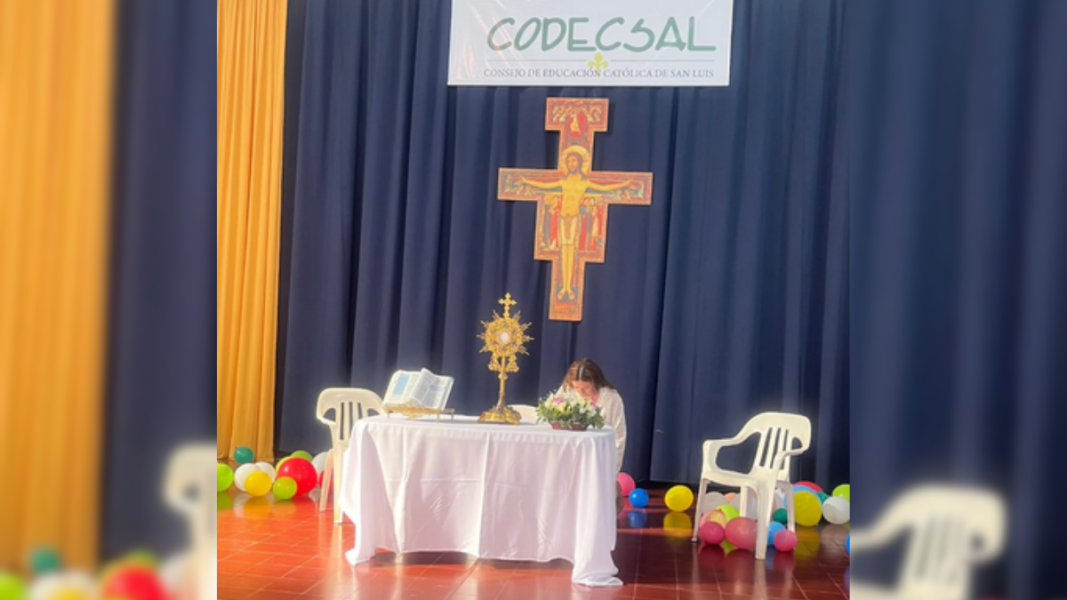
There are gestures that wound the soul more than a thousand words. On September 12th, at a meeting of Catholic educators organized in a school in the city of San Luis, an unforgettable affront was committed: the Most Holy Sacrament was treated with the utmost irreverence: exposed on a plastic table and surrounded by colorful balloons, as if the real Presence of Christ could be reduced to a pedagogical resource or a surprise effect in a school event.
But let’s look at the full scene, because it was even more painful. There was a nun who was leading a “group dynamic”; at one point, she asked all those present to blindfold themselves. Some who didn’t do it saw how a woman entered with the monstrance, carrying the Most Holy Sacrament, and placed it on that table. Then, the nun instructed those present to remove the blindfolds, and in this way, the Most Holy “appeared” before their eyes as if Eucharistic adoration were a magician’s trick and not the august mystery of our faith. Everyone who was present knows that there were priests there, ¡and even Bishop Gabriel Barba! So why did a woman handle the monstrance? And, moreover, who ensures that it wasn’t she herself who placed the host in it? It is very likely that the priests either did not know what was going to happen or did not expose it by express order of the bishop.
And here is the most serious part: because if this happened, it was due to the express consent of Bishop Barba, who not only allowed but ordered this irregular practice, disfiguring the dignity of the sacrament. Earlier, during his talk, he even allowed himself to recommend to the priests that they hear confessions, but that they do it “quickly,” as if the priest were a dispenser of absolutions and the sacrament of reconciliation a mere formality without mystery or depth. What is the sense of all this? Does the bishop think that in this way he will attract the faithful? Is not this banalization an expression of acedia, of that spiritual tedium that despises sacred realities and the goods of heaven? It is clear, the Sacraments are not for Him vehicles of grace, but simple external gestures (they will remember when, for a meeting of catechists, he brought a priest who denied the importance of Baptism to be children of God and, by the way, denied the existence of Original Sin. In this talk, or chatter, the bishop was present who nodded with his silence).
The Church has spoken clearly: Redemptionis Sacramentum teaches that “no one, on their own initiative, may add, remove, or change anything in the liturgy” (n. 59), and reminds that the exposition and benediction with the Most Holy is reserved to priests and deacons, and only in the absence of them to authorized instituted ministers (cf. nn. 134-138). Vatican Council II declared that the Eucharist is “the source and summit of the whole Christian life” (Lumen Gentium 11). And St. John Paul II warned in Ecclesia de Eucharistia (n. 52): “There is no danger of exaggerating in the care for this Mystery, because in this Sacrament the whole mystery of our salvation is contained”.
St. Peter Julian Eymard, apostle of the Eucharist, warned: “The greatest misfortune that can befall a people is to lose respect for the Eucharist. When it is treated as a common thing, everything is lost, because God Himself is lost”. How relevant his words ring today before an act where Christ was reduced to a didactic resource, to an object amid childish dynamics!
There is no possible excuse. Neither good intention, nor the supposed “pedagogical approach,” nor festive joy justify such a lack of respect. The Eucharist is not improvised, it does not “appear”: it is adored, it is guarded, it is received with trembling and love. Placing the Lord on a plastic table is, in the end, placing faith, devotion, and the tradition that the Church has guarded with the blood of martyrs and the tears of saints in plastic as well.
There is sadness, because the believing heart shrinks before so much frivolity. But there is also holy anger: the one that springs up when seeing the Sacrament that is the source and summit of Christian life outraged. It is not exaggerated to speak of profanation, for the sacred was reduced to the level of the banal. The Lord was silent in that instant, as He was silent in Gethsemane and in the praetorium. May those who were witnesses not grow accustomed to the banalization of the Mystery. May a new fervor of reparation arise and reverent love abound.
Before such an outrage, it is not enough to be indignant: reparation is urgent. St. Peter Julian Eymard taught us that “reparation is the duty of faithful friends when the divine Friend is forgotten or despised.” Therefore, it is incumbent upon every faithful who loves the Eucharist to offer acts of reparation: prolonged adorations, holy hours, reparative communions, silent supplications that return to the Lord what was denied Him in that moment. Let us raise interior altars of reverence and faith. Let us not allow the Real Presence of Our Lord to be sullied. Only in this way will we respond with fidelity to Christ humiliated in the Sacrament of His love.