


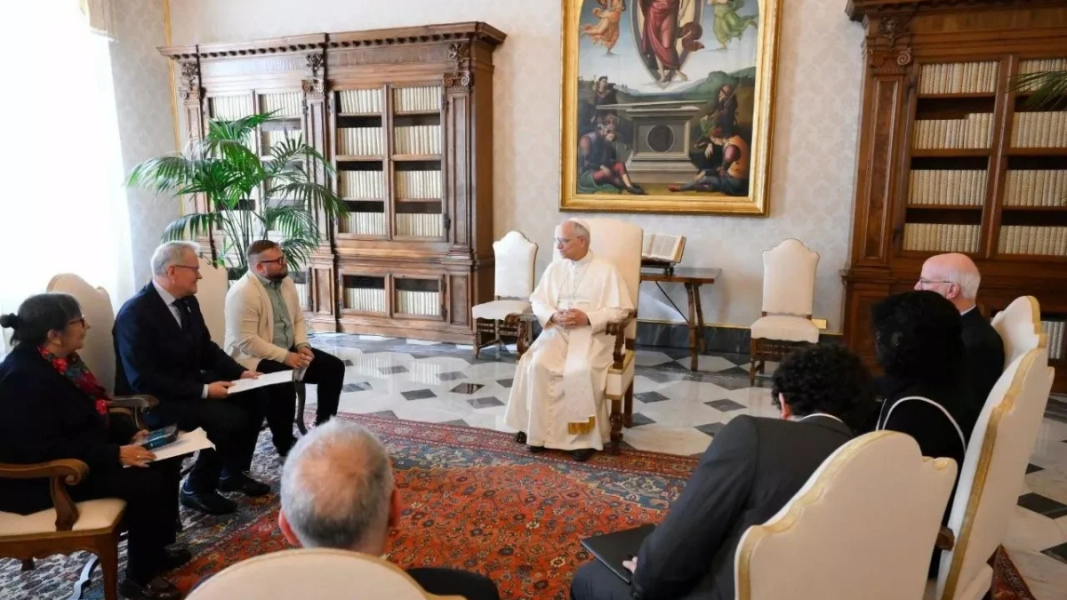
Pope Leo XIV met on Monday, October 20, in the Vatican with four survivors and two representatives of Ending Clergy Abuse (ECA), an international network that brings together victims of sexual abuse committed by clergy members in more than thirty countries. According to Aciprensa, it was the first meeting of this kind since the beginning of his pontificate.
An unprecedented audience in the pontificate of Leo XIV
The meeting, which lasted approximately one hour at Casa Santa Marta, was described by attendees as a “profoundly meaningful” dialogue. Gemma Hickey, president of the ECA board and a survivor of clerical abuse, stated that “we all felt heard.” According to Vatican News, the group had requested the audience in a letter sent after the Pope’s election and received the invitation as a sign of openness.
The ECA representatives did not limit themselves to recounting their experiences, but also presented concrete proposals. Janet Aguti, vice president of the organization, explained that they came “not only to raise our concerns, but also to explore how to work together to ensure the protection of children and vulnerable adults worldwide.”
Demand for transparency and justice
In statements quoted by Reuters, Tim Law, co-founder of ECA, emphasized that the group’s intention “is not confrontation, but accountability, transparency, and a willingness to walk together toward solutions.” Among the demands, they raised the need for a universal policy of expulsion from the ministry upon a single credible accusation of abuse, similar to the measures implemented in the United States after the Boston crisis in 2002. “If it worked there, why can’t it be universal?” they asked the Pontiff.
The context: an uncomfortable report for the Church
The meeting took place just a few days after the Pontifical Commission for the Protection of Minors published its second annual report, in which it criticizes the slowness of some bishops in applying protection measures, denounces the lack of clear sanctions, and demands greater commitment to repairing victims. The document warns that the Church continues to fail in offering transparency and justice, which fuels the distrust of the faithful.
In a previous interview granted to Crux, Leo XIV acknowledged that providing a just response to victims and, at the same time, guaranteeing the rights of the accused, constitutes “one of the great challenges” of his pontificate. The Pope insisted on the need for “authentic and profound compassion” in the face of the suffering caused by priests, bishops, religious, or laypeople linked to the Church.
Critical assessment
Leo XIV’s gesture is significant: receiving survivors directly sends a message of openness that his predecessors took years to give. However, the key is not in the audience, but in what comes next. As the victims warn, symbolic gestures do not substitute concrete reforms: effective sanctions against abusers and cover-up enablers, universal prevention mechanisms, and true reparation for the victims.