


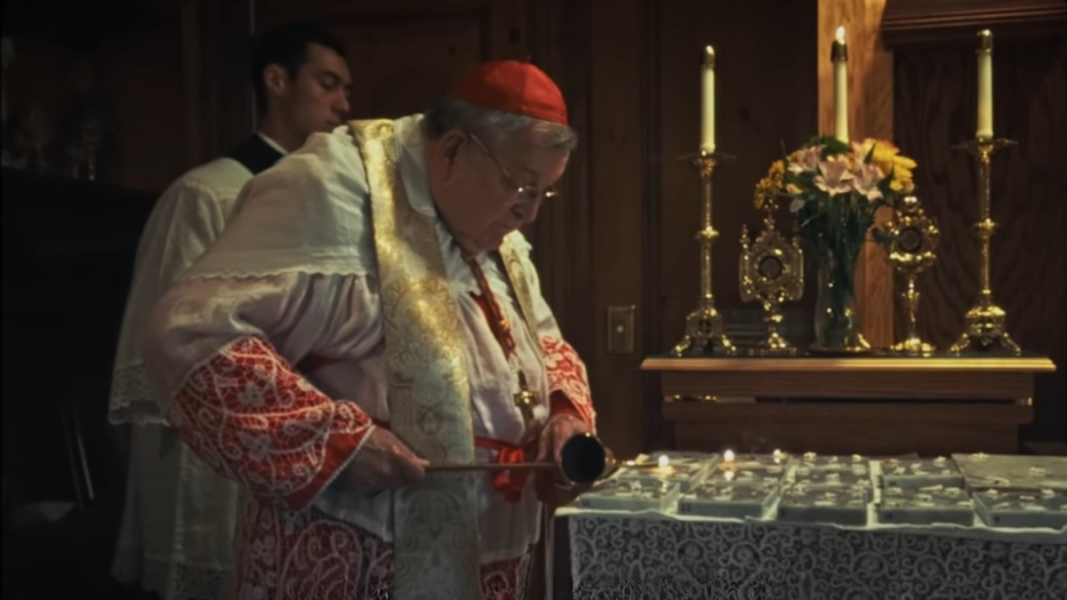
Cardinal Raymond Leo Burke, emeritus prefect of the Supreme Tribunal of the Apostolic Signatura, presided over the consecration of several altar stones at the Shrine of Our Lady of Guadalupe in La Crosse (Wisconsin, United States), a liturgical gesture of great spiritual depth and today rarely performed.
An Ancient Gesture in Full Relevance
The altar stone—also called the ara—is a slab of natural stone, consecrated by a bishop and which usually contains relics of saints. It is the heart upon which the Mass is celebrated, as it makes present the tradition of the first Christians, who offered the Eucharist over the tombs of the martyrs.
Sean Pilcher, director of Sacra, Relics of the Saints, an apostolate dedicated to the study and conservation of relics, explained in the video that these stones are used especially when a fixed altar is not available: “in a hospital, in a prison, in a cemetery, or in any place where there is no temple.” He also recalled that during the First and Second World Wars, many priests carried them to the trenches, ensuring that soldiers could receive the sacraments.
The Rite of Consecration
Pilcher detailed that the rite of consecration of the altar stone is one of the oldest in the Church and is entrusted to the bishop by the fullness of his priesthood. The process includes:
- The blessing with Gregorian water, a particularly solemn holy water, applied to five crosses engraved on the slab.
- The anointing with consecrated chrism, the same oil used in baptism and priestly ordination.
- The incensation of the stone, a sign of the prayers of the people ascending to God as a pleasing fragrance.
- The placement of relics of saints and martyrs, which connects to the origins of Christian liturgy.
Once sealed and blessed, the stone becomes an authentic, portable altar worthy for the celebration of the Mass in any place.
The Theological and Spiritual Meaning
The expert recalled that in each celebration over these stones “the saints are present in a particular way through their relics.” Thus, the liturgy unites heaven and earth: the faithful who participate in the Mass are incorporated into the praise of the angels and saints, actualizing the sacrifice of Christ.
Cardinal Burke, known for his defense of traditional liturgy and continuity with the Church’s tradition, rescued with this consecration a rite that testifies to the richness of the Catholic liturgical heritage and the importance of preserving gestures that express the faith with all its depth.
Source: Aciprensa