


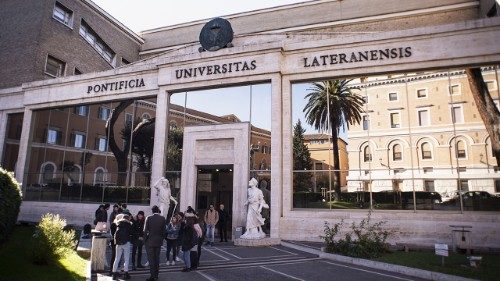
On October 17, during an event at the Pontifical Lateran University in Rome, journalist Edgar Beltrán, Venezuelan and correspondent for The Pillar, was violently assaulted while asking Archbishop Edgar Peña Parra about the possible political instrumentalization of the canonizations of the first Venezuelan saints by Nicolás Maduro’s regime.
An aggression in the midst of the pontifical university
According to the outlet’s own account, Beltrán approached the archbishop to ask if he feared that the Venezuelan government would use the canonizations as propaganda. At that moment, a man interrupted him, snatched his phone, threw it to the ground, pushed him, and insulted him, demanding that he not mention the regime. After a few moments of tension, the journalist managed to regain his composure and continue with his reporting work.
Read also: The Maduro regime tries to take advantage of the canonization of the Venezuelan saints.
The aggressor, identified as a businessman close to the regime
Although the attacker did not initially identify himself, witnesses at the scene later confirmed his identity: it was the Venezuelan businessman Ricardo Cisneros, who was part of the official delegation linked to Maduro’s government. The information was corroborated by various sources and publicly disseminated by journalist Orlando Avendaño.

Cisneros’s presence at an ecclesiastic event of international relevance and his violent reaction upon hearing an uncomfortable question highlight to what extent the regime attempts to control the narrative even beyond its borders.
A blow to press freedom
The episode is particularly grave due to the context in which it occurred: an academic and ecclesiastic event in Rome, the heart of the universal Church. For a journalist to be physically assaulted for fulfilling his duty to ask about the relationship between faith and politics constitutes a direct attack on press freedom and the transparency that the Church is called to defend.
Beyond an isolated incident
The aggression against Beltrán cannot be interpreted as a mere personal outburst. It occurs at a time when Venezuela is facing allegations of electoral fraud, repression of opponents, and hundreds of political prisoners. The canonization of such beloved figures as José Gregorio Hernández and Madre Carmen Rendiles thus becomes a delicate scenario: while the Catholic people celebrate, the regime seeks to benefit from the devotion to improve its image.