


By Francis X. Maier
Every few years I reread a couple of my favorite authors. George Orwell, despite his disdain for Catholicism, is always on my list. This time I paid special attention to his essay “The Principles of Newspeak”. He added it to his dystopian novel 1984. As Orwell notes in his text, Newspeak—the language of Airstrip One (the former United Kingdom) in Oceania—had three distinct vocabularies: A, B, and C. Vocabulary B “had been deliberately constructed for political purposes.” Its words “had, in every sense, a political implication.” They were designed to impose on the user a desired mental attitude.
A perfect word from that Vocabulary B was duckspeak. It meant “to quack like a duck.” Ultimately, for the linguists of Newspeak:
it was expected “that articulate speech would come straight from the larynx without involving the higher brain centers at all.” Thus, like several other words in Vocabulary B, duckspeak was ambivalent in meaning. Whenever the quacked opinions were orthodox, it implied praise, and when The Times referred to a Party speaker as doubleplusgood duckspeaker, it was granting a warm and valuable compliment.
On the other hand, duckspeak could also be used to describe and vilify any opinion that the Party considered crimethink. In effect, words meant what, and only what, the Party wanted them to mean in each circumstance.
The other author I returned to this year is the philosopher Augusto Del Noce. After flirting with the Italian left as a young man, Del Noce returned to his Catholic faith. From the postwar period until his death in 1989, he wrote a series of brilliant reflections (collected here and here) critiquing Marxist thought, technological civilization, the sexual revolution, progressive politics and theology, and the emerging contours of the postmodern world.
Of special interest, given our current environment, is his late-sixties essay, “On Catholic Progressivism”. In it he argued that:
[W]hile a discussion with a rigorous Marxist intellectual is possible, it is not with a Catholic progressive. Not because we despise him, but because he despises his critic, treating him from the outset as someone who stops at a merely formulaic intellectualism. Therefore, one does not discuss with a Catholic progressive, but in front of him, in the hope that our arguments may provide him with an opportunity to stimulate his critical reflection.
If Del Noce’s frustration sounds familiar, it should. The internal Catholic debate has been heated since the close of the Second Vatican Council, with tensions renewed in the last twelve years. Whatever its strengths, the pontificate of Francis, despite its supposed openness, was the most authoritarian in over a century, resistant even to faithful criticism, lax on issues of Church law, and marked by a studied ambiguity on various matters of doctrine.
Now we have a new Pope who has taken the name “Leo.” His predecessor, Leo XIII, worked tirelessly to align the modern world with eternal principles through his personal leadership and encyclicals like Rerum Novarum. We can hope that Leo XIV will do the same. We urgently need that kind of faithful leadership, because—according to the aforementioned essay by Del Noce—the Catholic progressivism of today, reborn during the years of Francis, represents the “exact inverse” of Leo XIII’s efforts. On the contrary, it seeks “to bring Catholicism into line with the modern world”.
This is most evident—though not exclusively—in matters of sexuality. There is an abyss between respecting people with same-sex attraction and their God-given dignity, and affirming sexually destructive behaviors. Channeling Del Noce at the 2018 Rome Synod of Bishops, Archbishop Charles Chaput, among others, emphasized that “what the Church holds as truth about human sexuality is not an obstacle. It is the only real path to joy and fulfillment”.
He went on to argue that:
There is no such thing as an “LGBTQ Catholic” or a “transgender Catholic” or a “heterosexual Catholic,” as if our sexual appetites defined who we are; as if these designations described distinct but equally integral communities within the true ecclesial community, the Body of Christ. This has never been true in the life of the Church, and it is not now. It follows that “LGBTQ” and similar language should not be used in Church documents, because their use suggests that they are real and autonomous groups, and the Church simply does not categorize people that way.
Yet this is precisely the divisive and misleading language that today’s cultural left—inside and outside the Church—seeks to employ.
So what is the point of all the foregoing words?
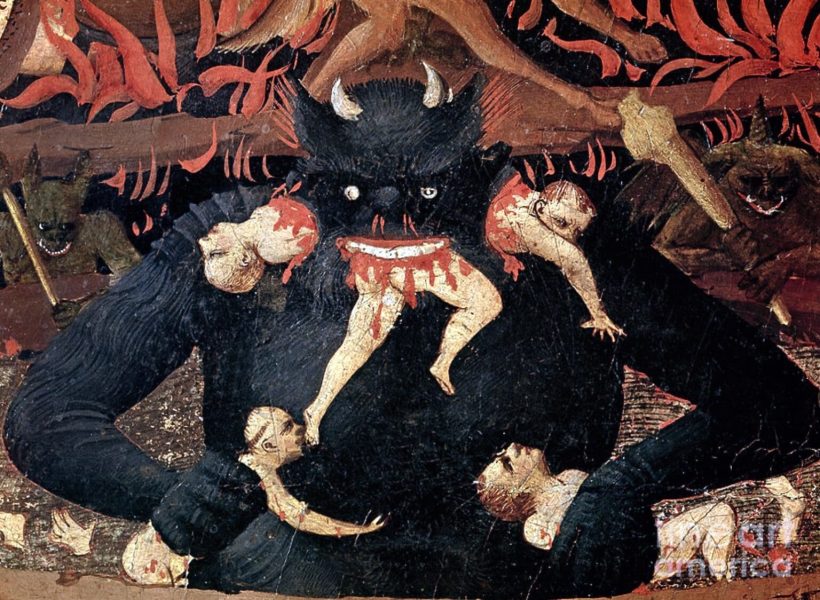
Just this: the devil is real. And he is not a cartoonish, leathery imp. If you want an idea of angelic greatness and power, even in a corrupted state, read Rilke’s poem, “The Angels”. That is the kind of creature, outside of space and time, whose genius and beauty were poisoned by its own sin of pride, which hates the human race and seeks to infect us with exactly the same hatred for Creation and embodied life.
In light of the industrial-scale mass murders of the last century, his batting average is perfect. The only “mysterious” thing about Satan is how many people refuse to believe in him; which, of course, serves his purposes very well. We find him now in the brainless quacking of our political discourse (“Fascist! Racist! Hater!”), in the duckspeak of our mass media, in the cynicism disguised as our behavioral sciences, in the toxic use of our sexuality, in our indifference toward the weak and suffering, and in the mutilation of our bodies, which God became Man to redeem.
October slides gently into the grotesque spectacle of Halloween on the neighbor’s lawn. It is a strange month, full of witches and goblins and odd thoughts like these. But it reminds me that, in the end—perhaps in every age—we have only one choice: the duckspeak, in all its many forms and vocabularies, or speaking the truth in love.
About the author
Francis X. Maier is a senior research fellow in Catholic studies at the Ethics and Public Policy Center. He is the author of True Confessions: Voices of Faith from a Life in the Church.