


By George J. Marlin
In the summer of 2014, Yohana Al-Zeebaree was a 12-year-old boy when his world turned completely upside down. From his home in Duhok, a city in northern Iraq, he remembers the rumors spreading through the neighborhoods, saying that ISIS was approaching.
“It was a big scare,” says Al-Zeebaree, now 23 years old. “I remember the night they said ISIS was approaching the northern cities, like Erbil and Duhok. Everyone was watching the news, and we received multiple calls from our relatives telling us to leave the city and head further north.”
Although Erbil and Duhok never fell, Mosul —Iraq’s second-largest city, with nearly two million inhabitants, and not far away— was taken. And the Nineveh Plains, with Mosul as its regional capital, home to some of Iraq’s oldest Christian communities, was devastated. Hundreds of thousands fled, filling Erbil’s refugee camps. Churches became shelters; classrooms, dormitories; streets, makeshift homes for families who had left everything behind except their faith.
The Christians living in the provincial capital of Mosul —ancient City of Nineveh— are descendants of Christ’s first followers. The region had been the traditional home of Assyrian Christians and the cradle of monasticism. But on June 11, 2014, Chaldean Archbishop Emil Nona announced that the last Christians had fled the city.
Describing the attacks on churches and monasteries, Archbishop Nona declared: “We received threats… [and] now all the faithful have fled. I wonder if they will ever return. My diocese no longer exists; ISIS has taken it from me.”
The organization Open Doors, advocate for religious freedom, agreed with the prelate: “This could be the last migration of Christians from Mosul,” its representative said. “Islamist terrorists want to turn Iraq into an exclusively Muslim nation and, therefore, expel all Christians.”
Amid that chaos, the Chaldean Archdiocese of Erbil, led by Bishop Bashar Warda, understood that those refugee families needed more than food and shelter: they needed education and hope. In 2015, the Catholic University of Erbil (CUE), Iraq’s first private nonprofit university, was inaugurated.
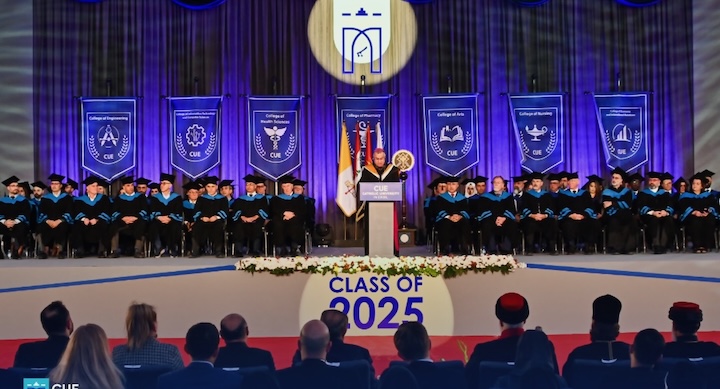
When the university recently celebrated its fifth graduation, it also commemorated its tenth anniversary, a milestone born of faith and resilience in the face of what seemed insurmountable adversity.
The CUE’s first academic building was funded by the Italian Episcopal Conference. The pontifical organization Aid to the Church in Need (ACN) provided funds for new faculties —such as architecture and medicine—, laboratories, and a modern library. Between 2018 and 2019 alone, ACN-USA contributed more than $1.8 million.
An educational initiative that began with just eleven students now has more than 760 students. Approximately 65% study with full scholarships, most funded by ACN.
Today, Iraq’s Christians are reaping the fruits of that carefully directed generosity, and the Iraqi people as a whole are too. Although Christians represent less than 1% of the population, after years of persecution, they can and must exert significant influence on the nation’s future, and the CUE is contributing essentially to that purpose.
Although the CUE is rooted in the Catholic tradition, its doors are open to all. Approximately 60% of its students are Christian, 30% Muslim, and the rest belong to minorities like the Yazidis. In a country where religious and ethnic divisions are deep, the campus is a living example of coexistence and shared purpose.
“When you go to the villages, you see Christians on one side and Muslims on the other,” says John Smith, a member of the university board. “But at the university, you see young people from all backgrounds having fun together, supporting each other. I think they are creating a learning environment for coexistence. If we achieve a critical mass of people who think and act like them, it will make a difference in the future.”
The rector, Fr. Karam Shamasha, emphasizes the importance not only of academics, but also of human relationships at this historic moment for Iraq: “We want to be a light in society. Not just provide education, but build peace.”
Looking back, it is astonishing how much the university has progressed in just a decade. When construction began in 2015, ISIS dominated much of the Nineveh Plains, and refugee camps stretched around Erbil.
“ISIS was still in control, and the future was totally uncertain,” recalls Regina Lynch, executive president of ACN International. “In the midst of all this, several small buildings were erected to start the CUE. Now, as more and more students graduate and work in various regions of Iraq, the values they learn there will continue to positively influence the country.”
That influence is already visible in numerous sectors of Iraqi life. Graduates work in hospitals, NGOs, international companies, and local businesses. Some have founded their own projects, bringing innovation and hope to previously forgotten communities. Others continue their studies abroad, but remain tied to Iraq by faith and family.
Today, in 2025, the Catholic University of Erbil not only trains the new generation, but fosters peace and resilience in a land still marked by war. There is much to do to rebuild and look to the future with hope, but the story of the CUE shows that even in times of darkness, education and faith can ignite a lasting light.
About the author
George J. Marlin, chairman of the board of Aid to the Church in Need USA, is the author of The American Catholic Voter and Sons of St. Patrick, written with Brad Miner. His most recent book is Mario Cuomo: The Myth and the Man.