


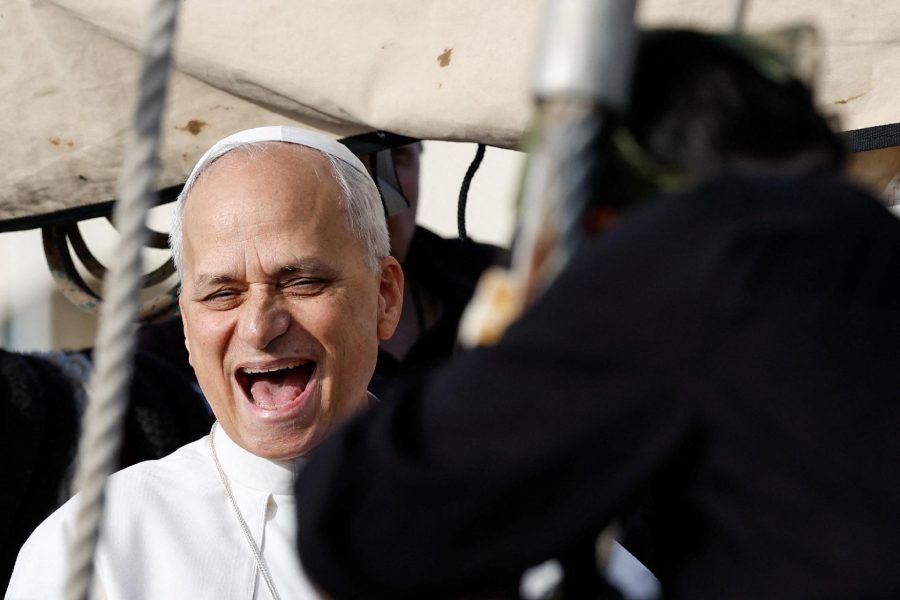
There comes a moment when one stops getting angry and simply starts looking at the ground, with the resignation of someone attending their child’s festival knowing that their child is already 22 years old and has a receding hairline.
The same happens when reading Dilexi te, the first exhortation of Leo XIV. It doesn’t outrage: it embarrasses.
It’s the serene embarrassment of discovering that our Pope writes like an NGO copywriter with “humanist” sensitivity and an allergy to dogma.
Nothing serious, some say. Just the detail that the successor of Peter speaks as if he worked for Save the Children.
A Theology of Cardboard
It all starts badly with a phrase that summarizes the general tone:
“In a world where the poor are increasingly numerous…”
No, Holiness, they are not. The poor, in the material sense, are fewer than ever; the poor in the spiritual sense, probably more, but you don’t seem to be referring to those.
The text continues by describing the “elites of the rich in their comfortable bubble” with the same depth as a tertuliana from the SER comments on inequality.
And then comes the poetic summit:
“Many—men and women—work from morning until night, sometimes collecting cardboard…”
Collecting cardboard.
Just like that, without context, without metaphor, without theology.
As if the Pope had spent some time leafing through Cáritas reports and decided to poeticize them.
Laborem exercens spoke of work as participation in the Redemption; Dilexi te speaks of recycling cardboard. That’s what there is.
The Pontiff and Calendar Phrases
The aphorisms that would delight a community manager with a clerical collar are not missing:
- “Love is not imposed, it is proposed.”
- “A Church that knows no enemies, only men and women to love.”
- “We must look at reality through the eyes of the poor.”
All said with that tedious modulation of universal goodism that no longer even pretends to emotion: it just fills space.
The Magisterium has become a motivational brochure. What was once theological fire—“the riches of the world are dung”—is now a TED talk:
“The world needs an economy with a human face.”
The Great Substitution of the Verb
The old theology spoke of redemption, sacrifice, merit, grace.
Dilexi te speaks of “structures of injustice,” “new poverties,” and “human face.”
Original sin has disappeared and “inequity” has entered.
The Pope no longer exhorts to conversion: he exhorts to solidarity.
He no longer calls the saints: he convenes development agents.
Christianity is turning into an NGO with optional incense, and Dilexi te is its foundational brochure.
The Social Doctrine of the Church, which Leo XIII raised as a building of revealed truth, has been reduced here to a lay cooperator’s homily.
The Silence of Those Who Still Pray
One finishes the text without anger, but with a certain polite sadness.
Like the father who applauds discreetly while his adult son sings off-key on stage, because there is no longer any hope of change, only weary affection.
It is supposed that the Pope must confirm his brothers in the faith.
Leo XIV, on the other hand, confirms us in the suspicion that the Magisterium has moved to the United Nations communications department.
And so we continue: collecting, not cardboard, but the crumbs of what was once the voice of Peter.