


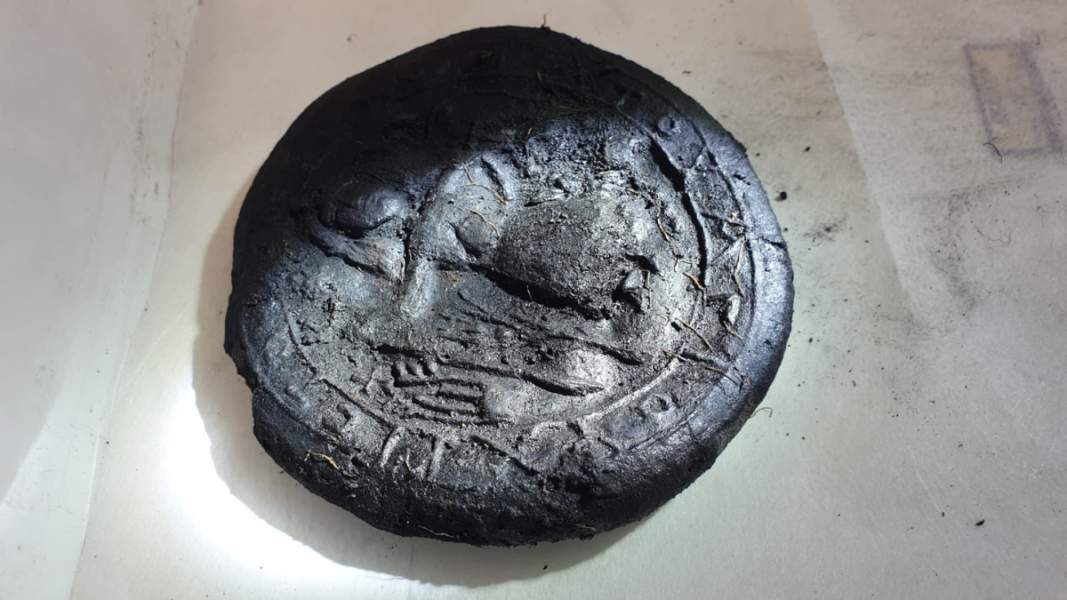
A team of archaeologists has discovered five carbonized loaves between 1,300 and 1,400 years old that may have been used as Eucharistic breads in early Christian celebrations. The find occurred in Topraktepe, an ancient Roman and Byzantine center known as Irenopolis —the “City of Peace”—, located in the current province of Karaman.
Breads with inscriptions and Christian symbols
As officially reported by the Government of Karaman, one of the loaves found contains the figure of Jesus Christ accompanied by a Greek inscription that reads: “With our thanks to the Blessed Jesus”.
Epigraphic analyses determined that this representation differs from the traditional Christ Pantocrator. Instead, it shows a farmer or sower Christ, a symbol linked to fertility and labor, with a strong spiritual background. The statement itself emphasizes that this iconography is significant because it reflects a popular devotion distinct from the official forms of Christianity in Constantinople or Rome.
Other loaves feature relief decorations in the shape of a Greek cross and a Maltese cross, elements that reinforce the hypothesis of their use in Christian contexts.
Exceptional preservation
The discovery has surprised experts due to the extraordinary state of preservation of the loaves, which have survived to this day thanks to the carbonization process and their location in an oxygen-free environment. According to the archaeologists, these are the best-preserved examples of this type found to date in Anatolia.
Unique iconography
According to the official statement, the image depicted corresponds to a “sower Jesus” or “farmer Jesus”, an iconography distinct from the classic Christ Pantocrator —depicted in a majestic attitude, with the Gospel in one hand and the other raised in a gesture of blessing—.
This symbolism, the researchers explain, reflects the importance of fertility and agricultural labor in the Christian spirituality of the time, which may indicate a more local and popular cult, removed from the official liturgical forms of Constantinople or Rome.
Historical and religious value
For Professor Giovanni Collamati, a specialist in medieval history at CEU San Pablo University, this find is especially relevant because it sheds light on a little-documented period:
“The current liturgy is fixed in Rome starting from the 11th century. This find, on the other hand, comes from a local Byzantine context, which allows us to see a more autonomous and popular Christian devotion”.
The fact that it occurred in a secondary city of the Byzantine Empire —and not in a first-order ecclesiastical center like Constantinople— offers new clues about the diversity of cults and forms of devotion that coexisted in the early centuries of Christianity.
Ongoing excavations
The excavations at Topraktepe are directed by the Karaman Museum in collaboration with the Turkish Ministry of Culture and Tourism. The researchers will continue studying the remains with the aim of clarifying their origin and determining with greater certainty their liturgical function.
This find, already described as one of the most important in the region in recent years, constitutes a unique testimony to the faith of the early Christian communities in Anatolia.