


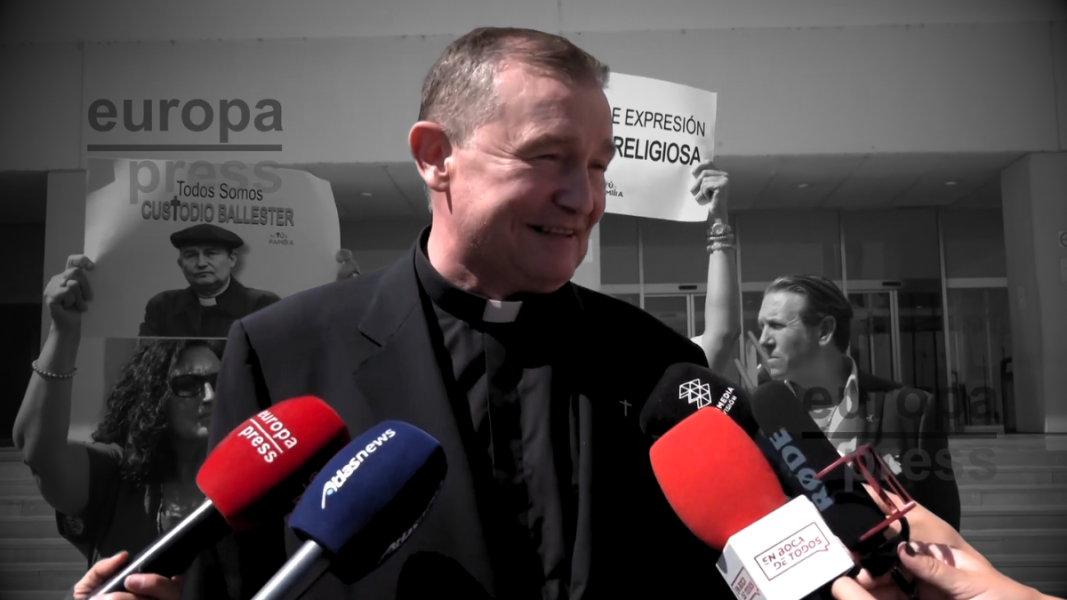
After two weeks of waiting, the First Section of the Provincial Court of Málaga has acquitted the priest Custodio Ballester of the hate crime charge for his criticisms of Islam, as well as the priest Jesús Calvo and the layman Armando Robles, who were in the same trial. The sentence, notified today October 17, 2025, concludes that their statements are protected by freedom of expression and do not constitute incitement to violence in any case, although, as El Debate rightly reported, the statements that led Ballester to trial were «unfortunate, Manichean, linked to intransigent religious or ideological stereotypes or that resort to unfair and arbitrary generalizations, they cannot be considered constitutive of the crime of incitement to hatred» according to the sentence.
With this ruling, an end is put to a judicial process that had been ongoing for almost a decade and that had turned the priest into a symbol of a broader battle for the defense of free speech in the religious sphere.
A prolonged and controversial trial
The case began in 2017, when various public interventions by Father Custodio were reported for their critical tone toward Islam. The Málaga Prosecutor’s Office even requested three years in prison, arguing that certain expressions could be considered incitement to hatred against a religious group. During the oral hearing, the defense argued that his words were directed at radical Islam and the ideologies that inspire jihadist terrorism, and not against the Muslim community in general. The court has finally sided with the defense, emphasizing that in a democracy it is legitimate to question doctrines and warn about their risks without this being criminalized.
A message of hope for Catholics
Father Custodio’s acquittal also sends a message of hope to Catholics who, from public life or from the pulpit, do not fear denouncing what they consider a danger to the faith or to society. The sentence confirms that one can speak clearly, without fear that every critical word will be taken to the courts. In a time marked by attempts at censorship and the pressure of political correctness and ideologizing every word, this ruling is a positive signal: religious freedom and freedom of expression still have space in Spain, and the testimony of priests cannot be silenced by the abusive use of justice.