


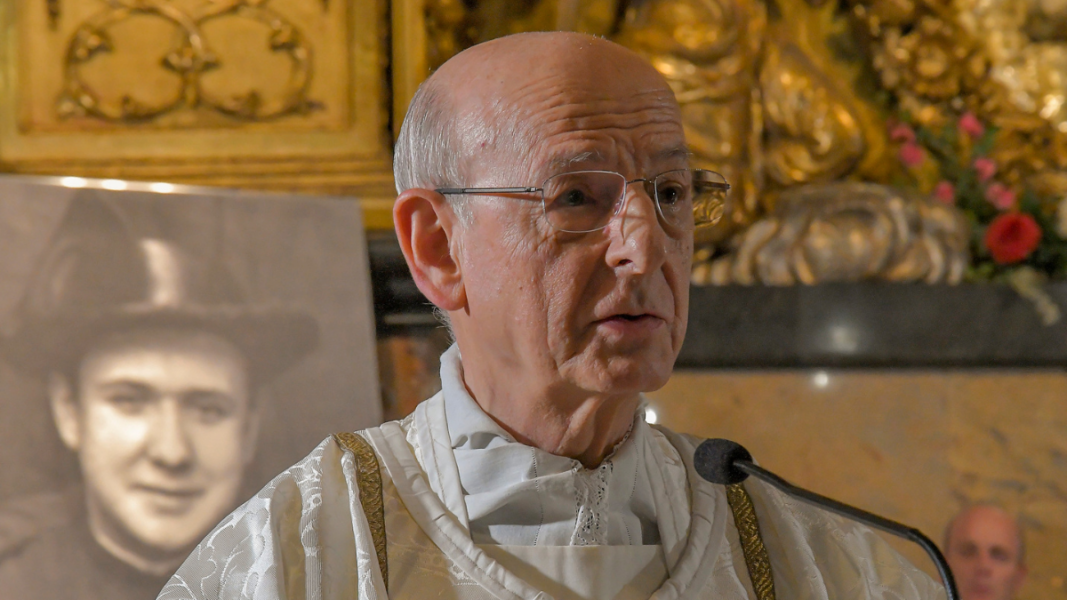
The prelate of Opus Dei, Fernando Ocáriz, has published on this October 16 a new letter to his faithful. At first glance, the text seems like a spiritual meditation on fidelity and tradition; but read in context, its content functions as an indirect preparation for the imminent reform of the statutes that the Holy See has been studying since June.
The key phrase of the message hints at it: «At the same time, nothing changes in the spirit, nor in the content of the norms of piety and family customs». Ocáriz does not yet speak of the reform, but puts the bandage before the wound: he warns that, whatever the new legal configuration of Opus Dei may be, the members must keep intact the spirit, the customs, and the family sense inherited from Saint Josemaría.
A Preventive Language
The insistence that “nothing changes in the spirit” only makes sense if an external change of great scope is expected. It is the discreet, but unequivocal, way in which the prelate anticipates the impact that the imminent division of Opus Dei into three distinct legal entities will cause: the clerical prelate, the Priestly Society of the Holy Cross, and a public association of the faithful for the laity.
In practice, Ocáriz implicitly confirms what InfoVaticana published days ago: that the reform is imminent, that it will deeply alter the governance structure, and that in Rome it is taken for granted that the prelate will cease to have authority over the laity.
The Message Between the Lines
The general tone of the letter is one of serenity, but also of doctrinal shielding. The prelate calls for preserving “the little customs” and “the family tradition,” emphasizing that the unity of the Work does not depend on its legal structure, but on the interior fidelity of its members. It is a discourse of continuity in form, but that tacitly assumes the substantive rupture.
Ocáriz himself quotes a phrase from Benedict XVI about Tradition as “a living river that goes back to the origins,” a metaphor that in this context sounds like a warning: the Work may change its course, but it must try not to lose its water. In short, an appeal to obedience and spiritual resilience before an inevitable readjustment.
A Confirmation Without Saying It
The publication of this letter—hours after the official note denying “novelties”—demonstrates that Opus Dei is already preparing for the moment when those novelties become public. There is no possible denial, only a call to fidelity and acceptance. Ocáriz’s style, contained and pastoral, acts as a preventive shield: he who warns his children that “nothing changes” does so because he knows that everything is about to change.
The Full Letter
Message from the Prelate (October 16, 2025)
The prelate of Opus Dei encourages living the vocation to Opus Dei with gratitude and fidelity, keeping its spirit and family tradition alive with love and apostolic creativity.Dearest ones: May Jesus keep my daughters and my sons!
On the 2nd of this month we celebrated the anniversary of the foundation of the Work, and on the 6th the one of the canonization of Saint Josemaría. These are two dates that help us to consider, with gratitude to God, the reality of our vocation to Opus Dei, with the consequent joyful personal responsibility to strive to be and make the Work in service of the Church.
Many of you will remember these words of our Father: «Just as the identity of the person remains throughout the various stages of growth: childhood, adolescence, maturity…; so there is, in our development, evolution: otherwise, we would be a dead thing. The core, the essence, the spirit remains unshakable, but the ways of saying and doing evolve, always old and new, always holy» (Letter 27, n. 56).
It is especially in personal apostolate, also with the effort to orient professions and human structures in a Christian way, where we must put personal creativity and initiative in the ways of saying and doing. At the same time, we strive to be faithful to the norms and customs—of spiritual and apostolic life—that Saint Josemaría transmitted to us.
On the other hand, what our Father expresses when writing that «the ways of saying and doing evolve» has been and is a reality throughout this century of the Work’s life. The examples of this are very numerous. At the same time, nothing changes in the spirit, nor in the content of the norms of piety and family customs. Naturally, not everything has the same importance, for in our spirit there are from essential realities of Christian life—first of all, the Eucharist—to details that we might think our Father, as founder, could have omitted or replaced with others, without affecting the spirit. However, it is good to keep in mind that those realities can be lived with much love and thus acquire great value. And moreover, the little customs also contribute to creating and maintaining a family tradition that, as a whole, is important as an additional element of unity: of current unity and of vital unity with the origin. In this context, and saving the evident distances, I recall some words of Benedict XVI referring to the universal Church: «Tradition is the living river that goes back to the origins, the living river in which the origins are always present» (Benedict XVI, Audience, April 26, 2006).
Sometimes we may experience the temptation of routine in living the norms of piety, the customs, and the means of formation. If we strive to do so with love, there will be no routine or habituation: love renews all things (cf. Rev 21:5). As Pope Leo XIV has just reminded us, «love is above all a way of conceiving life, a way of living it» (Dilexi te, n. 120). Each day will have a new splendor, and we will be able to rediscover the beauty of our spirit. For this reason, it is important to keep very much in mind that we desire to be faithful not only to something—to a plan of life—but mainly to someone: to Jesus Christ and, with him and in him, to our brothers and to the whole world. Also with this perspective we can understand that exhortation of our Father: «Be faithful, children of my soul, be faithful! You are the continuity» (In Conversation with the Lord, n. 79). The Work is in our hands, like an inherited legacy, a treasure, which we must collaborate to make fruitful and transmit, with the grace of God and with joy, despite our personal limitations and errors. And without becoming discouraged either in the face of external difficulties according to times and places.
Let us not fail to unite ourselves to the person and to the intentions of the Roman Pontiff, in these crucial moments for world peace.
With all affection, he blesses you
your Father
Fernando Ocáriz
Rome, October 16, 2025