


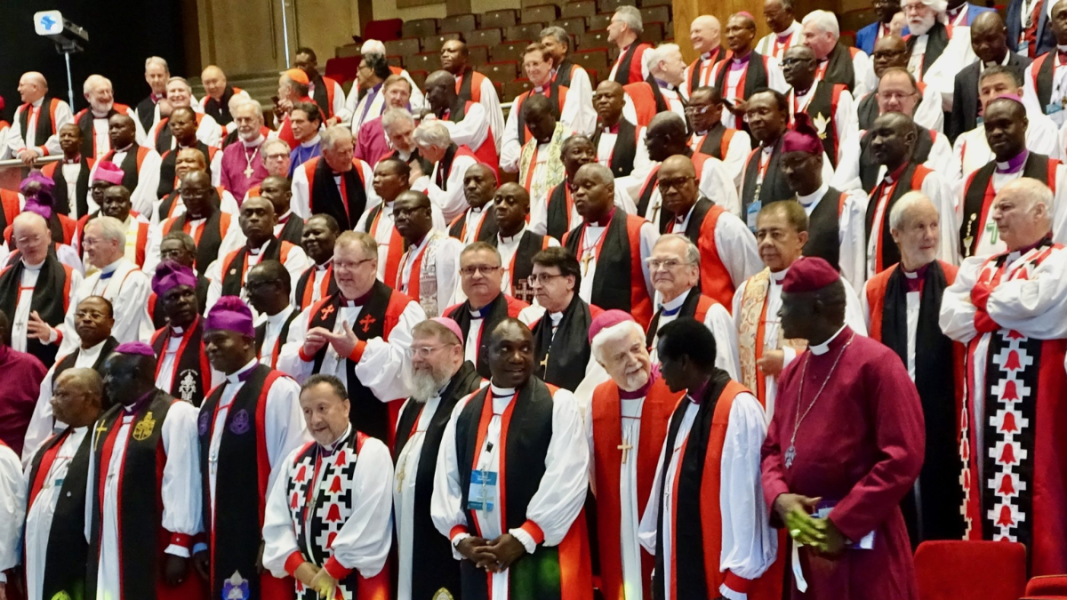
A few weeks after the announcement of Sarah Mullally’s election as the new «Archbishop of Canterbury» —the first woman to hold such a position in the Anglican hierarchy—, the Global Anglican Future Conference (GAFCON), which represents approximately 80% of Anglicans worldwide, took a decisive step with its statement «The future has arrived», declaring that the Anglican Communion has been reordered under its exclusive leadership and abandons the traditional instruments of communion with England. An institutional break that had been hinted at for some time became a reality.
Sarah Mullally: the prior progressive framework
On October 3, the Crown Nominations Commission, with the approval of King Charles III, selected the Bishop of London Sarah Mullally as the 106th Archbishop of Canterbury, replacing Justin Welby. Mullally has been praised for her career and seen as a symbol of change and inclusion in the Anglican Church.
Let us recall that Catholics, including Cardinal Vincent Nichols, representing the episcopal conference of England and Wales, expressed a friendly and hopeful greeting for the strengthening of ecumenical unity.
This progressive appointment intensified the internal tensions already present in the Anglican Communion: the ordination of women, the reinterpretation of marriage, gender policies, and the abandonment of biblical centrality were already points of rupture that had been debated.
A structural break
The Anglican churches of Africa, gathered in GAFCON, affirm that they cannot maintain communion with those provinces that defend «revisionist agendas» that subordinate Scripture to modern cultural values. It calls for reordering the Anglican Communion around a single foundation of communion: the Bible, interpreted in its plain and consensual sense (according to the Jerusalem Declaration).
The statement includes rejecting the so-called instruments of communion —the Archbishop of Canterbury, the Lambeth Conference, the Anglican Consultative Council (ACC), and the primates’ meeting— for considering them complicit in doctrinal deterioration. The new adhering provinces must amend their constitutions to sever ties with Canterbury and not participate in those institutional structures or fund the ACC. GAFCON also proposes establishing a Primates’ Council elected from among its members, chaired by a primus inter pares (first among equals).
The declaration does not hide its definitive character: «Today, that future has arrived… we are the Global Anglican Communion».
The confirmation of what was already looming
This has not been a surprise, but the formalization of a latent tension: Anglican progressivism was no longer just a faction but a hegemonic bloc whose public face is Mullally’s appointment in Canterbury. By designating her, the Church of England reinforced that progressive inclination, and GAFCON’s reaction was bound to be the structural response.
This definitive step places two irreconcilable visions of Anglicanism face to face: one that relativizes biblical authority and traditional forms of ministry, and another that claims it firmly.