


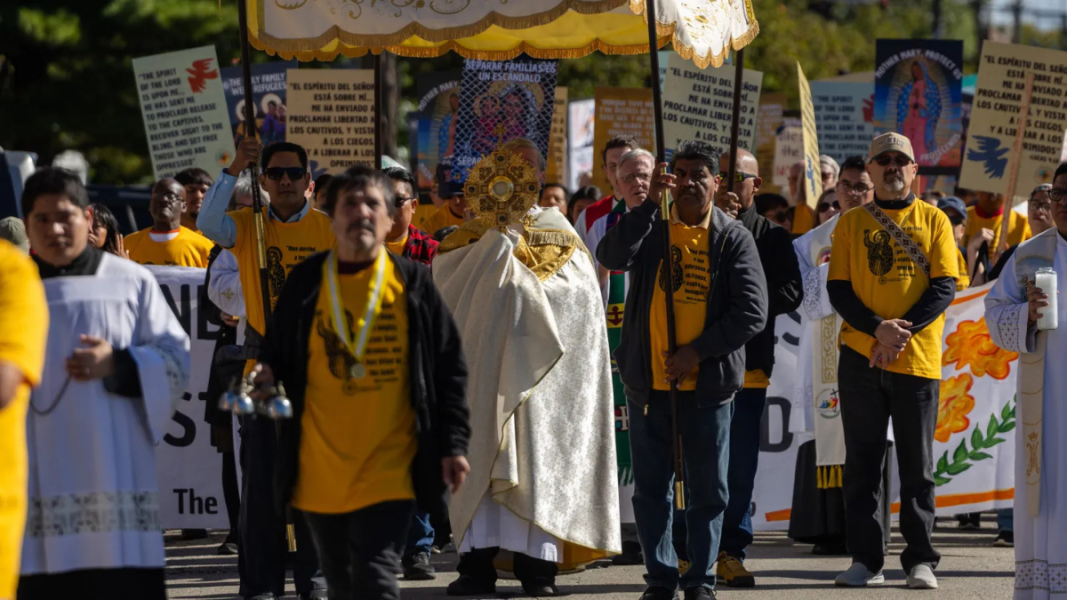
According to Wbez Chicago, on Saturday, October 11, a group of priests, nuns, and laypeople gathered in front of the Broadview detention center in Illinois, with the intention of bringing Holy Communion to the immigrants detained by Immigration and Customs Enforcement (ICE). Hundreds of people participated in the march that culminated in front of the facilities, but the access request submitted to the authorities was rejected without explanation. The denial generated immediate protests among those present, who celebrated the Eucharist right on the street and shouted “shame!” against ICE’s decision.
The Instrumentalization of the Eucharist
What initially seemed like a pastoral gesture toward those deprived of liberty ended up becoming the center of a larger controversy. The legitimacy of bringing the sacraments to detainees is not in question—a right protected by the Access to Religious Ministry Act of 2008—but the way in which the Eucharist was publicly used. The images of a priest carrying the monstrance in front of agents and cameras opened a debate about the banalization of the body of Christ.
Criticism from Within the Church
Various Catholic voices emphasized that what happened was not a genuine attempt at spiritual assistance, but an act of political protest with the Eucharist as a banner. The writer Eric Sammons, with years of experience in prison ministries, recalled that in no penitentiary center in the United States is access allowed without prior authorization and described the scene as a “political spectacle.” Others pointed out that prison protocols do not exclude religious care, but require order and properly managed permissions, so it was not necessary to expose the Most Holy to demand access.
The Risk of Banalizing the Sacred
The Holy Eucharist cannot be reduced to a tool for media pressure. Displaying the Most Holy as if it were a banner in a protest implies a serious banalization of the real presence of Christ. Even more so when this type of gesture was not repeated in other equally dramatic scenarios, such as hospitals during the pandemic or abortion clinics, where the public presence of faith would have been a more coherent and necessary witness.
A Context of Political Tension
The episode occurred amid strong protests over intensified deportations in Broadview under the federal operation Midway Blitz. Tensions between protesters and agents have been constant, with arrests and clashes almost daily. In this climate of confrontation, the irruption of priests with the exposed monstrance added fuel to an already ignited conflict and turned an act of pastoral charity into a gesture with partisan tones.
Faith Is Not a Spectacle
The problem is not that immigrants cannot receive spiritual assistance—the norms allow it if the established process is followed—but the use of the Eucharist as an excuse to generate political debate. The Church is called to defend the dignity of migrants and denounce injustices, but never at the cost of putting at risk the sacrality of its mysteries. Faith does not need to become a spectacle to be credible; it needs coherence, fidelity, and respect.