


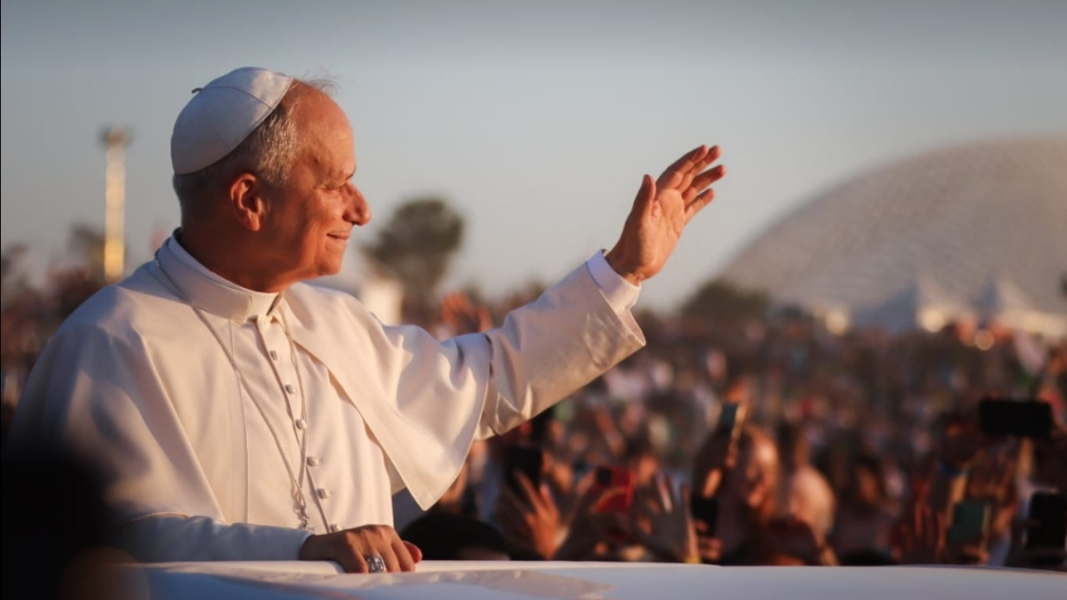
León XIV sent a message to the virtual meeting organized by the Presidency of the Latin American Episcopal Council (CELAM) on the occasion of the Holy Year. In the message dated October 12 but published today in the Holy See Bulletin, the Pontiff emphasized that the Jubilee must be lived as a personal encounter with Jesus Christ, source of reconciliation and hope, and specially invited indigenous peoples to boldly present their cultural and Christian richness within the universal Church.
We leave below the full message from León XIV:
Dear brothers and sisters:
I am pleased to join the virtual event that, on the occasion of the Holy Year, you have kindly organized from the Presidency of CELAM. It is certainly a welcome opportunity to delve deeper into the meaning of the gift that the Lord gives us through his Church. The jubilee must be for us primarily “a moment of living and personal encounter with the Lord Jesus, ‘door’ of salvation” (Francis, Bull Spes non confundit, 1), being an occasion for reconciliation, grateful memory, and shared hope, more than a mere external celebration. In planning the jubilee moments, Pope Francis has wanted to highlight the universality of the Church, which is manifested in so many vocations, ages, and life situations: families, children, adolescents, young people, older adults, ordained ministers and laity, servants in the Church and in society. That same universality, which does not uniformize but welcomes, dialogues, and enriches itself with the diversity of peoples, includes you in a special way, the Indigenous Peoples, whose history, spirituality, and hope constitute an irreplaceable voice within the ecclesial communion.
In this line, it seems important to me to understand that when we pass through the Holy Door, more than the realization of a symbolic gesture entering a beautiful temple, what we want is to introduce ourselves, through faith, into the very source of divine love, the open side of the Crucified (cf. Jn 20,27-29). It is in that faith that we are a People of brothers, one in the One (cf. S. Augustine, Commentary on Psalm 127,4). It is from that Truth that we must reread our history and our reality, to face the future with the hope to which the Holy Year calls us despite labors and tribulations (ibid., 5.10).
This perspective can help us in our reflection, for being Indigenous Peoples, you are strengthened by the certainty that One alone is the origin and goal of the universe (cf. Rm 11,36), the First in everything (cf. Col 1,18); origin of all goodness, and therefore, the primary source of all that is good, also in our peoples. It is from that certainty of faith that our joyful thanksgiving springs forth as we enter through the Holy Door of the Heart of Christ: “Blessed be God, He chose us in Christ, before creating the world to be his children” (cf. Ef 1,3-5). This is the goal of our hope, it is not only for some but for all, even those formerly considered enemies: “Philistines, Syrians, Ethiopians,” “Egypt and Babylon” (vv. 3-4), the great occupying powers, “all have been born in her” (Ps 86,5). Saint Augustine will say: “of which he names only some, so that we may understand all” (Commentary on Psalm 86,6).
Unfortunately, as human beings, this is not the only meaning of “original” with which we have to confront ourselves. The long history of evangelization that our Indigenous Peoples have known, as the bishops of Latin America and the Caribbean have taught so many times, is laden with “lights and shadows.” Saint Augustine applies it in the case of the servants of the Gospel saying: “If the man is good, he is united to God and collaborates with God; if he is bad, God works through him the visible form of the sacrament and gives grace by himself. Let us hold this and there are no schisms among us” (Letter 105, 12). In this way, the Jubilee, a precious time for forgiveness, invites us to “forgive from the heart our brothers” (cf. Mt 18,35), to reconcile with our own history, and to give thanks to God for his mercy toward us.
In this way, recognizing both the lights and the wounds of our past, we understand that we will only be able to be a People if we truly abandon ourselves to the power of God, to his action in us. He, who has inserted into all cultures the “seeds of the Word,” makes them flourish in a new and surprising form, pruning them so that they may bear more fruit (cf. Jn 15,2). So affirmed my Predecessor, Saint John Paul II: “The power of the Gospel is everywhere transformative and regenerative. When it penetrates a culture, who can be surprised that not a few elements change in it? There would be no catechesis if it were the Gospel that had to change in contact with cultures” (Post-Synodal Apostolic Exhortation Catechesi tradendae, 53). Therefore, in dialogue and encounter, we learn from the different ways of seeing the world, we value what is proper and original to each culture, and together we discover the abundant life that Christ offers to all peoples. That new life is given to us precisely because we share the fragility of the human condition marked by original sin, and because we have been reached by the grace of Christ, who for all poured out until the last drop of his Blood, so that we might have “Life in abundance” (cf. Jn 10,10), healing and redeeming all who open their hearts to the grace that was given to us.
You are now gathered to delve deeper into all these things, so I do not want to end without quoting that term that my Predecessor, Pope Francis, loved so much: parrhesia, that evangelical boldness, going out of oneself to announce the Gospel without fear and with freedom of heart, which “says all the truth because it is coherent” (Daily Meditation, April 18, 2020).
In the concert of nations, indigenous peoples must present with courage and freedom their own human, cultural, and Christian richness. The Church listens and enriches itself with their singular voices, which have an irreplaceable place in the magnificent choir where all proclaim: “Lord God eternal, joyfully we sing to you, to you our praise” (cf. Hymn of the Te Deum). And in this common praise, we also remember the call of the Gospel to avoid the temptation of putting at the center what is not God—be it power, domination, technology, or any created reality—so that our heart may always remain oriented toward the one Lord, source of life and hope.
Therefore, for those who, by God’s mercy, call ourselves and are Christians, all our historical, social, psychological, or methodological discernment finds its ultimate meaning in the supreme mandate to make known Jesus Christ, who died for the forgiveness of our sins and rose so that we may be saved in his Name, already from this earth, and then adore him with all our being in the glory of Heaven.
Entrusting your works to the Blessed Virgin Mary of Guadalupe, Star of Evangelization, who in an admirable way showed us how Jesus Christ “made two peoples one, breaking down the wall of enmity that separated them” (cf. Ef 2,14), I invite you to renew your commitment to the Lord’s mandate: “Go, and make disciples of all nations, baptizing them in the name of the Father and of the Son and of the Holy Spirit, and teaching them to observe all that I have commanded you. And behold, I am with you always, until the end of the age” (Mt 28,19-20), spreading the joy that springs from having encountered his Divine Heart.
Vatican, October 12, 2025, Our Lady of the Conception of Aparecida.
LEÓN PP. XIV