


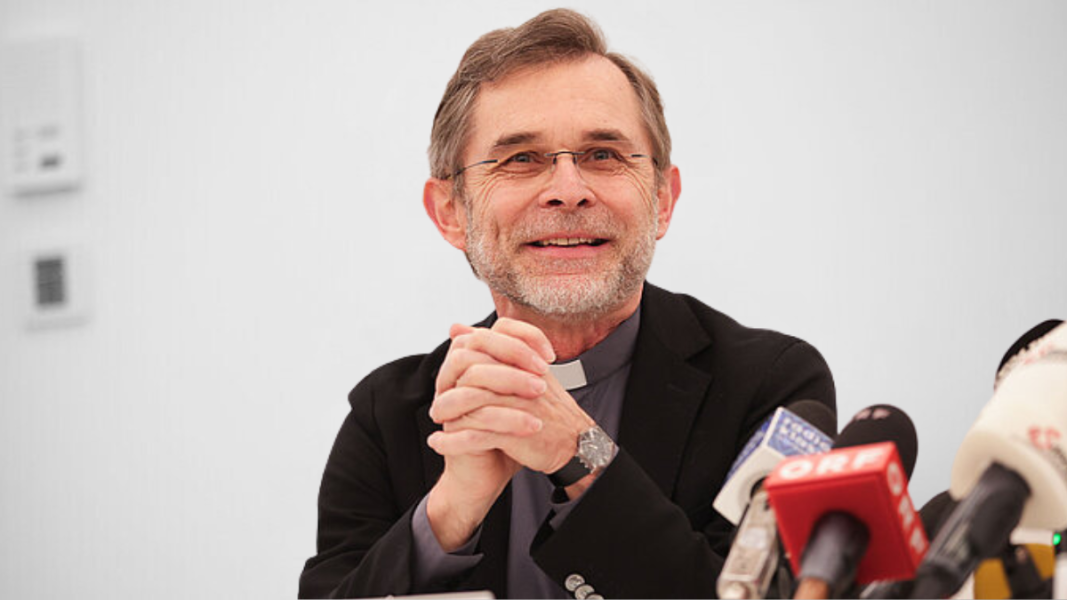
According to Campus-a, the Vatican is now almost definitively inclined to appoint Josef Grünwidl as the new Archbishop of Vienna in place of Cardinal Christoph Schönborn. The appointment, which could be made public in November, confirms a line of continuity with the progressive stances that have characterized Schönborn’s governance and that have generated so much bewilderment among the faithful to tradition.
Grünwidl, until now the apostolic administrator of Vienna, had repeatedly rejected the proposal to succeed the cardinal, even citing the absence of a doctorate in theology. However, according to sources cited by the Austrian media outlet, Rome would have reminded him of his duty of obedience, finally managing to get him to accept the charge.
Controversial statements: celibacy and the role of women
In a recent interview on the public broadcaster Ö1, Grünwidl stated that «the era of the people’s Church has ended» and that only in exceptional cases is faith transmitted from parents to children today. Beyond this pessimistic diagnosis, what is truly worrying are his proposals: celibacy should not be a condition for the priesthood and women should hold responsibilities even in the College of Cardinals, which has always been reserved for men by the doctrine and tradition of the Church.
These statements represent a direct attack on two constitutive elements of Catholic life: priestly celibacy, which the Latin Church defends not as a mere disciplinary norm, but as a sign of radical dedication to Christ, and the exclusively male nature of the priesthood, linked to Christ’s own design. Elevating women to the College of Cardinals would, de facto, relativize the sacrament of holy orders and open the door to a clericalization of ecclesial feminism.
Continuity with Schönborn and risk of fracture
The appointment of Grünwidl would be read in Austria as the prolongation of Schönborn’s legacy, a figure always ambivalent who, despite his gestures of fidelity in some areas, has aligned himself with opening currents in matters of moral and ecclesial discipline. For many Catholics, Schönborn has represented a Church accommodated to the spirit of the world, seeking to please public opinion more than to boldly proclaim the truth of the Gospel.
Grünwidl’s profile does not seem different. His insistence on “adapting” the Church to Austria’s social demands—where secularism has emptied parishes and where a good part of the baptized formally abandon the Church each year—seems to respond more to an institutional survival strategy than to a true missionary zeal.
The risk is clear: continuing to weaken Catholic identity, presenting as “options” what are in reality truths and sacraments, and thus fostering a greater fracture between those who remain faithful to the doctrine and those who desire a Church turned into a spiritual NGO.
Rome between obedience and pragmatism
The designation of Grünwidl also shows how Rome addresses the tensions of the universal Church. Faced with the difficulty of sustaining a single coherent message in a fragmented world, profiles “pragmatic” are chosen that, more than safeguarding the faith, seek to translate it into language acceptable for each country. Thus, what seems “modern and adapted” in Vienna is, for the Catholic faithful who expect fidelity to tradition, a sign of surrender to secularization.
The result, however, is predictable: the Church does not grow when it dilutes the Gospel to please the world. The experience of the last decades confirms it: where doctrine, liturgy, and discipline have been relativized, churches empty; on the other hand, where the truth has been proclaimed clearly and tradition defended, communities resist and grow.
Conclusion
The appointment of Josef Grünwidl as Archbishop of Vienna seems to be decided. His profile confirms a continuity with the Schönborn line: openness to progressivism, questioning of celibacy, clericalization of ecclesial feminism, and a more sociological than pastoral vision of the Church. Faced with this, many Catholic faithful in Austria and beyond look to Rome with concern, which seems to forget that the Church’s mission is not to adapt to the world, but to transform it with the power of the Gospel.