


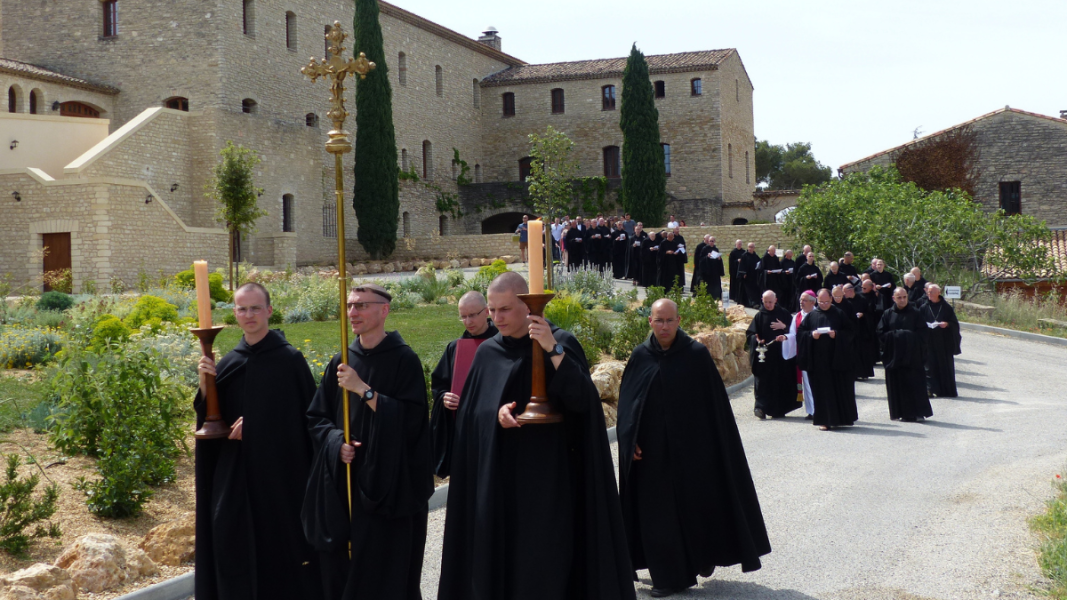
The Benedictine community of Sainte-Madeleine du Barroux, in the French Provence, will take over the spiritual and liturgical direction of the Bellefontaine Abbey (Maine-et-Loire) starting in 2026.
The Benedictines of Le Barroux are known for their attachment to the traditional liturgy, celebrated according to the Roman rite in its extraordinary form, and for a community life strictly in accordance with the Rule of St. Benedict. Founded in 1978 by Dom Gérard Calvet, they have become a point of reference for many young vocations seeking a life of contemplation, silence, and liturgy lived with solemnity.
Their arrival at Bellefontaine does not mean just a change in management, but a true spiritual renewal with a traditional stamp: Gregorian chant, fidelity to the timeless liturgy, monastic discipline, and a contemplative lifestyle that attracts those seeking authenticity in faith.
The end of a Cistercian stage
The Cistercian community of Bellefontaine, with an average age close to 80 years, had reached the limit of its possibilities. The vastness of the monastery (120 hectares) and human wear and tear made it impossible to sustain daily life. On November 13, 2025, on the feast of All Monastic Saints, the abbey will temporarily close its doors to the public. Only two brothers will remain, along with employees, to maintain agricultural activities and prepare the transition.
The other monks will integrate into other communities or move to residences adapted to their age. It is the end of a Cistercian stage that marked more than two centuries of history in Bellefontaine.
Twelve Benedictines for a new beginning
It will be twelve monks from Le Barroux who will move to reopen Bellefontaine. This is a symbolic gesture of “return to the origins,” as the abbey was born in the 12th century as a Benedictine house before passing to the Cistercian family.
Bellefontaine was founded around the year 1010 as a hermitage, then became a Benedictine priory, was transformed by the Feuillants, and after the French Revolution, was reborn in 1816 as a Cistercian abbey. At its peak, it housed more than 120 monks.
A sign of hope
That a young and traditional community like that of Le Barroux takes over the continuity of Bellefontaine is news that transcends the administrative: it is a sign of hope for contemplative life in Europe. Where decline seemed inevitable, God raises new vocations, faithful to tradition and capable of reviving monasteries that seemed destined for definitive silence.
In a noisy and secularized world, Le Barroux’s decision reminds us that traditional monastic life is not dead, but continues to attract those seeking evangelical radicality, liturgical solemnity, and a deep encounter with God.