


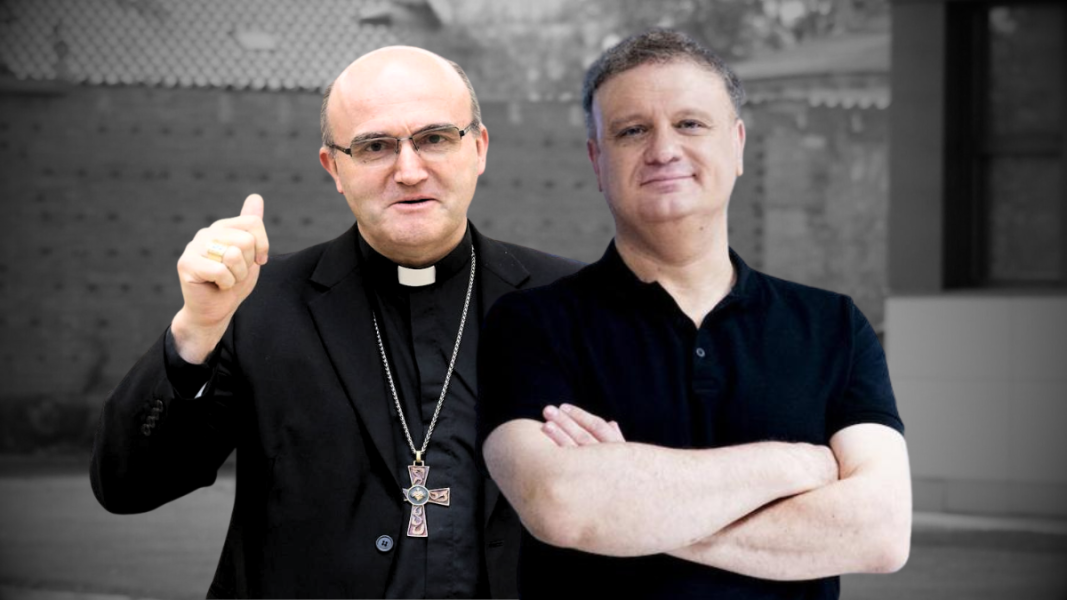
The Bishop of Alicante José Ignacio Munilla and the philosopher Miguel Ángel Quintana Paz have agreed to hold a public debate on the conflict in the Middle East, following an intense exchange of opinions on the social network X (formerly Twitter).
The controversy began on October 4, when Mons. Munilla posted a hopeful message about a possible ceasefire in Gaza, accompanied by an invocation to Saint Francis of Assisi and a prayer for peace that portrayed Trump as a warring faction. Days later, on October 14, once the peace led by Trump was signed, Quintana Paz replied criticizing the image shared by the bishop and stating that Donald Trump was not a “combatant” in the conflict, but rather the one who ended it, in contrast—according to his opinion—with the “null role” of the Vatican and of Cardinal Pierbattista Pizzaballa, Latin Patriarch of Jerusalem.
Mons. Munilla responded by defending his stance and reproaching the philosopher for a “triumphalist” view of Trump. In that context, the bishop proposed an open debate, an invitation that Quintana Paz accepted by suggesting the ISSEP Madrid as the venue and leaving the choice of moderator in Munilla’s hands.
A dialectical clash focused on Gaza
The encounter promises to be a high-level dialectical clash. Quintana Paz will have to deploy his argumentative skills to explain the military ethics behind a violent action with more than 50,000 civilian casualties among Palestinians compared to the minimal Israeli military losses, as well as the apartheid regime that Israel maintains in the Holy Land.
It will be interesting to hear the philosopher explain his point of view on issues such as those raised by the Orthodox nun Agapia Stephanopoulos, who in a recent interview with Tucker Carlson denounced segregated roads, military checkpoints, walls that separate families and Palestinian Christian communities, and a systematic policy that pushes Christians into exile. “The occupation turns Palestinians—Christians and Muslims—into administrative prisoners within their own land,” she stated.
The role of Trump and social pressure on networks
For his part, Munilla will have to explain his thesis that Trump did not play a determining role in the peace process, and that the success of certain recent agreements is due more to social and cultural pressure arising on networks. What real role has the Church played in peace? Should it have done more? The prelate’s vision may be criticized as naive or ingenuous. In the end, Munilla detects a crack in the right-wing narrative on the Israeli issue that he wants to highlight, however an excessive focus on not recognizing Trump’s objective merit could make him lose the debate.
Awaiting confirmation of the date and format of the debate, the dialogue between Munilla and Quintana Paz points to becoming a highly followed intellectual encounter and a very enriching format for a public debate that is too superficial and entrenched.