


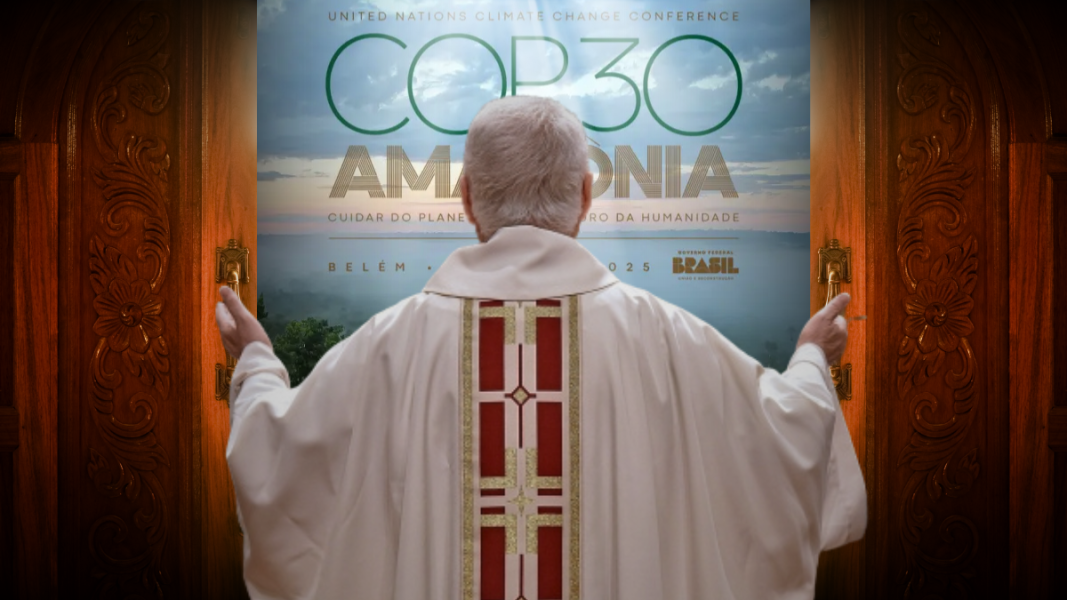
The COP30, the thirtieth Conference of the Parties of the UN on Climate Change, will take place from November 10 to 21, 2025, in Belém do Pará, Brazil. As every year, governments, bureaucrats, green lobbies, NGOs of all kinds, and companies that live off the “energy transition” will gather to negotiate climate commitments, demand more funds, and discuss who will pay the bill for the environmental apocalypse that they themselves announce.
In this scenario, the Catholic Church in Latin America has decided to present itself, not as the Bride of Christ, but as just another NGO alongside Greenpeace and Oxfam. Cáritas Latin America and the Caribbean recently published its “position” document ahead of COP30. Translation in four languages, solemn tone, much environmental indignation… and, of course, not a trace of Jesus Christ.
Laudato Si’: the new constitution of the Ecological Church
The text relies on the encyclical Laudato Si’, presented de facto as the new constitutional document of the “Ecological Church.” There is all the terminology: “ecological conversion,” “climate justice,” “care for our Common Home.” But the essentials of the Catholic faith—Christ, redemption, eternal life—are conspicuously absent.
The risk is evident: that Laudato Si’, instead of being a pastoral exhortation, becomes the official catechism of a new ecological religion without transcendence, where what matters is not the salvation of souls, but the reduction of CO₂ emissions.
A document without Christ
Its pages abound with concepts straight from the United Nations: “climate financing,” “loss and damage,” “green colonialism.” Not bad for a seminar in Brussels or New York, but is this really what the Church has to offer the world?
The absence of Christ is not an oversight: it is a symptom. The Church runs the risk of becoming just another green NGO, diluting its identity in a secularized discourse that anyone could sign.
The European bishops: an uncomfortable contrast
Curiously, in Europe the bishops—who are not exactly examples of apostolic courage these days—have just taken a small different step. In their plenary in Fátima, they sent a letter to Ursula von der Leyen asking the EU to act decisively at COP30. So far, similar to the Latin American document.
The difference lies in the tone: the European bishops spoke of the forgetting of Christian roots, the need to “reconquer Europe with love,” and the mission of being missionary disciples in a secularized Europe. In other words, even in the midst of the green discourse, they dared to remind that the Church does not exist to manage climate budgets, but to evangelize.
Between secular environmentalism and the Church’s mission
No one denies that caring for creation is part of the Christian duty. Benedict XVI recalled it forcefully. But he also warned that the Church is not an NGO. When Cáritas sits at the COP30 tables without mentioning Christ, the only thing it achieves is to reinforce the usual secular narrative: more funds, more policies, more bureaucracy. And meanwhile, the Gospel is left out of the game.
The contrast is evident: the European bishops, with all their limitations, at least hinted that the underlying problem is spiritual and cultural. Cáritas Latin America, on the other hand, seems to speak from an alternate world—a kind of climatic Narnia—where the Church no longer evangelizes, it only drafts technical documents.
Caring for creation is not the ultimate end
And let’s clarify! This is not about denying the Christian obligation to steward creation. We are part of it and we must care for it. But without forgetting what the Catechism teaches: “We were created to know, love, and serve God in this life and thus enjoy Him in eternity.”
Creation is a gift from God, but it is not our ultimate end. Turning the environment into the absolute center of the Church’s mission is inverting the order of things. The end of human life is not “caring for our Common Home,” but reaching Heaven. Caring for creation makes sense only insofar as it helps us fulfill our eternal destiny.
No need to be scandalized, but yes to pointing out the lost direction
There is no need to tear one’s garments. It is enough to read the text and confirm that the institutional Church, more and more, speaks the language of the world and silences the name of Christ. It is not scandal, it is diagnosis. And the diagnosis is clear: when the Church becomes a commentator on green policies, it renounces its true mission.
COP30 will pass, as the previous 29 did, with big headlines, promises for a better future, and green agreements. But the Church should ask itself what its participation will leave behind: a Christian contribution with its own name that transcends beyond nature, or just another document that any NGO could sign?