


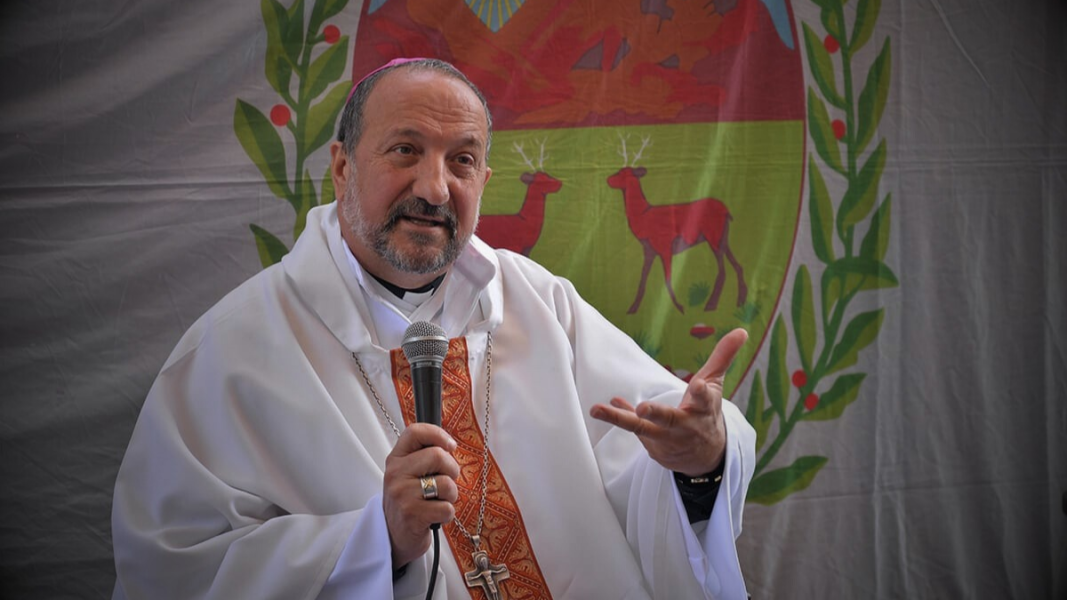
In a letter addressed to candidates for extraordinary ministers of the Eucharist, the bishop of San Luis, Argentina, Mons. Gabriel Bernardo Barba has established a controversial condition: those aspiring to this service must receive Communion solely in the hand, in order to “preach by example”.
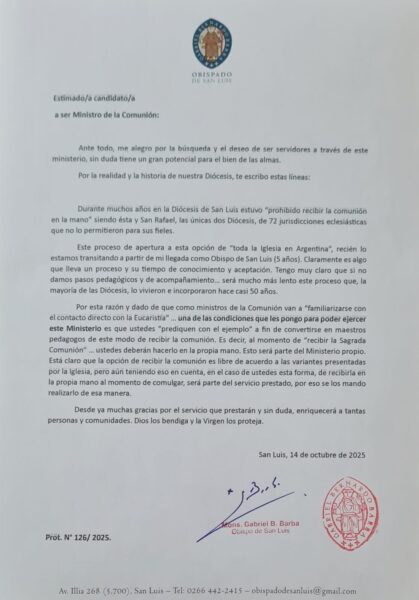
The document recalls that the diocese of San Luis, like San Rafael, was for decades an exception in Argentina, maintaining the prohibition of Communion in the hand. In fact, under the governance of Mons. Juan Rodolfo Laise —author of the well-known book Communion in the Hand— the diocese was a reference point in the defense of Communion on the tongue and kneeling. Today, however, there is a complete turnaround: not only is the practice allowed, but ministers are required to adopt it publicly.
From Example to Imposition
Bishop Barba acknowledges in his letter that the adoption of this practice is being “slower” in San Luis than in other dioceses, and therefore demands that extraordinary ministers become “pedagogues of this way of receiving Communion.” The instruction is clear: if they are to distribute the Eucharist, they must receive it in the hand, even though the universal norms of the Church state that the manner of receiving Communion is free for each faithful.
A Change that Weighs on the Diocese’s History
What became generalized in the rest of Argentina more than fifty years ago was resisted in San Luis out of fidelity to tradition. The current measure, however, seems to leave that heritage behind to align with majority practices, even at the cost of imposing a mandatory criterion on those who provide an extraordinary service in the liturgy.
More Uniformity, Less Freedom
The bishop’s letter marks a fundamental shift: from a diocese that defended the freedom to remain faithful to tradition, to one that imposes Communion in the hand as a condition for serving.