


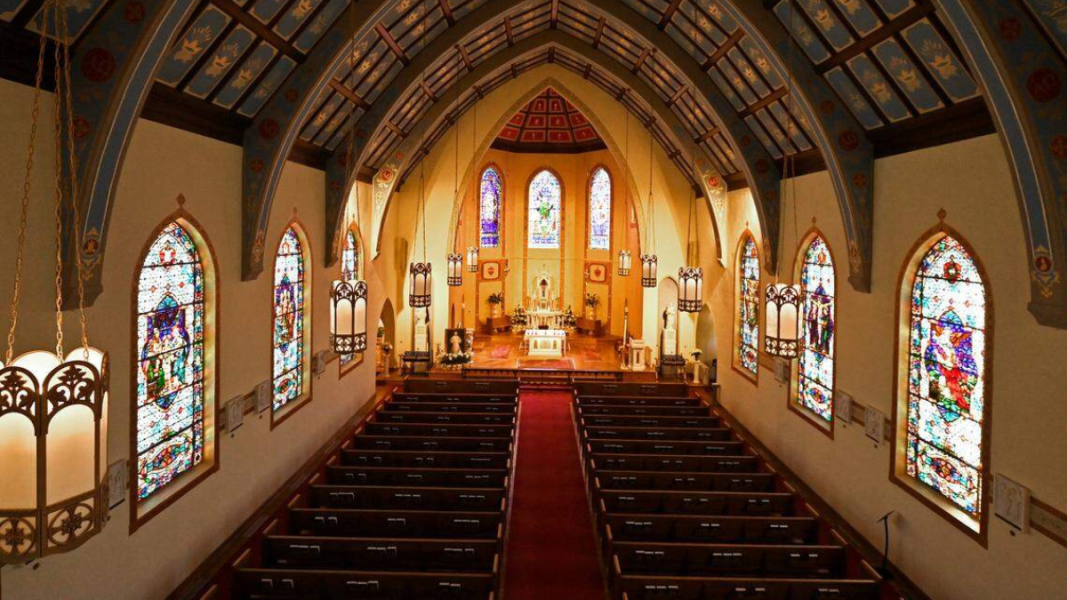
On October 6, the Diocese of Charlotte (North Carolina, USA) announced the removal of the portable kneelers that had been used until now in St. Patrick’s Cathedral to receive Holy Communion kneeling and on the tongue. The decision was communicated by the cathedral’s rector, Fr. Peter Ascik, and disseminated by the Charlotte Latin Mass Community, a lay group that brings together faithful linked to the traditional liturgy.
The kneelers had been introduced for those who wished to receive Communion kneeling, a gesture deeply rooted in Catholic piety and maintained by many faithful even in the post-conciliar liturgy. Their removal is interpreted as another step in Bishop Michael Martin’s restrictive policy toward expressions of liturgical tradition.
Chain of Decisions
St. Patrick’s Cathedral, built in 1939 in the neo-Gothic style, is a landmark of the diocese. However, in recent months, measures have accumulated that seem aimed at limiting traditional practices. In August, Bishop Martin prohibited the use of the communion rail at Charlotte’s Catholic school, despite it having been installed in 2017 in memory of a deceased student and used regularly in school Masses. Since then, students and teachers have been required to receive Communion standing, outside the sanctuary.
In September, the bishop also published a letter limiting the celebration of the Traditional Mass to a single location: the Little Flower chapel in Mooresville. This suppressed public celebrations in populous parishes like St. Ann’s and St. Thomas Aquinas, which gathered hundreds of faithful each week.
Unity or Uniformity
The bishop has justified the measures as an effort to “promote unity in the liturgy” and align the diocese with the Holy See’s guidelines following Traditionis Custodes, Francis’s 2021 motu proprio that severely restricted the celebration of Mass according to the 1962 Missal.
However, for Catholics in Charlotte, the facts speak for themselves: the disappearance of kneelers, the elimination of communion rails, and the virtual extinction of the Traditional Mass. What is presented as “unity” is perceived by many as imposed uniformity that marginalizes precisely those who remain most faithful to the Church’s centuries-old practices.
A Turning Point
What happened in Charlotte reflects a pattern that repeats in many dioceses in the United States and around the world: where there were thriving communities around the traditional liturgy, increasing restrictions are applied in the name of obedience to Rome.
For the faithful, the suppression of kneelers is not a minor detail, but a symbol: they are told that the way their parents and grandparents received the Lord no longer has a place in the current Church. A clear sign that the diocese has entered a new restrictive phase, which contrasts with the longing for reverence and liturgical continuity of so many Catholics.