


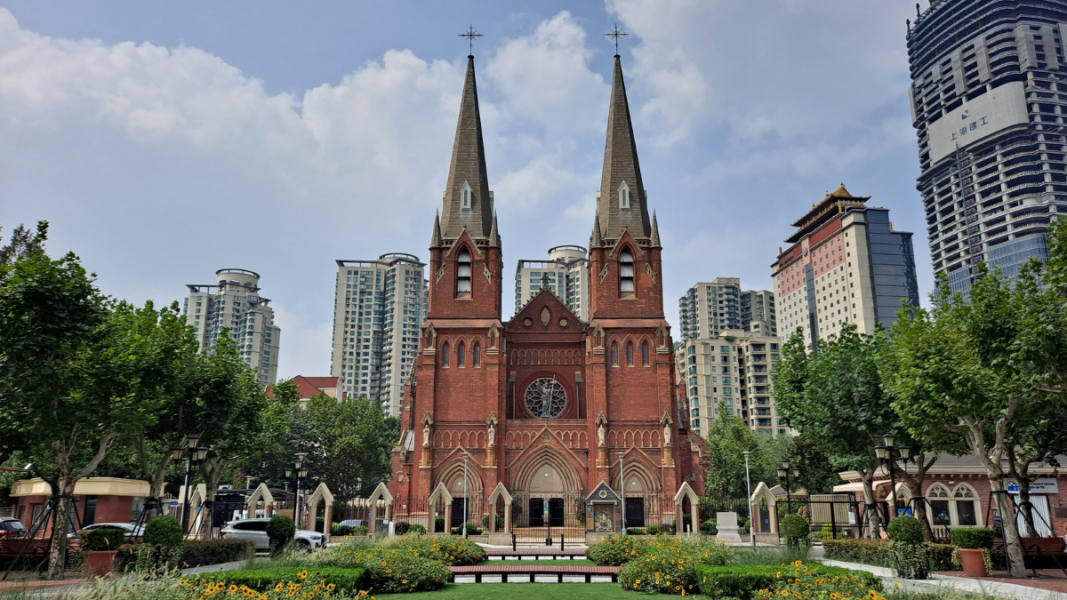
On October 15, in the Cathedral of St. Ignatius of Shanghai, the episcopal consecration of Joseph Wu Jianlin as auxiliary bishop will take place. The appointment does not have the recognition of the Holy See and was decided directly by the Chinese Catholic Patriotic Association, an organ controlled by the Communist Party.
The most serious thing is that this bishop was designated on April 29, just a week after Francisco’s death and during the sede vacante. Along with Wu, Li Jianlin was also appointed as bishop of Xinxiang. In other words: Beijing took advantage of the power vacuum in Rome to impose its men without even disguising it.
The secret agreement: seven years of concessions
The episode constitutes a direct blow to the secret agreement signed in 2018 between the Holy See and China, designed by Cardinal Pietro Parolin and renewed in 2024 for another four years. We were told that the pact guaranteed that the Pope would have the final say in the designation of bishops. The reality is different: in seven years, barely a dozen prelates have been appointed, and almost always giving the impression that Rome was simply ratifying what Beijing had already decided.
The Shanghai ordination demonstrates that, for the Communist Party, the pact was never a real commitment, but a cover to continue controlling the Church with the blessing—or the passivity—of the Vatican.
Rome’s response: patience and silence
Faced with this situation, Cardinal Parolin’s words border on the surreal. “The agreement is moving forward, it is a positive step,” he said on October 10, as if nothing had happened. Meanwhile, the Holy See maintains official silence regarding the consecration of Wu Jianlin.
This attitude conveys an image of impotence: Rome remains silent while Beijing advances. And with it, the secret agreement reveals itself as what it always was: a diplomatic experiment doomed to failure, which has weakened the Church’s moral position and disoriented Chinese Catholics.
Shanghai, symbol of resistance and humiliation
It is no coincidence that the battle is taking place in Shanghai. The diocese was for decades an emblem of resistance to the “nationalization” of the Church. There, Bishop Ignatius Kung Pinmei spent thirty years in prison for his fidelity to Rome, and was created a cardinal in pectore by John Paul II as a sign of hope.
Today, the same diocese becomes the scene of humiliation: bishops imposed by the regime, persecuted faithful, and the Vatican resigned to accepting the unacceptable.
The time to decide
The failure of the secret agreement is now undeniable. Rome believed it could gain spaces with patience, and the only thing it has achieved is to endorse with its silence Beijing’s strategy.
Leo XIV inherits a huge problem, but also an opportunity. He can continue the path of appeasement, as until now, or recover the prophetic voice of the Church, that which never makes pacts with dictatorships at the cost of the truth.
What happened in Shanghai is definitive proof. The secret agreement has collapsed, and the question now is whether Rome will continue pretending that it works or if, once and for all, it will speak clearly in defense of its persecuted children in China.