


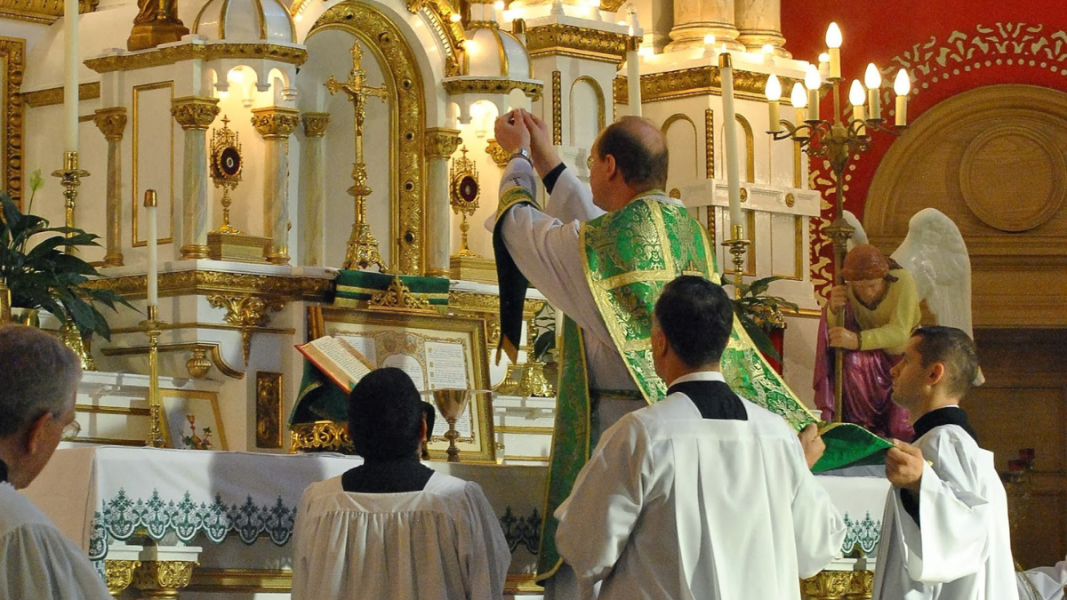
A few days ago, the Diocese of Knoxville announced the definitive elimination of the Traditional Mass in one of its parishes. In parallel, in Chattanooga (Tennessee), faithful linked to the Latin liturgy listened in stunned silence to a sermon by the local basilica’s pastor, who justified that same reform under the banner of “unity.”
It is no coincidence: the two events evidence a coherent liturgical strategy aimed at suppressing—sorry, unifying— the tradition in various dioceses of the state of Tennessee.
The homily delivered on October 12 by the pastor of the Basilica of Saints Peter and Paul in Chattanooga, Fr. David Carter, revealed what many suspected: the elimination of the Traditional Mass in the Diocese of Knoxville is not just a local decision, but a direct order from the Dicastery for Divine Worship in Rome, the priest declared in his homily:
“After a year of discernment and consultation with pastors where the usus antiquior is celebrated, Bishop Mark Beckman received a request from the Dicastery for Divine Worship in Rome to implement Traditionis Custodes in the Diocese of Knoxville”.
In other words, Knoxville has been chosen as a pilot diocese to apply the policy of “liturgical unity” across its entire territory with the instructions of Francis’s motu proprio from 2021. The decision means the forced transition of all celebrations of the 1962 Missal toward the reformed 2002 Missal, although it is promised that the latter will be celebrated in Latin and preserving solemnity:
«We will preserve the ancient —Latin, chant, sacred silence, ad orientem celebration, etc.— and receive the new —the more complete cycle of biblical readings, the unified calendar, and the deeper participation envisioned by the Council».
Blind Obedience
Far from recognizing the fidelity of those who love the liturgy of all time, the sermon fell into the usual clichés: warnings against schism and insistent calls for blind obedience.
Fr. Carter went so far as to claim that those who cling to the 1962 Mass run the risk of breaking communion with Rome —like the FSSPX—, comparing that fidelity to attitudes of rebellion. A painful manipulation for the faithful, who ask for nothing more than to continue celebrating the liturgy that Rome itself recognized, under Benedict XVI, as “never abrogated.”
Unity or Forced Uniformity
The decision means the forced transition of all celebrations of the 1962 Missal toward the reformed 2002 Missal, although it is promised that the latter will be celebrated in Latin and with a certain solemnity. In the words of the pastor: “We are not losing the Mass, but gaining unity.”
However, for many faithful, the measure is not a gain but a real loss: they are deprived of the rite that has flourished for more than a decade in Chattanooga and other parishes of the diocese, under the shelter of Summorum Pontificum. What is presented as “unity” is, in reality, uniformity imposed from Rome.
Speaking of “unity” while uprooting the tradition that nourished generations of saints is nothing but imposing uniformity. A uniformity that does not respect the legitimate diversity of rites recognized for centuries in the Church, and that stigmatizes those who seek reverence, sacrality, and continuity with the faith of their ancestors.
A Somber Vision for the Faithful Who Love Tradition
The message coming from Chattanooga is clear and worrying: the Vatican is no longer limiting itself to restricting the Traditional Mass; now it seeks to eliminate it completely under the banner of “unity.” Knoxville becomes a symbol of this offensive, not by local initiative, but by direct order from Rome.
Bishop Beckman —appointed in Knoxville by Francis in 2024— thus appears more as an executor than as a discerner: it is not a matter of a pastoral decision of his own, but of obedience to an instruction from the Dicastery. And what is tested in Tennessee could later be exported to other dioceses of the world, justifying it with words of “obedience, unity, and renewal” according to Traditionis Custodes.
We leave below the full sermon of Fr. David Carter delivered in Chattanooga:
New and Old Treasures
Unity in the Faith
After Traditionis Custodes
Homily – October 12, 2025
Very Rev. J. David Carter, JCL, JV, Pastor and Rector
Basilica of Saints Peter and Paul
As you know, in 2021 Pope Francis issued the motu proprio Traditionis Custodes, limiting the celebration of the 1962 Roman Missal —commonly called the Traditional Latin Mass— and replacing the broader permissions granted in Summorum Pontificum by Pope Benedict XVI in 2007. This decision was a heavy cross for our community.
Since Christmas 2014, we have enjoyed the celebration of the Mass according to the 1962 Missal, at least monthly. In 2020, discerning the legitimate desires of the faithful and following the still valid provisions of Summorum Pontificum, we began to offer the 1962 Missal every Sunday at the 11:30 a.m. Mass. Thus, when Traditionis Custodes was published a year later, our pastoral plan was interrupted.
At that time, I reminded our parish that Saints Peter and Paul is a Novus Ordo parish in which the traditional Latin Mass is celebrated, and that the main purpose of doing so was mutual enrichment, one of the goals that Benedict XVI identified in Summorum Pontificum. I also firmly exhorted that we receive the directives of the Holy Father with humility and obedience, resisting any temptation to oppose ecclesiastical authority. We must make a decision: to be Catholic or Protestant. Many mistakenly cling to the trappings of Catholic identity rather than its essence, which is union with the successor of Peter. As for Saints Peter and Paul, we chose to be Catholic.
After a year of discernment and consultation with pastors where the usus antiquior is celebrated, Bishop Mark Beckman received a request from the Dicastery for Divine Worship in Rome to implement Traditionis Custodes in the Diocese of Knoxville. Like the centurion in the Gospel of Luke who famously said: “Lord, I am not worthy,” but also: “I am a man under authority,” so too Bishop Beckman is a man under authority. He loves the faithful who are dedicated to the ancient liturgy, and his love will not be denied to them. But he, and I with him, have professed an oath of fidelity to the Roman Pontiff and to the laws of the Church. It is for us also to make this our refrain: Domine non sum dignus… I too am a man under authority.
We are not the owners of the liturgy; we are its servants. The truth is that since 2021 we have been living on borrowed time. Another pastoral reality we face is the lack of clergy trained to celebrate the 1962 Missal. I am the only priest in the basilica capable of doing so. What would happen if I were unavailable due to illness or travel? Moreover, our division between two liturgical calendars has created an unintended division: two cycles of readings, two feasts, two rhythms of time. It is becoming increasingly clear that the Spirit calls us to unity.
After consulting with Bishop Beckman, we have reached a clear plan. The Diocese of Knoxville will be transitioning all celebrations of the Latin Mass using the 1962 Missal to the 2002 Missal in Latin by the end of this year. In this way, we are not losing the Latin Mass, nor the Roman Rite. The bishop has assured that legitimate aspirations for transcendence, reverence, and beauty will continue to be honored. The celebration of the 2002 Missal in Latin, with all the options and traditional elements permitted in its rubrics, will ensure that the treasures of our tradition are preserved while we remain in full communion with the Church. This is not the path of loss — it is the path of unity.
I know this decision is difficult for many who have deeply attached themselves to the older form. However, I urge you to respond with humility and obedience. No one is being deprived of the sacraments. The Eucharist is no less Jesus in the 2002 Missal than in the 1962 one. The Holy Father rightly warns those who, perhaps unwittingly, suggest otherwise. To remain Catholic is to remain united to the successor of St. Peter. The movement of the Church is toward a unity of faith expressed in one Roman Missal, though it is still deeply nourished by the same source of tradition.
Our worship will continue to be beautiful, reverent, and sacred. The spirit of Summorum Pontificum — the mutual enrichment between the old and the new — has borne fruit. You are the proof of it. Now we are called to bring that fruit to the life of the Church as it is today unified.
Christ’s parable reminds us that the good steward “brings out of his treasure what is new and what is old” (Matthew 13:52). We will preserve the ancient —Latin, chant, sacred silence, ad orientem celebration, etc.— and receive the new —the more complete cycle of biblical readings, the unified calendar, and the deeper participation envisioned by the Council. These are not enemies; they are gifts meant to complement each other.
In this unity, we will no longer be divided by different calendars or feasts. Our parish will celebrate together, as one household of faith. The solemnity of Christ the King, now placed at the end of the liturgical year, will be our moment of transition — a sign that Christ reigns over all time, the old and the new. From November 23, we will offer one form of the Roman Rite here, though in the diversity of languages, including the universal language of Latin.
I speak to you as a pastor of faith who desires only the salvation of your souls: do not become Protestants. Remain united to the Church that Christ founded. In our time, some voices —though clothed in reverence and tradition— are leading faithful souls toward attitudes of suspicion, division, and disobedience. This is a grave danger. It is never a light matter to separate, even in spirit, from the Body of Christ. To elevate personal liturgical preference over communion with the Church, made manifest especially in the Office of St. Peter, is to risk repeating the tragic errors of the past — errors that began as a true zeal for reform but ended in rebellion and schism. Some communities, like the Society of St. Pius X (FSSPX), may preserve venerable liturgical forms, but they do so outside of the full obedience due to the Vicar of Christ.
The Church has made it clear that its canonical status remains irregular, and the faithful are not encouraged to attend their liturgies. Participation in such communities, when it expresses a rejection of the legitimate authority of the Church, can constitute a real break in communion — a wound to the unity that Christ desires. The Church’s own authority has clarified that a person who formally adheres to a schismatic movement may incur the penalty of excommunication. This is not about punishment, but about the seriousness of choosing separation over communion. The Pontifical Council for Legislative Texts explains that such adherence occurs when one “opts for the followers of Lefebvre in such a way that this option is placed above obedience to the Pope.” (PCLT Communicationes, 29 [1997] 239-243).
As I have repeated often, it is good to be right, but one must also be right in the right way. Cling to the faith, but do so within the ark of Peter. This is not the time to abandon ship, but to trust in the Captain who calms the storm, even if you feel fear and anxiety in your hearts.
We are not losing the Mass. We are gaining unity. We are being invited to bring the treasures of our tradition to the very heart of the living Church. The same Jesus who is truly present on the altar has not changed. His grace has not been diminished because His Church has reformed its rites.
This is the hour of holy obedience — not servile obedience as slaves, but filial obedience as children before a father. The obedience that conforms us to Christ Himself, who “became obedient unto death, even death on a cross” (Philippians 2:8).
If we walk together on this path, with humility and fidelity, I am convinced that the Basilica of Saints Peter and Paul will continue to be a beacon of beauty, unity, and holiness — an example of the desire for reform in continuity of Pope Benedict. For this reason, I invite you to set aside resentment today and take reverence. Change bitterness for blessing, and join me in bringing out of our treasure both the new and the old, so that Christ the King may reign in us and through us: one faith, one Church, one Lord, forever and ever. Amen.