


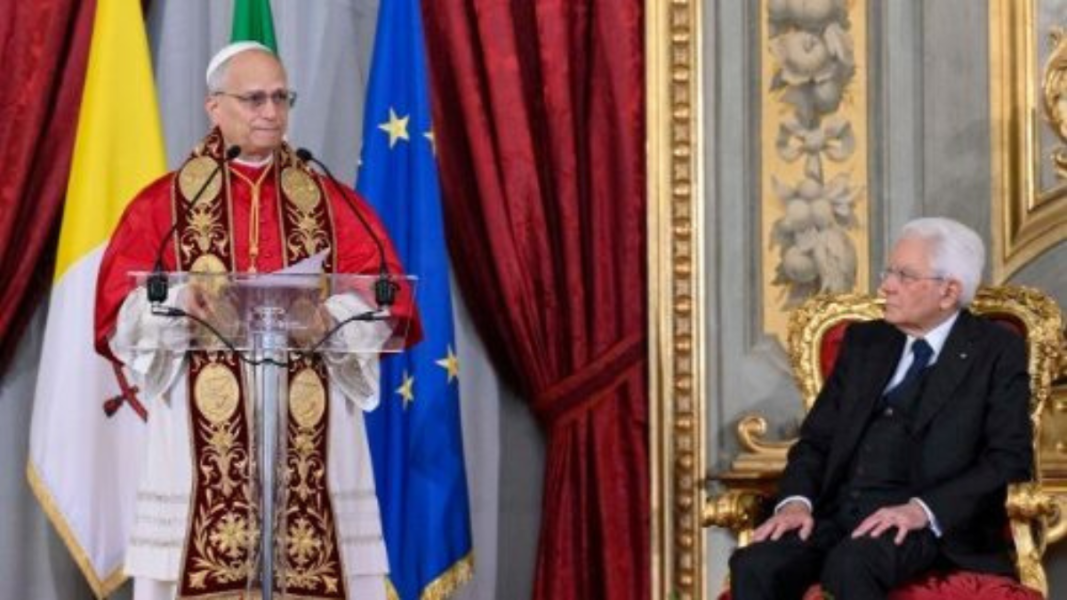
Pope Leo XIV made an official visit this October 14 to the President of the Italian Republic, Sergio Mattarella, at the Quirinal Palace. In his speech, the Pontiff emphasized the importance of cordial relations between Italy and the Holy See, highlighting collaboration in organizing the 2025 Jubilee and the country’s historical testimony in the life of the Church.
The family and birthrate
One of the main axes of the intervention was the demographic issue and the role of the family. The Pope expressed his concern about the decline in birthrate in Europe and encouraged Italy to support and promote family life.
“Father, mother, son, daughter, grandfather, grandmother are, in the Italian tradition, precious words that sustain solid communities and transmit essential values to society”.
He called for trust in young families, encouraging policies that favor birthrate and recalling that the future is built “with the welcoming of life, from conception to old age, until the moment of death”.
Migrants and integration
The Holy Father thanked Italy for the generous assistance it offers to migrants and the effort against human trafficking. At the same time, he insisted on the need for respectful integration of the country’s traditions and values, so that the encounter between peoples may be an authentic enrichment.
“Let us not value too little what we are and what we have received. Let us not despise what has made us grow as a society”.
He emphasized that the more one recognizes and loves one’s own cultural identity, the easier it is to open up to the other without fear and with an open heart.
The anniversary of Saint Francis of Assisi
Looking ahead to the coming year, Leo XIV recalled that in 2026 it will be 800 years since the death of Saint Francis of Assisi, patron of Italy. He invited a rediscovery of the saint’s message in respect for creation, describing the country as the depositary of a particular mission.
“Italy has received in a special way the mission of transmitting to the peoples the culture that recognizes the earth as a sister and as a beautiful mother who welcomes us in her arms”.
The Pope concluded his message by encouraging Italians to rediscover “the immense wealth, sometimes hidden” of their nation, to face present and future challenges with hope, trusting in the roots of freedom, responsibility, and solidarity that have marked the country’s history.
We provide below the full speech (and translated) of Leo XIV:
Speech of the Holy Father Leo XIV
Official Visit to the President of the Italian Republic, Sergio Mattarella
Quirinal Palace – Tuesday, October 14, 2025
Mr. President,
I thank you for the kind words you have addressed to me and for the invitation to come here, to the Quirinal, a Palace so closely linked to the history of the Catholic Church and the memory of numerous Pontiffs.
As Bishop of Rome and Primate of Italy, it is significant for me to renew, with this visit, the strong bond that unites the See of Peter to the Italian People, whom you represent, within the framework of the cordial bilateral relations that exist between Italy and the Holy See, based on sincere friendship and mutual and effective collaboration.
It is, in essence, a happy union that has its roots in the history of this Peninsula and in the long religious and cultural tradition of this Country. We see its signs, for example, in the innumerable churches and bell towers that dot the territory, true reliquaries of art and devotion, in which the innate creativity of this People, united to its genuine and solid faith, has delivered the testimony of so much beauty: artistic, certainly, but above all moral and human.
I take advantage of our meeting to express the Holy See’s heartfelt gratitude for what the Italian Authorities have done and continue to do on the occasion of various and demanding ecclesial events centered in Rome and with universal resonance.
I wish to express in particular my recognition for the effort deployed at various levels following the death of my venerated Predecessor, Pope Francis. Precisely here, in the Quirinal, he had said: “My roots are in this Country” (Speech on the Official Visit to the President of the Italian Republic, June 10, 2017), and certainly his love for the land and the Italian people found in those days a moving and warm response, which was also manifested in the great and concerted effort carried out during the subsequent Conclave for the election of the new Pontiff.
I also want to give a sincere “thank you” to you, Mr. President, and to the entire nation for the beautiful testimony of welcome, united to effective organization, with which Italy has been welcoming for months the numerous pilgrims of the Jubilee, coming from various countries, and for the commitment to ensure the smooth development of the celebrations—logistics, security, infrastructure, and management of the flows of the faithful—, opening its heart and arms to welcome them. The universal Church is preparing to celebrate the Jubilee of hope. Pope Francis, in Spes non confundit, with a view to the 2025 Jubilee, emphasized the importance of “paying attention to so much good that is present in the world so as not to fall into the temptation of feeling overwhelmed by evil and violence” (n. 7). I think that the beautiful synergy and collaboration we are living in these days already constitutes in itself a sign of hope for all those who, with faith, come to cross the Holy Door and pray at the tombs of Peter and the Apostles.
In a few years we will celebrate the centenary of the Lateran Pacts. All the more reason it seems right to me to emphasize how important it is the reciprocal distinction of spheres, from which, in a climate of cordial respect, the Catholic Church and the Italian State collaborate for the common good, at the service of the human person, whose inviolable dignity must always be in the first place in decision-making processes and in action, at all levels, for social development, especially in the protection of the most fragile and needy. To this end, I praise and encourage the reciprocal commitment to maintain and promote all collaboration in the light of and in full respect of the 1984 Concordat.
As unfortunately appears evident, we live in times in which, alongside so many signs of hope, situations of grave suffering abound that wound humanity on a global level and demand urgent responses and, at the same time, far-reaching ones.
The first commitment I wish to recall is that of peace. There are numerous wars that devastate our planet and, looking at the images, reading the news, listening to the voices, and meeting the people who are painfully struck, the words of my Predecessors resound strong and prophetic. How can we not recall the irrefutable, though ignored, warning of Benedict XV during the first world conflict (cf. Letter to the Heads of the Warring Peoples, August 1, 1917). And, on the eve of the second, that of the venerable Pius XII (cf. Radio Message to the Governments and Peoples on the Imminent Danger of War, August 24, 1939).
Let us look at the faces of those who are dragged by the irrational ferocity of those who without mercy plan death and destruction. Let us listen to their cry and remember, with Saint Pope John XXIII, that “every human being is a person, that is, a nature endowed with intelligence and free will; and therefore subject to rights and duties that flow immediately and simultaneously from his very nature” (cf. Pacem in terris, April 11, 1963).
I therefore renew the appeal to the leaders of nations to work for peace with courage and foresight, to rekindle the awareness that war is always a defeat for humanity, and to commit to sincere and patient dialogue, an instrument of diplomacy and basis for a just, peaceful, and stable coexistence (cf. Saint Paul VI, Message for the Celebration of the Day of Peace, January 1, 1968).
I express my appreciation for the commitment of the Italian Government in favor of so many situations of suffering linked to war and misery, particularly towards the children of Gaza, also in collaboration with the Bambino Gesù Hospital. These are significant contributions to building a dignified, peaceful, and prosperous coexistence for all members of the human family.
To this end, the common commitment that the Italian State and the Holy See have always maintained and continue to maintain in favor of multilateralism certainly helps. It is a very important value. The complex challenges of our time require seeking and adopting shared solutions. For this reason, it is indispensable to implement dynamics and processes that recall the original objectives, aimed mainly at resolving conflicts and promoting development (cf. Francis, Enc. Fratelli tutti, October 3, 2020, 172), promoting transparent languages and avoiding ambiguities that may cause divisions (cf. Id., Speech to the Diplomatic Corps, January 9, 2025).
We are preparing to celebrate an important anniversary next year: the eighth centenary of the death of Saint Francis of Assisi, Patron of Italy, on October 3, 1226. This offers us the occasion to place emphasis on the urgent issue of caring for the “common home”. Saint Francis taught us to praise the Creator in respect for all creatures, launching his message from the “geographical heart” of the Peninsula and making it reach, through the beauty of his writings and the testimony of him and his friars, down through the generations to us.
For this reason, I consider that Italy has received in a special way the mission of transmitting to the peoples the culture that recognizes the earth “as a sister with whom we share our life and as a beautiful mother who welcomes us in her arms” (Laudato si’, 1).
In recent decades we have seen in Europe, as we know, a notable decline in birthrate. This requires commitment to promote valid options at various levels in favor of the family, supporting its efforts, promoting its value, protecting needs and rights. “Father”, “mother”, “son”, “daughter”, “grandfather”, “grandmother” are, in the Italian tradition, precious words that sustain solid communities and transmit essential values to society.
The vocation and mission of Italy is also to testify that the future is built with the generous gift of self and with the welcoming of life, which means openness to birthrate and also to paternity. Let us do everything possible to give confidence to families, especially to young ones, so that they can look to the future serenely and grow in harmony.
In this context is inscribed the fundamental importance, at all levels, of respect and protection of life, in all its phases, from conception to advanced age, until the moment of death (cf. Francis, Speech to the Plenary Assembly of the Pontifical Academy for Life, September 27, 2021). I hope that this sensitivity continues to grow, also concerning access to medical care and medicines, according to each one’s needs.
I express gratitude for the assistance that this Country offers with great generosity to the migrants who increasingly knock at its doors, as well as for its commitment in the fight against human trafficking. These are complex challenges of our time, before which Italy has never backed down. I encourage keeping the spirit of openness and solidarity always alive.
At the same time, I would like to recall the importance of constructive integration of those who arrive, in the values and traditions of Italian society, because the reciprocal gift that takes place in this encounter of peoples may truly be an enrichment and a good for all. I emphasize how precious it is, for each one, to love and communicate one’s own history and culture, with its signs and expressions: the more one serenely recognizes and loves what one is, the easier it is to encounter and integrate the other without fear and with an open heart.
However, there exists, in these times, a certain tendency, at various levels, not to appreciate sufficiently the models and values transmitted over the centuries that form our cultural identity, to the point of wanting to deconstruct them. Let us not value too little what we are and what we have received. Let us not despise what has made us grow as a society. On the contrary, let us treasure it, strengthening in young people the love for the great roots of freedom, responsibility, and solidarity, so that they may assume with renewed confidence the tasks that await them.
Mr. President, to you and, in you, to the entire Italian people I wish to express, in conclusion, my most heartfelt wishes for every good. Italy is a country of immense wealth, often humble and hidden, and which for that reason sometimes needs to be discovered and rediscovered. This is the beautiful adventure to which I encourage all Italians to embark, to draw hope and face present and future challenges with confidence. Thank you.