


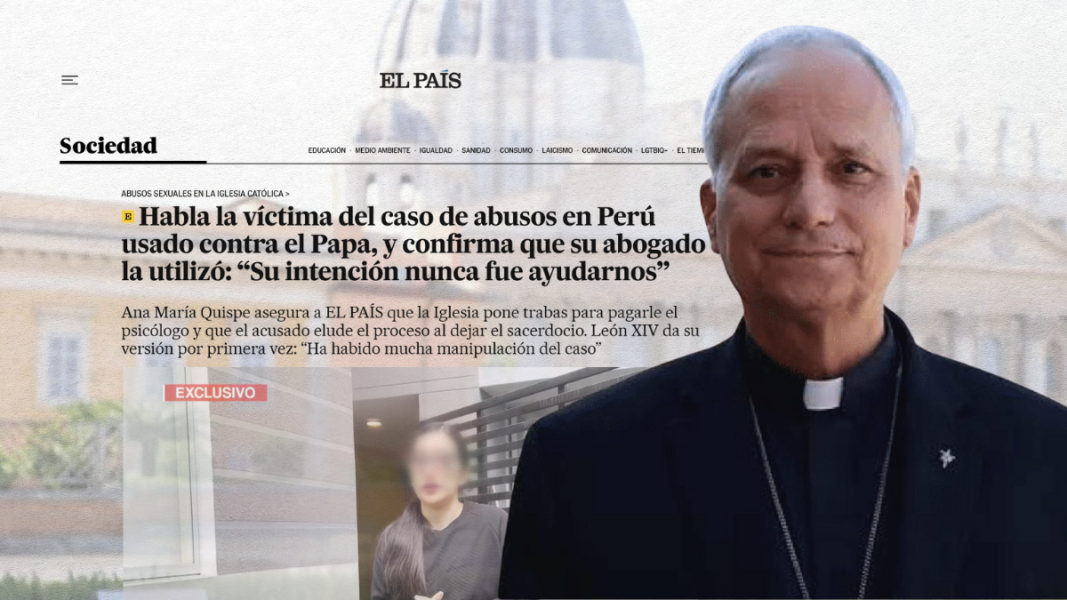
On October 1, 2025, the newspaper El País published an article about the current Pope, Leo XIV (Robert Prevost), in which statements from an abuse victim were used to accredit a sort of conspiracy against the prelate. However, what the victim of the priest from Chiclayo «Lute» actually expressed in a two-hour interview does not match what appeared in the media outlet. The affected woman herself, Ana María Quispe Díaz, submitted a written statement on October 7 exercising her right to rectification, which requires newspapers to publish the reply in the same space and with the same prominence as the original information. El País, after the legal deadline of three days had passed, has not done so.
The rectification document is explicit: “The information presented by the newspaper El País on October 1, 2025 in two news items, is misleading and does not reflect what was expressed in the two hours of the interview that journalist Paola Nagovitch conducted with me.” El País used phrases such as that “Prevost suffered a smear campaign that the victim herself now explains.” However, what the victim actually declared to the interviewer was very different: “Sadly, Robert Prevost did not act well in our case.” This alteration of the testimony cannot be explained as a minor error: it inverts the meaning of what was said and eliminates the criticisms of the abuse management, which, according to the rectification, “had many deficiencies that must be clarified.”
It is difficult to understand how a reference media outlet interviews an abuse victim for two hours—in a case moreover handled with serious irregularities—for then publishing a manipulated version and omitting the rectification that the law requires. The non-compliance not only affects the victims, who are once again exposed, but also constitutes a violation of the legal framework and the most basic deontological principles of journalism.
The matter has further implications. Infovaticana has had access to the full recording of the interview conducted by Paola Nagovitch, which clearly shows the distance between what was published and what was said. In addition, Vida Nueva Digital went on to replicate El País’s version in an article that it later withdrew, a significant gesture that reveals the difficulty of sustaining that narrative.
In view of the gravity of what happened, the victims have announced that they will file legal actions in court to ensure compliance with the right to rectification, and in addition, they will send the full recording of the interview along with what was published by El País to the Ethics Committee of the FAPE, so that it can evaluate the conduct of the newspaper and its journalist. This is not a minor controversy: at stake is the obligation of the media to report with rigor, respect the right to rectification, and not use testimonies of sexual abuse as a tool to protect the image of members of the ecclesiastical hierarchy for political interests.
The victims have insisted that they do not seek for their case to be forgotten or to be part of any political agenda. Their demand is simple: that justice be done, that they be compensated, and that their image not be distorted by campaigns unrelated to their interests. For this reason, they have asked that the grace of dispensation not be granted to avoid the investigation, they have requested access to the full file, the conduct of tests, and the guarantee of a fair and transparent process. Nothing more, nothing less. El País, by manipulating the testimony of an abuse victim to exonerate Prevost from his errors in the Lute Case, has diverted the focus from the essential: that the victims be heard on their own terms and that their rights be respected.