


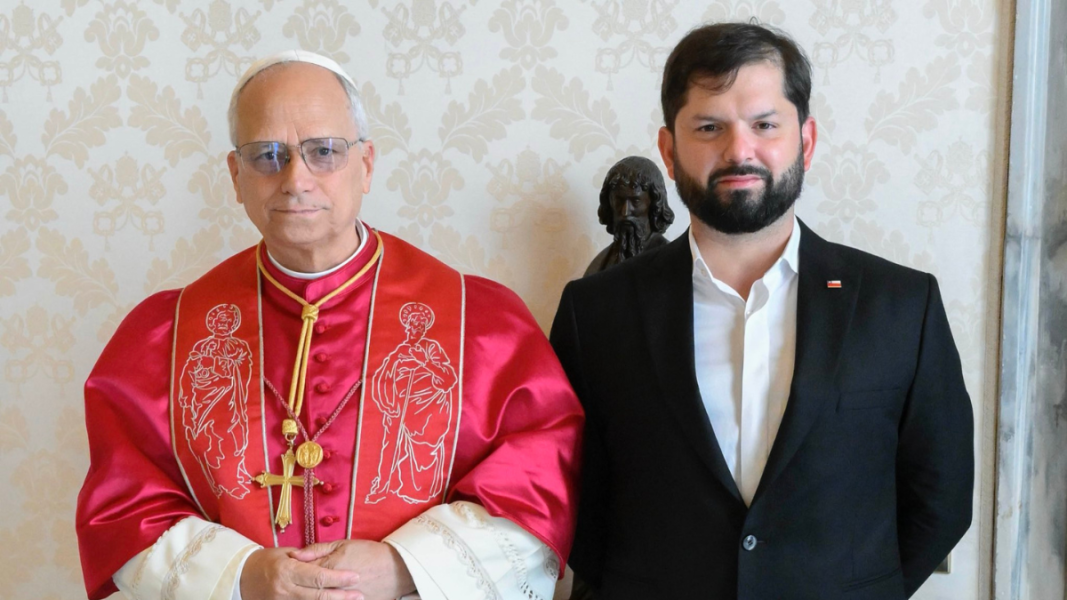
This Monday, October 13, Pope Leo XIV received the President of Chile, Gabriel Boric Font, at the Apostolic Palace. The Holy See’s statement was, as usual, sober: they spoke of good bilateral relations, the Church’s contribution in the country, the fight against poverty, migration, and “ethical issues.” A formula that, read between the lines, can be associated with the topic of the legalization of euthanasia, which is currently in process in Chile.
After the meeting with the Pontiff, Boric also met with Cardinal Pietro Parolin, Secretary of State, and Monsignor Paul Richard Gallagher, Secretary for Relations with States.
Boric’s diplomatic gestures
The president was quick to share his enthusiasm for the visit on his social media. On X, he described the encounter as “very beautiful and reflective” and recounted that they discussed the apostolic exhortation Dilexi Te, in which Leo XIV calls for addressing the structural causes of poverty and marginalization with humility.
Boric also assured that the Pope spoke to him with pain about sexual abuses in the Church, recalled the role of Vatican mediation in the peace treaty with Argentina in 1978, and they discussed the situation in Gaza. Additionally, he officially invited Leo XIV to visit Chile.
The president also took the opportunity to show the gifts given to the Pope: the Cantata de los Derechos Humanos, a book on the Vicaría de la Solidaridad, Alturas de Macchu Picchu by Pablo Neruda, and the jersey of Los Cóndores, the Chilean rugby national team. Symbolic gifts, carefully chosen to project a cultural and political image of Chile to Rome.
The background that Boric cannot hide: euthanasia
However, behind the diplomatic smile, there is an uncomfortable reality. The same Boric who delivers books and jerseys in the Vatican is the one pushing a euthanasia bill in Chile that is already advancing in the Senate.
The Chilean Episcopal Conference has spoken clearly in a recent letter: “Euthanasia remains an inadmissible act, even in extreme cases, because it constitutes a grave violation of God’s Law.” The bishops recall what the Catechism teaches: “whatever the motives and means, direct euthanasia is morally unacceptable” (n. 2277).
Additionally, they warn of the danger of a slippery slope. In all countries where it has been approved, what began as a limited exception has turned into a widespread practice: first extreme cases, then chronic illnesses, then psychological suffering… until life is reduced to a subjective criterion of utility.
The tension between diplomacy and truth
The Holy See, faithful to its diplomatic style, speaks of “ethical issues.” Boric, faithful to his political style, speaks of a “very beautiful and reflective” encounter. But the core of the issue remains unnamed with all the force it deserves: in Chile, they want to legalize a crime.
Boric’s visit to the Pope highlights this contrast. The president took away photos, gifts, and headlines. Leo XIV, for his part, showed cordial openness. But the question remains: who will speak in Chile in defense of those who have no voice, when the law allows the elimination of the sick and the elderly?