


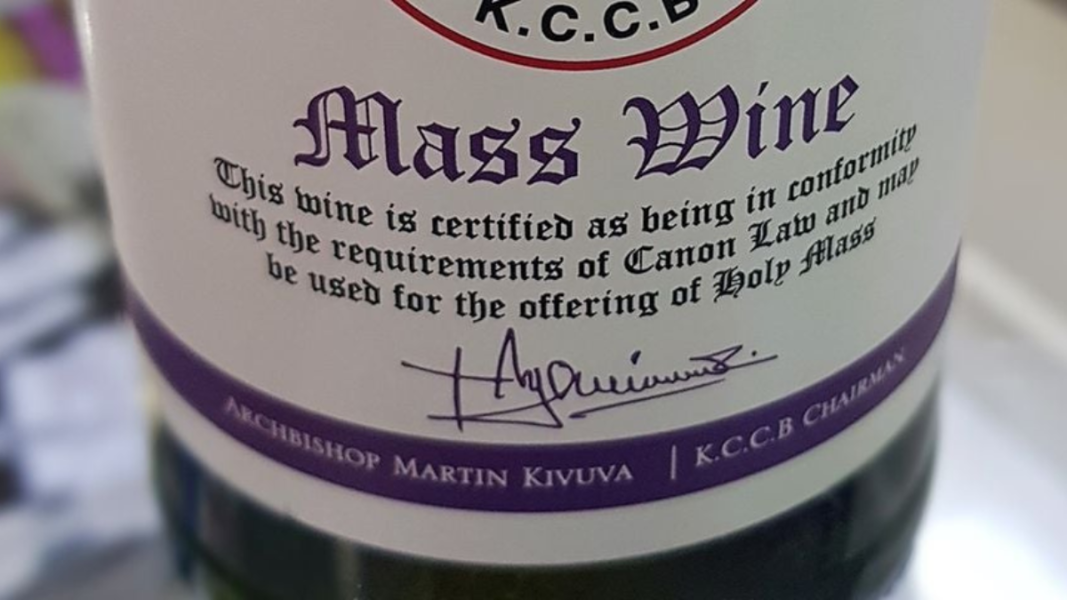
On October 4, during the National Day of Prayer held at the Marian Shrine of Subukia, the president of the Kenya Conference of Catholic Bishops (KCCB), Monsignor Maurice Muhatia Makumba, announced a significant change in the country’s liturgy: the wine used until now in Eucharistic celebrations will be replaced by a new one, officially approved by the bishops.
Before more than 50,000 faithful gathered for the celebration, the Archbishop of Kisumu showed two bottles, one of the wine that had been used until then and another of the new one, from South Africa, which from that moment was established as the only authorized one for Masses in all dioceses of Kenya, according to the local media Daily Nation.
Reasons for the change
Although Monsignor Muhatia did not publicly detail the reasons, ecclesiastical sources confirmed to the local press that the decision responds to the widespread availability of the previous wine in supermarkets, hotels, bars, and liquor stores. That situation, they added, had trivialized its sacred character and facilitated improper use outside the liturgical context. With the change, the bishops want to ensure that the wine used in the Eucharist is exclusive to the altar and not confused with an ordinary consumer product.
The new approved wine
The wine that replaces the previous one comes from the South African winery Lutzville Vineyards and is distributed in Kenya by the company Wow Beverages. It is presented in 750-milliliter bottles, with an alcohol content of 17%, slightly lower than the 18% of the previous wine. Its price ranges between 1,500 and 1,800 Kenyan shillings—equivalent to about 9 to 11 euros—, somewhat higher than the cost of the previous one, which ranged between 1,200 and 1,700 shillings.
Each bottle bears the coat of arms of the Kenya Conference of Catholic Bishops and the signature of the KCCB president as a seal of authenticity. The label also features a text alluding to the liturgy: “The fruit of the vine and of the work of human hands will become our cup of joy. It complies with the requirements of Canon Law, is certified and approved for the celebration of the holy Mass.”
Context and scope of the measure
Kenya has about 10 million Catholics, nearly 20% of the population, according to official 2019 data. The bishops’ decision affects the country’s 28 ecclesiastical circumscriptions, including the major archdioceses of Nairobi, Nyeri, and Mombasa, where wine consumption for Mass is higher in large-scale celebrations such as Easter, Christmas, or diocesan feasts.
Until now, Mass wine was produced by the local company Kenya Wine Agencies Limited, which facilitated its access in the common market and, according to sources consulted, caused it to even appear in non-religious contexts. With the measure approved by the Conference of Bishops, controlled distribution and strictly liturgical use are sought.