


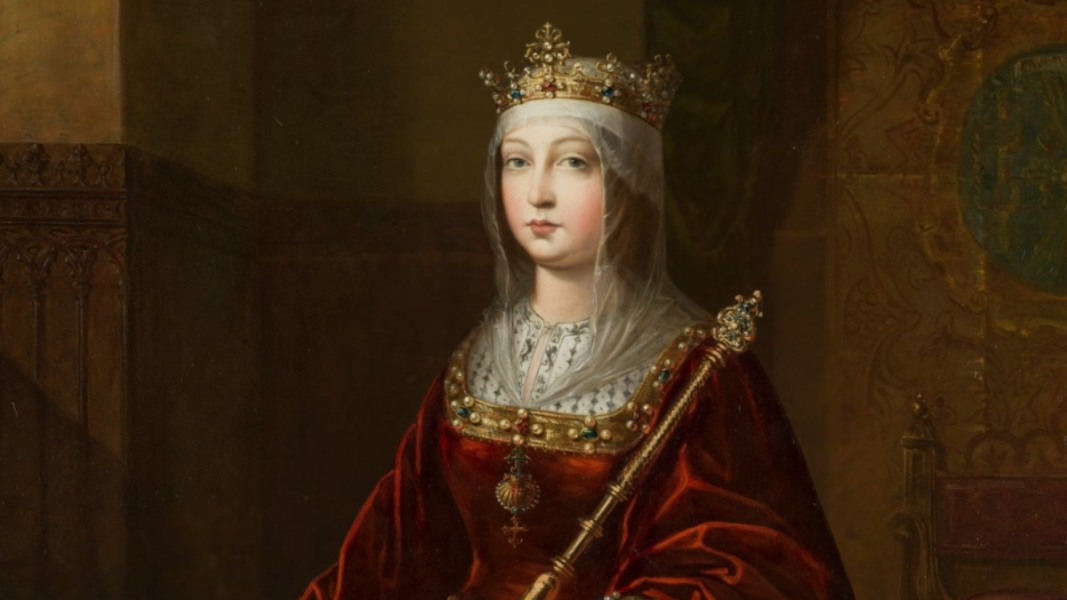
It has been repeated for centuries that the Catholic Monarchs financed Christopher Columbus moved solely by the ambition for power, riches, and earthly glory. This reductionist view, so favored by those who feed the so-called “Black Legend”, ignores the overwhelming documentation of the time, which demonstrates the opposite. For Isabel, the Columbian enterprise was never a commercial adventure, but a deeply spiritual mission. The Queen herself wrote it down: the objective of the voyage was the “expansion of the Catholic faith”.
The New World, in her gaze, was not a gold mine to exploit nor a board of courtly strategies, but an immense field open to grace. An entire continent, until then alien to the light of the Gospel, offered itself as the greatest of missionary opportunities. And it was that conviction—more than the insistence of the Genoese navigator or the calculations of the court—that definitively tipped the scales in favor of the discovery.
The queen who pawned jewels for the faith
The famous episode of Isabel’s jewels has been interpreted in many ways: for some, a symbolic anecdote; for others, a pious fiction. But the essential remains: the Queen was willing to put the most valuable part of her patrimony at the service of a project that had no human guarantees of success. It was not the first time. She had already pawned her jewels for the benefit of the Kingdom in other critical moments.
When Columbus’s enterprise seemed lost in delays and refusals, Isabel intervened personally, offering her goods as collateral. It was not a theatrical gesture, but visible proof of her faith that that voyage responded to a higher design. Many contemporaries interpreted her decision as “divine inspiration”. Without the Queen’s personal courage, universal history would have taken another course. America might have remained off the European map for decades, and the evangelization of millions of souls would have been irreparably delayed.
Evangelization before conquest
Columbus himself, who was not precisely a mystic, insisted in his writings that the purpose of the voyage was to glorify the Christian religion and extend the faith in those newly discovered lands. His onboard Diary records the prohibition of allowing there the presence of foreigners who were not Catholics, precisely to avoid tarnishing the initial purpose of the enterprise.
And the Queen, in an even more explicit way, ratified it: in the Capitulations of Santa Fe and in her own will, she declares without ambiguity that the purpose of the discovery was evangelization. This assertion, so often ignored by “progressive” historians, is uncomfortable for the modern mentality that prefers to see colonization as a simple business of gold and spices. But the facts are there: Isabel was not thinking of markets, but of souls.
The freedom of the Indians
One of the most controversial and distorted points by anti-Catholic propaganda is that of indigenous slavery. The reality is very different: when Columbus sent to Spain a first shipment of enslaved Indians, Isabel reacted quickly and forcefully. She suspended the sale, consulted theologians and canonists on the moral licitness of that traffic, and, after years of reflection, issued an unprecedented resolution in her time: she ordered the freedom of the Indians and their repatriation.
This decision, advanced by more than three decades to Francisco de Vitoria’s law of nations, marked a universal milestone. While in other continents slavery would remain in force for centuries, the Queen expressly prohibited bringing any slave to the Indies. Not for political or economic reasons, but because she understood that no one could be converted to Christ with chains on their feet. For this reason, with full justice, Isabel has passed into history as the “mother of the Indians”.
A legacy that still weighs
In her will, Isabel wrote with crystal clarity that evangelization should be the “principal end” of her successors in the Indies, prohibiting any harm to the natives either in their goods or in their persons. It was not a secondary clause, but the essence of her legacy.
The result of that vision is evident: today, half of the world’s Catholics are found on the American continent. That immense community of faith, which sustains the universal Church, is the fruit of that historical decision of a Queen who knew how to look beyond the political and economic circumstances of her time. Zavala summarizes it precisely: to Isabel is due the incorporation of America into the Western world and the irreversible imprint of its Christianization. A fact comparable only to the great missionary feats of the Mediterranean and barbarian Europe.
In Isabel the Catholic: Why She Is a Saint, José María Zavala shows us a Queen who broke molds, who did not measure her acts by political calculation, but by her faith. Her figure remains uncomfortable for many because it disproves the black myth that hovers over Spain and its mission in America. A book that does not limit itself to narrating facts, but invites us to discover the Isabel who changed the course of universal history with the strength of her faith.