


For 25 years, the Catholic Formation Encounter has been held in Buenos Aires (Argentina), under the patronage of Saint Bernard of Clairvaux. This event, which combines intellectual formation, liturgical life, and family spirit, has addressed in its various editions highly relevant themes: from the denunciation of liberalism and modernism to the defense of the family, Catholic education, beauty as a path to God, and resistance to the new world order. All of this, with the conviction that the Catholic must not flee from the world, but impregnate it with the spirit of Christ.
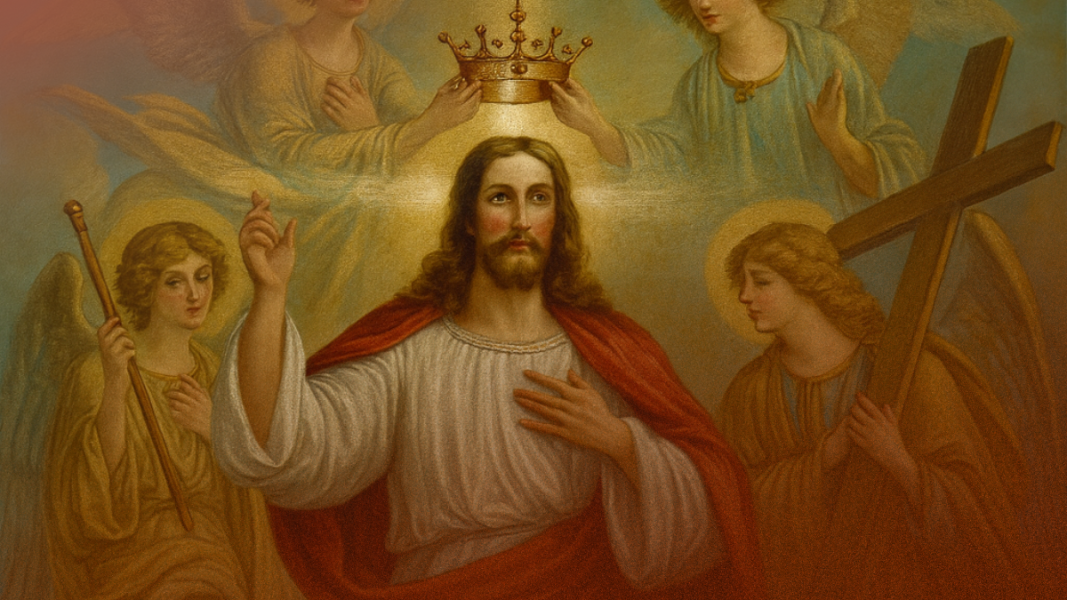
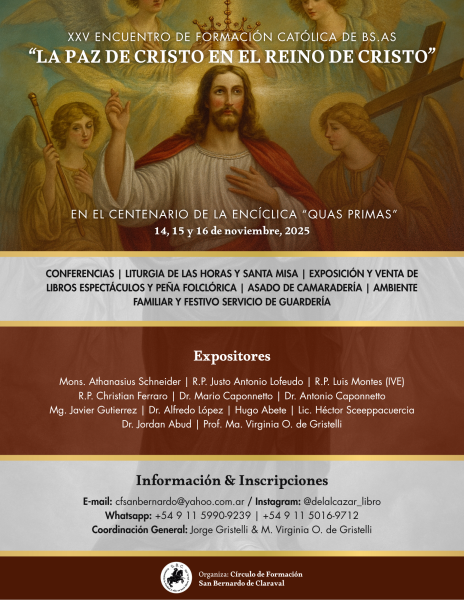
This 2025, the chosen motto is “The peace of Christ in the Kingdom of Christ”, on the centenary of the encyclical Quas primas by Pius XI, which proclaimed the social kingship of Our Lord Jesus Christ in the face of attempts to banish him from public life. A providential message in an era where syncretism, secularism, and apostasy advance forcefully, even within the Church itself. Against this backdrop, InfoVaticana spoke with the organizers, Jorge and María Virginia O. de Gristelli, who share the fruits, challenges, and hopes of this apostolate that has marked their lives and the lives of so many people.
—This year marks the 25th edition of the Catholic Formation Encounters in Buenos Aires. How did this initiative begin, and what was the inspiration for placing it under the patronage of Saint Bernard of Clairvaux?
We began organizing the Encounters in 1998, the first year of the Triduum of preparation for the Jubilee called by Saint John Paul II. My husband and I were leading a youth group and saw the need to fill gaps through extended encounters where themes could be deepened to strengthen Catholic thought against liberal-Marxist ideologies that have done so much damage to our homeland, distancing it from its Hispanic-Catholic roots.
In this way, each year we have chosen major themes (“Catholic Psychology and Spirituality”; “Liberalism is a Sin”; “The Last Times”; “The Family, Banner and Bulwark”; “Education for Difficult Times”; “Laws of Disorder”; “The Tyranny of the NOM”; “The Politics of the Common Good”; “Truth, Beauty, and Ideology”; “Faith and Fatherland”; “Modernism and Liberation Theology”; “Our Lady and the Church”, etc.) as axes around which to deepen various aspects of the Catholic’s life today. We began, then, in the “Year of the Holy Spirit”, and to Him we commend ourselves, with the warm and affectionate support of some friends—lay and consecrated—and of those first young people (some now parents, priests, or nuns) whom we will always remember with deep gratitude.
Saint Bernard was already the patron of our group (S.B.C. Formation Circle), with which we had been organizing Ignatian-style retreats with proven faithful priests and lectures in central Buenos Aires parishes, given by prominent figures in Argentine Catholic culture. The knowledge and friendship we had with some of them made us think that it could be a grace that needed to be enhanced for the common good, always keeping in mind that no encounter is fortuitous among the children of the Church and that we will have to account for every gift someday.
The choice of Saint Bernard responded, above all, to the fact that, in his multifaceted personality, he very well represents the three pillars on which our association was founded: formation (essential for the defense of the faith, even though many maintained that apologetics was no longer necessary); piety—especially Marian (Saint Bernard has been called the “harpist of Mary”)—; and militancy, insofar as the holy abbot not only advised and encouraged his sons from the cloister, but immersed himself in the world’s problems seeking to sow the Kingdom of Christ there, embodying the perfect synthesis of “monk and knight”.
—After so many years of work, what concrete fruits can you point to that this Encounter has left in the formation of the faithful and in the life of the local Church?
The Encounters have been an immense source of blessings, of which we will surely see the most important ones in Heaven, and all through the Most Holy Mary. However, here we have already been witnesses to a great number of fruits that God has allowed us to admire, especially in the multiplication of “networks” of friends, groups, associations, conversions, vocations…
In personal bonds, for example, we always remember that there have been several young people who met one year, the next returned as couples, then as spouses, and later with their children and other friend families. And this has not only happened in our country, but also among our Uruguayan brothers—some known through the dear Fr. Bojorge, a prolific spiritual father and frequent attendee at the Encounters as a speaker a few years ago—.
The relationship established between priests and consecrated persons or friendly institutes has also been very fruitful, and with some special guests from abroad, such as, for example, Msgr. Schneider in recent years, or—in the beginnings—Msgr. Ennio Innocenti, Msgr. Nicola Bux, Msgr. Rifan; and, among the Argentines, Fr. Alfredo Sáenz, SJ; Fr. J. C. Sanahuja (+); our dear Msgr. Baseotto (+), who generously sponsored us for nearly two decades; and many others. We believe it is an inestimable grace to have served as a “bridge” for the greater dissemination of figures and works representative of definitively Catholic thought, in a time of so many confusions.
The term “Encounter”, in the final analysis, points precisely to that: it is not only about knowing the doctrine—which, of course, we consider the main thing, since Our Lord calls us fundamentally to proclaim a faith, a message, a doctrine—, but also to promote “networks”, to become more aware of the efficacy of the communion of saints and to support each other amid more than tempestuous times, in which the great temptation is often to lower our arms believing that we battle alone, because Goliath “is bigger”…
—The motto of this edition is “The peace of Christ in the Kingdom of Christ”, within the framework of the centenary of the encyclical Quas primas. Why did you choose this theme, and what relevance does Pius XI’s teaching on Christ the King have in today’s context?
We always keep major anniversaries in mind, which help to make memory and formulate a certain “examination of ecclesial conscience”, as was the centenary of Pascendi a few years ago, in view of the ravages produced by modernism. Quas primas today has unquestionable relevance, because probably never before has there been such a search to “dethrone” Christ with so many devices, and now openly not only in the midst of society, but even from the very bosom of the Church. As Fr. Meinvielle points out:
“Seek first the Kingdom of God” is not an empty word from the Lord. God does not say, as we do, empty words. It is a law for the peoples. It is a law of History. It is also a solution for the peoples and for History that, when through infidelity they have fallen into the abysses of degradation, find their remedy in the Word of the Lord. Logos means Word. And the world today, especially the world that was Christian and no longer is, needs the breath of the Logos, of the Word, that raises it up and gives it new life.” (Communism in the Anti-Christian Revolution, Theoría Editions, Buenos Aires, p. 12)
And the dethronement of Christ begins significantly with the confusion of words, with their bastardization, by the father of lies.
The syncretism we have witnessed since the Abu Dhabi document on human fraternity, the scandalous vindication of Luther, or the apostate reverences before the pachamama are not a bad dream of the past, but continue to poison souls like the dampness that rots the foundations of a house. A little word here and another there, each time with more Masonic accent, reveal to us that an overwhelming number of so-called Catholics is more inclined to roll out the red carpet for the Antichrist than for Christ King of the Universe.
—What will be the main axes of the conferences, and how do they integrate with the liturgy, prayer, and also with cultural activities, such as the book exhibition, the folk music gathering, or the camaraderie barbecue?
The general thematic axis is the one declared in the Theme, as we saw, but it is addressed from different perspectives. This year, for example, we will have as a special guest Fr. Luis Montes, IVE, a missionary in the Middle East, because we consider that the persecution and martyrdom of so many of our brothers under the scourge of Islam is the “throne” where what we pointed out above is most clearly manifested. The number of martyrs in this century, which far surpasses the first centuries of the Christian era, is evidence of the Christophobia that afflicts society like a cancer: the evident wounds are in the Middle East, but the entire body of the West is full of “metastases” that must be clearly diagnosed.
Integration with the liturgy is always indispensable in a solid and coherent formation that claims to be Catholic, by definition, because the liturgy is the source and the most intimate life of the Church. If we presented only a handful of conferences without being able to share Holy Mass—with at least one of the celebrations in the traditional form—, everything would be truncated. On more than one occasion we have also had the grace to participate in the treasure of Eastern liturgies celebrated by the Syrian, Armenian, and Maronite bishop himself. Through this intimate relationship with He who is the axis of these days, we reserve Friday night for Eucharistic Adoration and begin each morning with the communal prayer of Lauds.
Regarding the book exhibition, we highlight that the main sponsorship has always been the Santiago Apóstol Bookstore and Publishing House, which we run together with my brother-in-law also for about thirty years, and from which we have been publishing works by some authors who honored us with their presence at the Encounters. In fact, we highlight the importance of mediating the encounter between great Catholic authors and the public, before or after having read their works; because, in the final analysis, the book must serve for the encounter between souls and of these with the eternal Word.
From our country, we keep, for example, enormous gratitude for the support of “giants” whom we miss greatly, such as Enrique Díaz Araujo (+), Federico Mihura Seeber (+), Alberto Caturelli (+), Hugo Verdera (+), and the uninterrupted presence of Fr. Alfredo Sáenz and Dr. Antonio Caponnetto.
As for the folk music gathering and the traditional camaraderie barbecue—this year we resume it after several years, thank God—, it responds to a more “eutrapelic” dimension, but also necessary. They are moments to share impressions and deepen contacts, which Providence will undoubtedly water in the warmth of the common interest in being embraced by the Truth.
—You have highlighted that this Encounter is also a family and festive space. What services and proposals do you offer so that families with children can participate, as well as people coming from abroad?
Yes; we have always emphasized families and not setting an age limit for participants. In the Church there are multiple initiatives aimed at different groups according to sex or age; and, as we said before, we thought that perhaps something more “universal” was needed. And the most universal is—or should be—the family, the “domestic Church”, where no one, ever, is superfluous. On the other hand, it seems ironic to us that, while many proclaim themselves pro-life, when organizing events they clarify that children are not admitted; and thus parents cannot share formative days together, without the tension of the child left with the aunt, the grandmother, or the neighbor.
That is why we implement a “Nursery” area, where parents can entrust their children while the conferences are taking place, with a series of parallel activities, also looking at the formative aspect, among traditional games, stories, drawing contests, readings, etc. It is a great joy to have had up to 30 children—from months to 12 years old—in this area during the days of some Encounters, happy and protected, close to their parents, to enjoy these days as a family. We know that some families even request their work vacations based on the dates of the Encounter.
—Organizing a massive Catholic event in these times must not be easy. What challenges do you face, and how do you overcome them to keep this tradition alive year after year?
It is never easy, no; although there are those who face much greater challenges. Many times we have thought it would be the last, a bit intimidated by the amount of work or personal inconveniences; but something or someone always arose that made us put our hand back to the plow, “without looking back”, showing us its need for many. Between 2020 and 2022 we had to interrupt them, because there were no retreat houses available, and we were only able to resume in 2023, by pure grace.
The main challenge is, perhaps, the search for a suitable house, taking into account the diversity of the public and special needs (for example, families with children cannot be placed in single rooms). Sometimes we organize, immediately after the Encounters, Spiritual Exercises with one of the guests (as it was with Msgr. Schneider and with Fr. Carlos Spahn).
Everything is pure grace, without a doubt. Year after year we have been verifying it, giving thanks to God for having given us each Encounter, with its thousand delicacies.
—For people who cannot attend this Encounter, is there a way to access the contents of the talks from this and previous editions?
Unfortunately, we do not have live streaming, but a few years ago—thanks to great friends who make it possible—we have kept the recordings. After each Encounter ends, the conferences are usually uploaded to TLV1 and to our YouTube channel.
—Finally, where can interested people get more information and register, and what message would you give to those who are still hesitant about participating?
To those who hesitate, we would simply say that life passes and that we can never guarantee that the graces that Providence offers us today will be available tomorrow. As Saint Louis Mary de Montfort said, in a deeper order: “He who promised you mercy did not promise you tomorrow”. He works true wonders, but we must be willing to receive them.
We urge them to attend, because He has allowed us to see great fruits, and we would like these to multiply, simply. For any inquiries, do not hesitate to contact us at the email cfsanbernardo@yahoo.com.ar or at WhatsApp +54 11 5990 9239.