


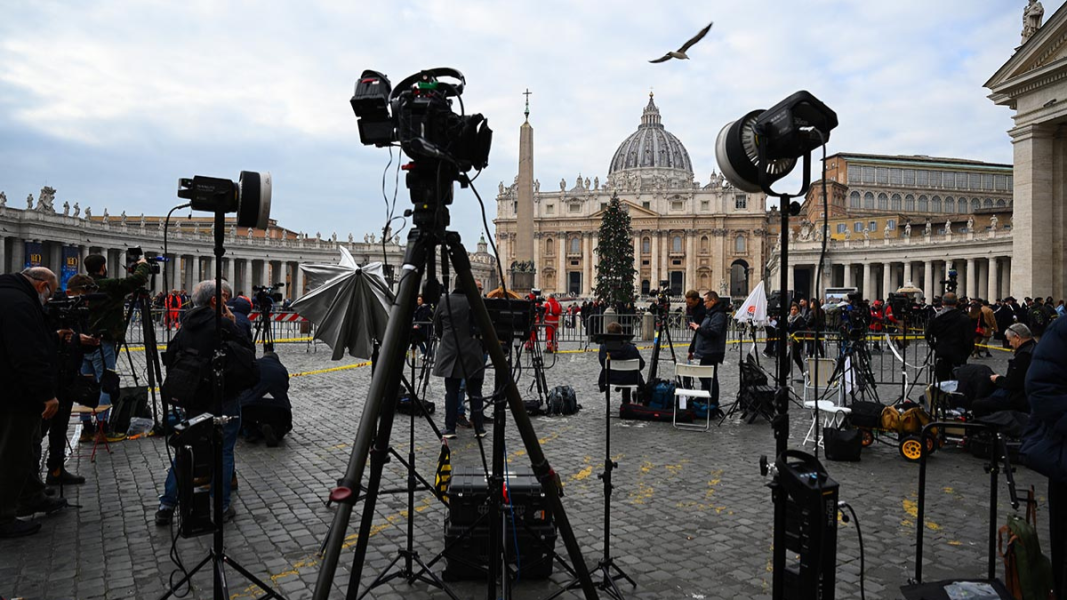
Pope Leo XIV emphasized this Thursday, October 9, the importance of press freedom and the responsible exercise of journalism, addressing the participants of the 39th Conference of the Association Minds International, gathered in the Clementine Hall of the Vatican. The Holy Father recalled that “the exercise of the journalistic profession can never be considered a crime, but is a right that must be protected,” as he also expressed in his message on the social network X.
Information as a public good
In his speech, he defined information as “a public good that we all must safeguard.” He pointed out that what is truly constructive is the alliance between citizens and journalists, founded on ethics and responsibility. “Every day there are reporters who personally risk their lives so that people know how things are,” he stated, remembering those who work in contexts of war, violence, or persecution.
The Pope warned about the danger of manipulation and the confusion between truth and falsehood in a time marked by the proliferation of news and the spread of ideological propaganda. “No one should be able to say today: I didn’t know,” he emphasized, calling for shared responsibility between those who produce information and those who consume it.
Risks of disinformation and uncontrolled technology
Leo XIV alerted against the impact of digital technologies and algorithms on contemporary communication. “Artificial intelligence is changing the way we inform and communicate, but we must watch to ensure that technology does not replace man and that information does not fall into the hands of a few,” he warned.
The Pontiff quoted Hannah Arendt to point out that totalitarianism imposes itself when society stops distinguishing between truth and falsehood. In this sense, he insisted that transparency of sources, quality, and objectivity are key to returning to citizens their role as protagonists in accessing truthful information.
Call to professional responsibility
Finally, Leo XIV exhorted journalists not to “ever sell their authority” and to resist the temptation of superficial or manipulated information. “The economy of communication cannot be separated from the truth,” he said, encouraging communicators to be competent, ethical, and brave in the face of external pressures.
The speech concluded with his blessing and a clear exhortation: “What sustains our societies is free access to information. That is why we are called to defend and guarantee it.”
We leave below the full message from Leo XIV:
Speech by Pope Leo XIV to the participants in the Conference of the International Association MINDS
Clementine Hall — Thursday, October 9, 2025
In the name of the Father, and of the Son, and of the Holy Spirit.
Peace be with you.
Dear brothers and sisters, good morning and welcome to all.
I am pleased to address you at this time, when current events demand particular discernment and responsibility, and it is evident that the media have a crucial role in the formation of consciences and the promotion of critical thinking.
It is a paradox that, in the age of communication, news and media agencies are going through a period of crisis. Similarly, information consumers are also in crisis, often confusing the false with the true and the authentic with the artificial. However, today no one can say: “I didn’t know.” That is why I want to encourage you in your important work and recommend opportunities for collaboration that allow you to reflect together.
Information is a public good that we all must protect. For this reason, what is truly productive is the partnership between citizens and journalists in the service of ethical and civic responsibility. One form of active citizenship is to value and support professionals and agencies that demonstrate seriousness and true freedom in their work. This creates a virtuous circle that benefits the whole society.
Every day, there are reporters who risk their lives to report on what is really happening. In times like ours, marked by violent and widespread conflicts, many have died fulfilling their duty. They are victims of war and the ideology of war, which seeks to prevent journalists from being present. We must not forget them! If today we know what is happening in Gaza, Ukraine, and so many lands bloodied by bombs, we owe it largely to them. These extraordinary direct testimonies are the culmination of the daily effort of countless people who work to ensure that information is not manipulated for purposes contrary to the truth and human dignity.
As you know, in my first meeting with journalists from around the world, immediately after the Conclave, I wanted to make an appeal for the release of their colleagues who had been unjustly persecuted and imprisoned for doing their work. Today I reiterate this request. Journalistic work can never be considered a crime, but a right that must be protected.
Free access to information is a pillar that sustains the building of our societies, and for this reason, we are called to defend and guarantee it.
As Pope Francis emphasized: “We need bold entrepreneurs, bold information, so that the beauty of communication is not corrupted” (Speech to the Participants in the Jubilee of Communication, January 25, 2025). Communication must free itself from misguided thoughts that corrupt it, from unfair competition, and from the degrading practice of so-called clickbait. News agencies are on the front lines and are called to act in the current communicative environment according to principles—unfortunately not always shared—that unite the economic sustainability of the company with the protection of the right to accurate and balanced information.
In turn, journalists working in news agencies are asked to be the first to arrive at the scene and report on what is happening. This is even more true in the era of continuous broadcasting and the growing digitalization of mass media. As you well know, those who work in an agency are required to write quickly, under pressure, even in very complex and dramatic situations. For these reasons, their service requires competence, courage, and a sense of ethics. This is invaluable and must be an antidote to the proliferation of “junk” information.
But we are not destined to live in a world where truth is no longer distinguished from fiction. In this sense, we must ask ourselves some crucial questions.
Algorithms generate content and data on a scale and speed never seen before. But who controls them? Artificial intelligence is changing the way we receive information and communicate, but who directs it and for what purposes? We must be vigilant to ensure that technology does not replace the human being, and that the information and the algorithms that govern it today are not in the hands of a few.
Dear friends, thank you for your work. I offer you my best wishes as you reflect on the challenges we face.
The world needs free, rigorous, and objective information. In this context, it is worth recalling the warning of Hannah Arendt: “The ideal subject of the totalitarian regime is neither the convinced Nazi nor the convinced communist, but people for whom the distinction between fact and fiction and between true and false no longer exists” (The Origins of Totalitarianism, 474).
With your patient and rigorous work, you can stand as a barrier against those who, through the ancient art of lying, seek to create divisions to rule by dividing. You can also be a bulwark of civility in the quicksands of approximation and post-truth.
The communication sector cannot and must not separate its work from service to the truth. Transparency of sources and ownership, accountability, quality, and objectivity are key to returning to citizens their role as protagonists in the system, convincing them to demand information worthy of the name.
I exhort you: never sell your authority!
May the Spirit of God, who is truth and strength, and infuses meekness and courage, sustain you. I accompany you with my blessing. Thank you!