


By Brad Miner
In the old days, a glimpse of a stocking
Was considered something scandalous,
But now, God knows,
Anything goes.
– “Anything Goes” by Cole Porter (1934)
A single headline in Vatican News made me reflect:
The Pope says that Israel’s attack on Hamas in Qatar constitutes a “very serious situation”.
In itself, it is a simple statement of fact. And it is disturbing if, as in my mind, it evokes “wars and rumors of wars” (Matthew 24:6-7, Mark 13:7, and Luke 21:9). The world is a dangerous place, and diplomacy is essential.
But there are existential reasons to be skeptical about the success of diplomatic efforts, not to mention pacifist statements about Gaza, etc. Moreover, negotiations—and let alone good intentions—will not save the world; Christ will. If we all lived in the light of God, we would have peace on earth. But since that is not the case…
Sweet reason is important, but I admire Jonathan Swift’s warning (from A Letter to a Young Gentleman, Lately Enter’d Into Holy Orders by a Person of Quality, 1721): “Reasoning will never make a man correct a bad opinion, which by reasoning he never acquired.” In other words, “it is useless to attempt to reason a man out of what he was never reasoned into.”
In Catholicism, we speak of the “just war theory,” which is a reasoned response to the reality—indeed, the inevitability—of conflict. Diplomacy that seeks peace requires both wisdom and prudence. Vito Corleone advises Tom Hagen about a contentious meeting with the Tattaglias regarding a matter concerning the Five Families: “Mention it, but don’t press.” Use prudent and measured speech.
It seems to me that the Vatican has lost the understanding of the economy in speaking. Every day, and this was especially true when Francis was Pope, the Holy See intruded into the “public conversation,” even to the point of sending messages to the meetings of the World Economic Forum in Davos.
It is tempting to believe that a Pope’s Catholic voice may have a Catholic appeal—that, because there is a universal message of peace and justice in Catholicism, the Pope has authority to speak and the world should listen. But I fear this is only true on some occasions (rarer than the Vatican imagines), and that sending a message to a progressive enclave like Davos is like throwing a bucket of water into hell. And I have no patience with the claim that “it can’t do harm.” Futile gestures almost always do harm.
If statements from Rome were scarce, incisive, and biblical, they might have some impact. But normally, the Vatican’s words are anodyne. And this is true even when a statement turns out to be scandalous—at least, to the sensibilities of a traditional Catholic.
Consider this, published by Catholic News Agency on September 10, 2025:
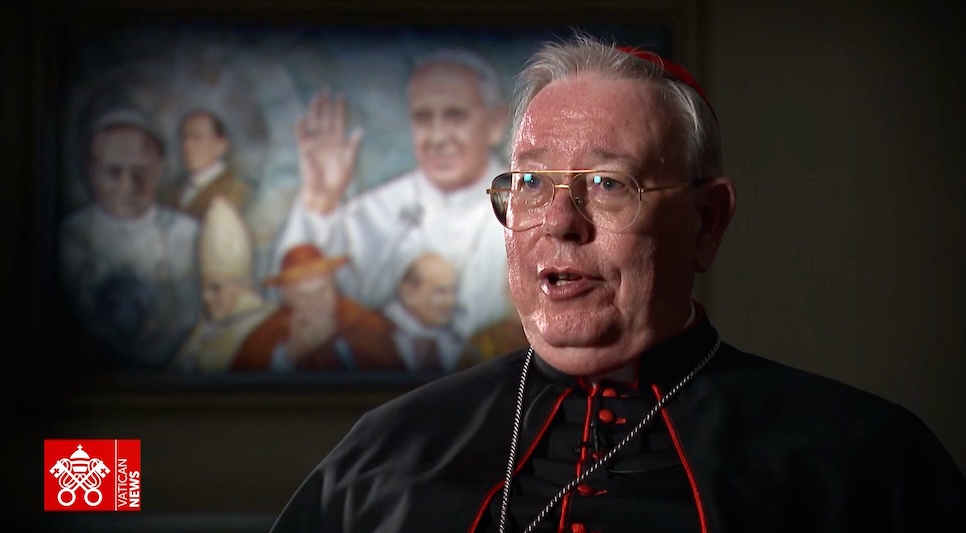
Cardinal Jean-Claude Hollerich, SJ, stated in a recent interview: “I would not define morality—especially sexual morality—as narrowly as the Church does today.”
Every time Cardinal Hollerich speaks, one knows it is in the context of synodality, which—as he himself suggests in that article—is mutating toward an “ecclesial assembly.” Although he adds: “it is still unclear exactly what such an ecclesial assembly will consist of.”
But, Eminence, if it is not clear, why are we doing it? And as for sexuality, why do you speak as if you were the Lawgiver?
When the Lord said (Mark 16:18) that we will be able to “take up serpents in our hands” and not be harmed, He was not recommending dangerous behaviors. He was promising that, if we live according to His word and law, we will be saved. Although in Hollerich’s homeland, Luxembourg, there is no proper church tax (like the Kirchensteuer in Germany), Luxembourg does provide direct financial support to officially approved religious groups through agreements with the State.
It is possible that the clergy of Germany and Luxembourg believe that the survival of the Church in their countries depends on governmental generosity, which in turn depends on increasing the number of Church members, which in turn depends on aligning governmental, cultural, and religious “values.” Change the perennial Catholic teaching on sexual ethics, and liberal bureaucrats, influencers, and seekers will tolerate, promote, and flock to Catholicism en masse.
This is essentially the same message conveyed by the Sisters of Perpetual Indulgence: “Go and sin more.” It is a flattery of the spirit of the age, and it will save neither the Church nor a single soul.
Is this why there was not a single official murmur from the Vatican at the tasteless spectacle when the LGBT group made its jubilarian assault on Rome? Robert Royal wrote about it here with his characteristic common sense:
There are no other events for groups that celebrate sins: pickpockets or adulterers. Why this one, unless Leo, with his silence, intends to align himself with those seeking a moral revolution in the Church?
It cannot be ignored that what is being probed by the tip of the LGBT spear is nothing less than a ginotopia: a sexual environment in which anything goes. In his charming introduction to the song of that title, Mr. Porter wrote:
Times have changed
And often we have changed the clock
Since the puritans got a shock
When they landed on Plymouth Rock
If today they tried to stop the scandal,
Instead of landing on Plymouth Rock,
Plymouth Rock would fall on them.
Mr. Porter, who was homosexual, would hardly agree with the interpretation I give to this, but the Church must begin to reaffirm its sexual ethics based on natural law. The ecclesiastical meliorism of liberal Catholics is a kind of suicide note addressed to future generations, and Plymouth Rock will fall on them.
The “gay event” in St. Peter’s was tailor-made for preventive action by the Vatican or, at least, a rare, incisive, and biblical rebuke. Instead, the defining headline came from the New York Times (September 6, 2025):
“L.G.B.T.Q. Catholics Celebrate the Jubilee with the Pope’s Blessing, Though Without His Presence.”
What happened to “Go and sin no more”?
About the author:
Brad Miner, husband and father, is Senior Editor of The Catholic Thing and Senior Fellow of the Faith & Reason Institute. He was Literary Editor of National Review and had a long career in the publishing industry. His latest book is Sons of St. Patrick, written with George J. Marlin. His bestseller The Compleat Gentleman is now available in a third revised edition and also in audiobook format on Audible (narrated by Bob Souer). Mr. Miner has been a board member of Aid to the Church In Need USA and of the recruitment committee of the Selective Service System in Westchester County, New York.