


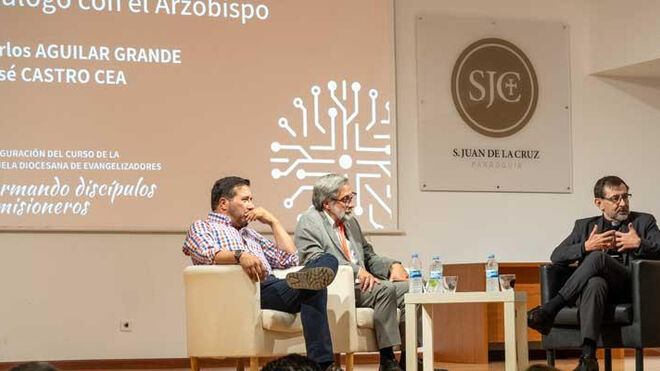
The Archdiocese of Madrid and the Instituto Internacional de Teología a Distancia have not provided a clear response regarding the affiliation of the priest José Castro Cea, the well-known «Josete», with this academic institution. Despite requests from InfoVaticana over the past few days to officially confirm whether the presbyter maintains or not a relationship with the institute—whether as director, teacher, or collaborator—, neither the archbishopric nor the entity has offered transparent information.
The Archdiocese’s communications office has limited itself to invoking a principle of confidentiality, stating that they cannot provide details on the particular situation of priests, religious, or laity who are receiving their due pastoral accompaniment—a topic that is understandable. However, what was requested was not private data, but institutional information: the identity of the institute’s leaders and its organizational structure, data that in any academic and/or ecclesial center are usually public.
A few weeks ago, we already commented that after a year since the controversial video came to light, José Castro maintained his ties with educational institutions responsible for priestly formation, as a professor of social ethics at the Pontifical University of Comillas—a position he left in September 2025—, and of social morality and Social Doctrine of the Church at the San Dámaso Ecclesiastical University—disaffiliated on the same date—.
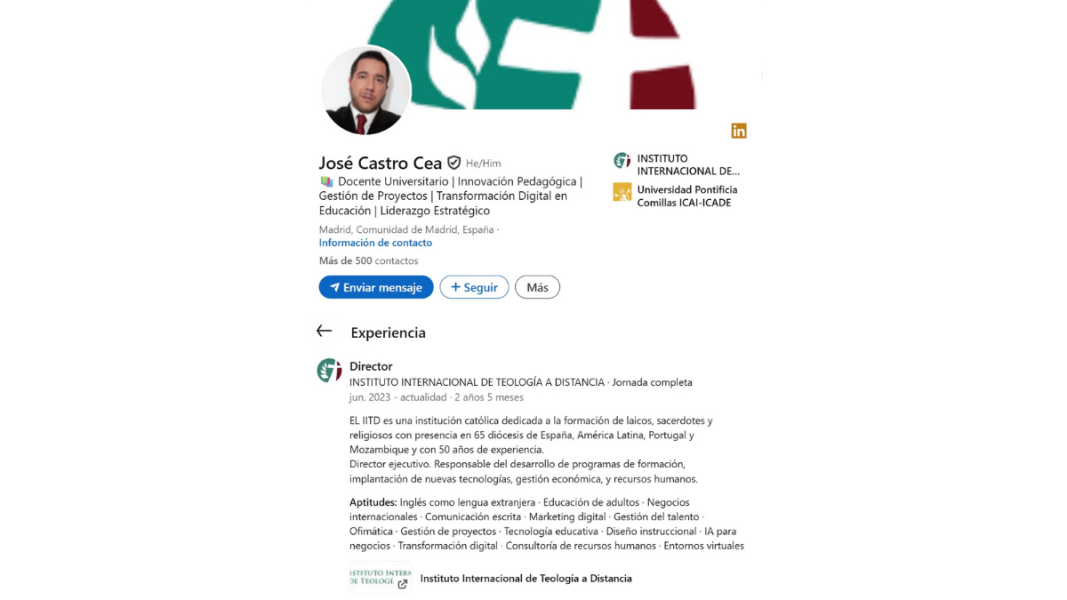
However, while the institutions remain silent, Castro’s own public LinkedIn profile presents him since June 2023 as Director of the International Institute of Distance Theology, a position that remains active to date. On that platform, the priest is listed as “executive director” and responsible for the development of training programs, economic management, and human resources of the institute.
The refusal to officially confirm or deny this information raises questions about the transparency and accountability of an institution that offers theological training to faithful around the world due to its online and international nature. The lack of clarity not only undermines trust in the Institute but also in the Archdiocese of Madrid, led by Cardinal Cobo, who, instead of ensuring light and truth, opts for silence.
While other ecclesial institutions openly publish the names of their executives and teachers, in this case, there is a preference to hide what is evident. A course of action that only fuels suspicion and calls into question the credibility of those who should set an example of transparency.
An institute with international impact
This scandal transcends the borders of a specific diocese. The International Institute of Distance Theology (IITD), with more than half a century of history, presents itself as a reference institution at the service of the Church. Founded in 1970, it has accompanied the formation of laity, religious, seminarians, and Catholic faith educators in different parts of the world, especially in Spain, Portugal, Latin America, and Africa. For more than fifty years, it has offered serious and accessible academic training in distance mode, with the mission of bringing theology to those who, due to various circumstances, cannot pursue in-person studies.
According to the information provided on its own website, its mission is to provide comprehensive theological-pastoral education that is accessible and of quality, recognized for its academic excellence, pedagogical innovation, and, above all, for its fidelity to the Magisterium and ecclesial commitment.
Additionally, the institute claims to maintain collaboration agreements with prestigious universities and the necessary ecclesial backing to ensure the validity and recognition of its programs. Its institutional values include ecclesial fidelity, universality, human closeness, missionary spirit, and ethical responsibility, presenting itself as a work at the service of ongoing formation within the Church.
Keeping a person noted for scandalous conduct at the helm of an institution with this identity and mission is inconsistent with the formative line that the institute itself proclaims. Such a contradiction not only damages its academic and pastoral credibility but also calls into question the seriousness with which the Church accompanies the formation of its faithful.