


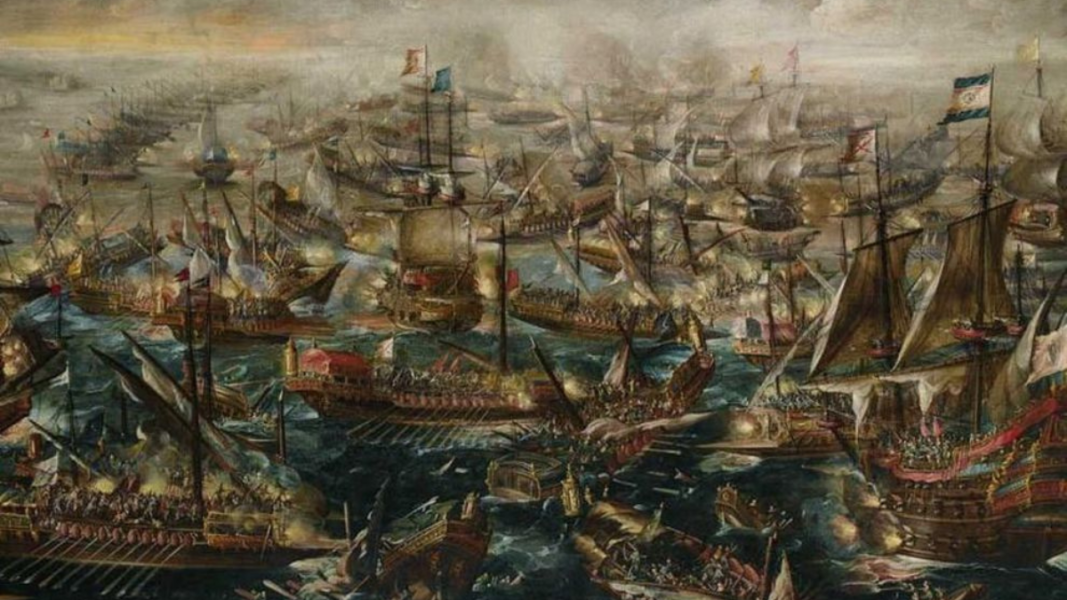
On October 7, 1571, the Christian forces gathered in the Holy League, under the command of Don John of Austria, defeated the Ottoman fleet in the Battle of Lepanto, off the coasts of Greece. It was a decisive victory for Christian Europe, threatened at that time by the Muslim advance in the Mediterranean, and which the Church attributed from the first moment to the intercession of the Most Holy Virgin of the Rosary.
The context: the Ottoman threat
In the 16th century, the Ottoman Empire represented a constant threat to Europe. After conquering Constantinople in 1453 and dominating much of the eastern Mediterranean, its expansion endangered the Italian and Spanish coasts. Pope St. Pius V, aware of the danger, promoted the creation of a great Christian coalition that would unite the Catholic powers. Thus was born the Holy League, formed by Spain, Venice, the Papal States, and other allied forces.
A victory attributed to the Virgin
The battle took place in the Gulf of Patras on October 7, 1571. Despite the Ottoman fleet being numerically superior, the Holy League achieved a crushing victory. That same day, in Rome, Pope St. Pius V called the people to pray the Rosary for the success of Christendom. When he received the news of the triumph, he proclaimed that the victory was due to the intercession of the Virgin Mary. In memory of that event, he instituted the feast of Our Lady of Victories, which shortly afterward would be known as the feast of Our Lady of the Rosary, celebrated to this day every October 7.
Lepanto and the identity of Europe
The battle not only halted the Turkish advance in the Mediterranean but also marked a milestone in Europe’s consciousness: faith, united with the courage of the Christian soldiers, had defended Western civilization against the Islamic threat. Miguel de Cervantes, who participated in the battle and lost the use of his left hand, described Lepanto as “the highest occasion that past centuries have seen, the present ones see, nor do future ones expect to see.”
A lesson for the present
Today, more than 450 years later, Lepanto continues to be remembered not only as a military victory but as a spiritual event: Christendom saved by the prayer of the Rosary. In times when the Catholic faith is besieged by secularization and new forms of cultural and political hostility, the lesson of Lepanto remains relevant: the unity of Christians and trust in the Virgin Mary are the true weapons against any threat.
From John Paul II to Benedict XVI: Lepanto and the Rosary in recent magisterium
St. John Paul II, in his apostolic letter Rosarium Virginis Mariae (2002), expressly recalled the victory of Lepanto as a sign of the power of the Rosary, inviting the faithful to rediscover this prayer as a spiritual weapon against the challenges of modernity. The Polish Pope did not hesitate to affirm that the Rosary is an effective means “to obtain peace in hearts, in families, in nations, and in the world.”
For his part, Benedict XVI, in celebrating the 440th anniversary of Lepanto in 2011, pointed out that devotion to the Rosary remains a school of faith, where the Christian learns to contemplate the face of Christ with Mary’s eyes. For Ratzinger, the memory of Lepanto was not merely a war episode but proof of how common prayer can change history and sustain Europe’s Christian identity.
The Rosary, help of Christians
As St. Pius V recalled when instituting the feast of Our Lady of the Rosary in thanksgiving for Lepanto, Mary always shows herself as the “help of Christians”. With the recitation of the Rosary, the Pontiff said, the Church receives from the Mother of God the necessary support in spiritual and temporal combats. More than four centuries after that victory, Pius V’s exhortation remains alive: returning to the Rosary is returning to the certainty that the Virgin accompanies and protects her people against any threat.