


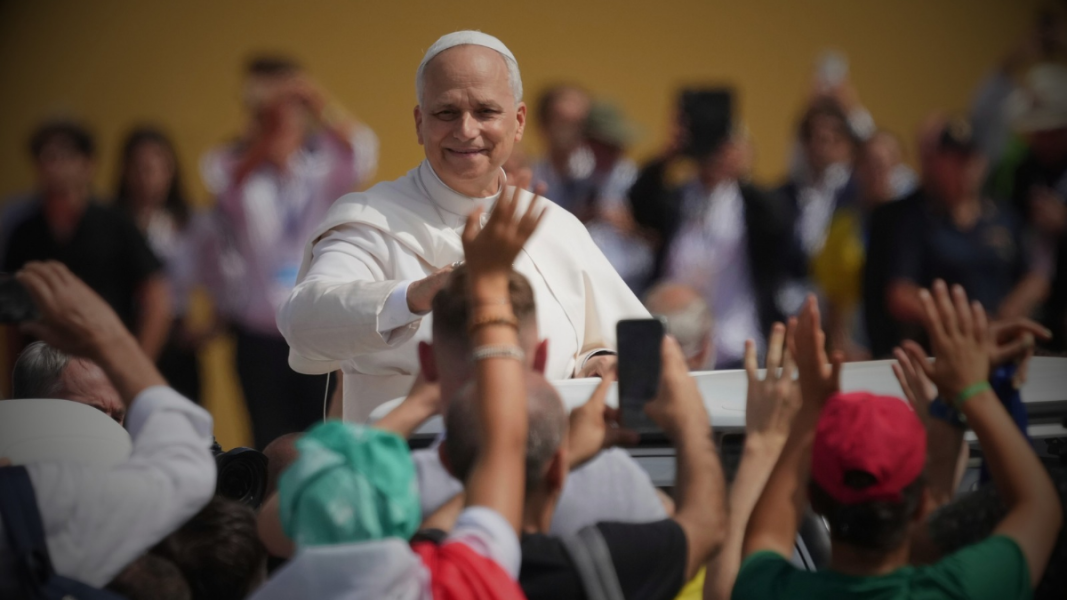
Leo XIV published this Tuesday, October 7, on the memorial of Our Lady of the Rosary, his first message addressed to young people on the occasion of the XL World Youth Day (WYD), which will be celebrated next November 23 on the solemnity of Christ the King. Under the theme taken from the Gospel of Saint John —“You also testify, because you are with me” (Jn 15:27)—, the Pontiff calls on Catholic youth to renew their friendship with Christ and to become missionaries and builders of peace in a society marked by injustice, violence, and secularization.
This World Youth Day is part of the preparation itinerary for the great international WYD gathering in Seoul 2026, which Leo XIV has invited us to look toward as the goal of the journey of faith and mission that now begins.
Message of the Holy Father Leo XIV for the XL World Youth Day 2025
“You also testify, because you are with me” (Jn 15:27)
Dear young people:
At the beginning of this first message that I send you, I wish first of all to say thank you. Thank you for the joy you have transmitted to us by coming to Rome for your Jubilee, and thank you also to all the young people who have joined us in prayer from different parts of the world. It has been a precious event to renew the enthusiasm of faith and share the hope that burns in our hearts. For this reason, let us make the Jubilee encounter not an isolated moment, but rather a step forward in Christian life for each of you and a strong stimulus to persevere in the witness of faith.
Precisely this dynamic is at the center of the next World Youth Day, which we will celebrate on the Sunday of Christ the King, November 23, and which will have as its theme “You also testify, because you are with me” (Jn 15:27). With the strength of the Holy Spirit, as pilgrims of hope, we prepare to become courageous witnesses of Christ. Let us therefore begin, from now on, a journey that will take us to the international edition of the WYD in Seoul, in 2027. In this perspective, I would like to dwell on two aspects of witness: our friendship with Jesus, which we receive from God as a gift; and the commitment of each one in society, as builders of peace.
Friends, therefore, witnesses
Christian witness arises from friendship with the Lord, crucified and risen for the salvation of all. This must not be confused with ideological propaganda, but rather is a true principle of interior transformation and social sensitization. Jesus wanted to call the disciples “friends,” to whom he revealed the Kingdom of God and asked them to remain with him to form his community and send them to proclaim the Gospel (cf. Jn 15:15.27). For this reason, when Jesus tells us: “Testify,” he is assuring us that he considers us his friends. Only he fully knows who we are and why we are here: he knows the heart of each one of you young people, your indignation at discrimination and injustice, your desire for truth and beauty, for joy and peace; with his friendship he listens to you, motivates you, and guides you, calling each one to a new life.
The gaze of Jesus, who always and only wants our good, precedes us (cf. Mk 10:21). He does not want us as servants, nor as “activists” of a party; he calls us to be with him as friends, so that our life may be renewed. And witness arises spontaneously from the joyful novelty of this friendship. It is a unique friendship, which gives us communion with God; a faithful friendship, which makes us discover our dignity and that of others; an eternal friendship, which not even death can destroy, because it has its origin in the Risen Crucified One.
Let us think of the message that the apostle John leaves us at the end of the fourth Gospel: “This same disciple is the one who gives testimony to these things and the one who wrote them, and we know that his testimony is true” (Jn 21:24). The entire previous account is summarized as a “testimony,” full of gratitude and wonder, on the part of a disciple who never says his own name, but defines himself as “the disciple whom Jesus loved.” This appellation is the reflection of a relationship: it is not the name of an individual, but the witness of a personal bond with Christ. This is what really matters to John: to be a disciple of the Lord and to feel loved by him. We then understand that Christian witness is the fruit of the relationship of faith and love with Jesus, in whom we find the salvation of our life. What the apostle John writes also applies to you, dear young people. Christ invites you to follow him and to sit at his side, to listen to his heart and share his life closely. Each one of you is for him a “beloved disciple,” and from this love arises the joy of witness.
Another courageous witness of the Gospel is Jesus’ precursor, John the Baptist, who gave “testimony to the light, so that all might believe through him” (Jn 1:7). Although he enjoyed great fame among the people, he knew well that he was only a “voice” pointing to the Savior: “This is the Lamb of God” (Jn 1:36). His example reminds us that the true witness does not aim to occupy the center of the stage, does not seek followers who join him. The true witness is humble and inwardly free, above all from himself, that is, from the pretense of being the center of attention. For this reason, he is free to listen, to interpret, and also to tell the truth to all, even before the powerful. From John the Baptist we learn that Christian witness is not a proclamation of ourselves and does not celebrate our spiritual, intellectual, or moral capacities. True witness is to recognize and show Jesus, the only one who saves us, when he manifests himself. John recognized him among sinners, immersed in common humanity. For this reason, Pope Francis insisted so much on this: if we do not go out from ourselves and our comfort zones, if we do not go out to meet the poor and those who feel excluded from the Kingdom of God, we do not encounter Christ nor give witness to him; we lose the sweet joy of being evangelized and of evangelizing.
Dear brothers and sisters, I invite each one of you to continue seeking the friends and witnesses of Jesus in the Bible. When reading the Gospels, you will realize that all of them found in the living relationship with Christ the true meaning of life. In fact, our deepest questions are not heard nor do they find an answer in the infinite scrolling of the mobile screen, which captures attention leaving the mind fatigued and the heart empty. They do not take us far if we keep them locked up in ourselves or in too narrow circles. The fulfillment of our authentic desires always passes through going out from ourselves.
Witnesses, therefore, missionaries
In this way, you, young people, with the help of the Holy Spirit, can become missionaries of Christ in the world. Many of your peers are exposed to violence, forced to use weapons, compelled to separate from their loved ones, to migrate and flee. Many lack education and other essential goods. All share with you the search for meaning and the insecurity that accompanies it, the discomfort from growing social or work pressures, the difficulty of facing family crises, the painful sensation of lack of opportunities, the remorse for mistakes committed. You yourselves can stand beside other young people, walk with them, and show them that God, in Jesus, has drawn near to every person. As Pope Francis used to say: “Christ shows that God is nearness, compassion, and tenderness” (Encyclical Letter Dilexit nos, 35).
It is true, it is not always easy to give witness. In the Gospels we often find the tension between the welcome and the rejection of Jesus, “the light shines in the darkness, and the darkness did not overcome it” (Jn 1:5). Similarly, the disciple-witness experiences rejection firsthand and, at times, even violent opposition. The Lord does not hide this painful reality, “if they persecuted me, they will also persecute you” (Jn 15:20). However, precisely this becomes the occasion to put into practice the highest commandment, “love your enemies, pray for your persecutors” (Mt 5:44). This is what the martyrs have done from the beginnings of the Church.
Dear young people, this is not a story that belongs only to the past. Even today, in many places in the world, Christians and people of good will suffer because of persecution, lies, and violence. Perhaps you too have been touched by this painful experience and perhaps have been tempted to react instinctively by stooping to the level of those who have rejected you, adopting aggressive attitudes. Let us remember, however, the wise advice of Saint Paul: “Do not be overcome by evil. On the contrary, overcome evil with good” (Rm 12:21).
Therefore, do not be discouraged; like the saints, you too are called to persevere with hope, especially in the face of difficulties and obstacles.
Fraternity as a bond of peace
From friendship with Christ, which is the gift of the Holy Spirit in us, arises a way of living that carries with it the character of fraternity. A young person who has found Christ carries with him or her everywhere the “warmth” and “flavor” of fraternity, and anyone who comes into contact with him or her feels attracted by a new and profound dimension, made of disinterested closeness, sincere compassion, and faithful tenderness. The Holy Spirit makes us see our neighbor with new eyes, there is a brother, a sister in the other!
The witness of fraternity and peace that friendship with Christ arouses in us frees us from indifference and spiritual laziness, making us overcome isolation and distrust. Moreover, it unites us to one another, impelling us to commit ourselves, from volunteering to political charity, to build new living conditions for all. Do not follow those who use the words of faith to divide; organize yourselves, instead, to eliminate inequalities and reconcile polarized and oppressed communities. For this reason, dear friends, let us listen to the voice of God in us and overcome our selfishness, becoming industrious artisans of peace. Then that peace, which is the gift of the Risen Lord (cf. Jn 20:19), will become visible in the world through the common witness of those who carry his Spirit in their hearts.
Dear young people, in the face of the sufferings and hopes of the world, let us fix our gaze on Jesus. While he was agonizing on the cross, he entrusted the Virgin Mary as mother to John, and to her John as son. That last gift of love is for every disciple, for all of us. I therefore invite you to welcome this holy bond with Mary, Mother full of affection and understanding, cultivating it especially with the prayer of the rosary. Thus, in every situation of life, we will experience that we are never alone, but always beloved children, forgiven and encouraged by God. Of all this, give witness with joy!
Vatican, October 7, 2025, Memorial of the Blessed Virgin Mary of the Rosary.
LEO PP. XIV