


By: Yousef Altaji Narbón
When a torrent of water breaks open and comes with impetuous force, the task of closing it or managing it becomes difficult due to the pressure it exerts against any obstacle or gate. The quantity of initiatives, groups, movements, ideas, and trends currently present within the Holy Mother Church could be a sign of restoration and supposed fruits when in reality they are the proliferation of novelties without filter or restriction that plague the horizon of the pious layperson. More and more, this torrent of groups without foundation in the Church’s tradition, unvetted initiatives, charisms with little solid support, are the ones setting the pace in diocesan structures because they are usually youthful in tone, innovative, of the times, and with apparent ease in attracting the lukewarm back to the Church. This is not only rooted in lay and consecrated religious groups but also in ideas, trends, and concepts foreign to the perennial doctrine of the Deposit of Faith. To what exact point must the yes recurrent to these things be curbed to give the firm negative, based on love for the faith?
Permissibility yes, exclusion never
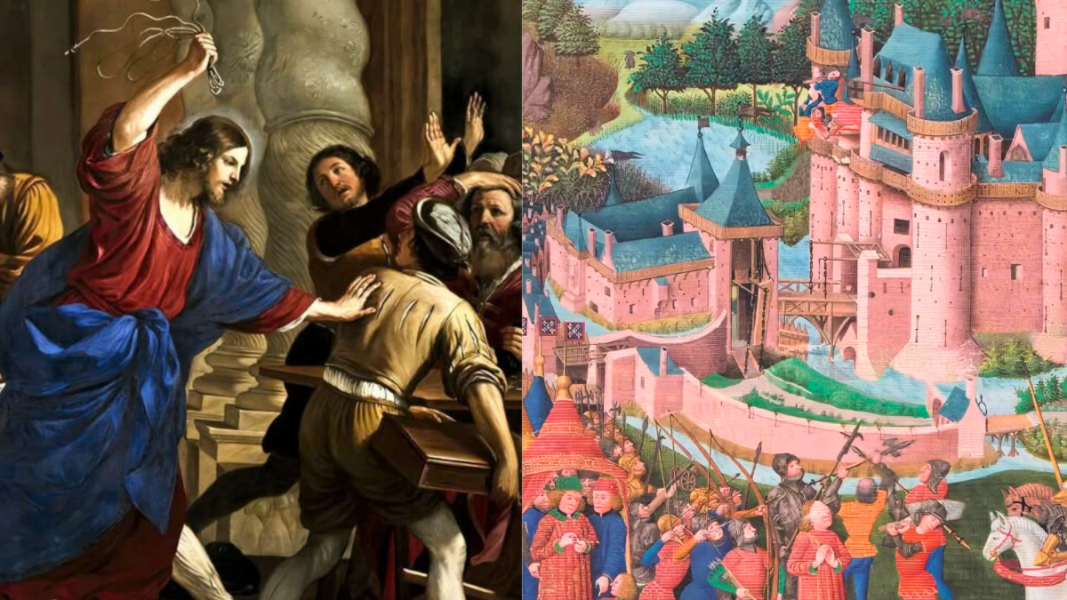
In recent decades, this spirit of openness to the liberal and secularized world, under the pretext of a listening to the people, propelled by ecclesiastical authorities, has led to the action of allowing the creation of groups or carrying out events where what is taught by the Magisterium of the Church is flagrantly injured, even where exactly what is prohibited by the paternal wisdom of the Mystical Body of Christ is done. Ideas and concepts have free rein as long as they appear or smell slightly Christian or baptized with mere brushstrokes of something Catholic to try to pass through the door of acceptance within the Church. For centuries, the warnings and admonitions of the Roman Pontiffs, together with the help of the saints, resounded throughout the Christian world, similar to the orders of a guard commander centered in the heart of the fortress who issues his directives of protection and these echo through the entire outer wall. These guidelines to defend the integrity of the city of faith severely warned against the permissiveness that today has become the governing principle toward mysterious visitors announcing themselves at the main gate, waiting to be admitted to the precious city.
This venerable city went from being careful out of love for its citizens to being anything but closed toward visitors called “idea, group, event, initiative” seeking to be admitted within its walls to carry out hostile actions against the native inhabitants. The revolutionary world has demonized concepts/principles like exclusion, division, denial, intolerance to the point of being seen as utterly boorish. This has influenced the human structure of the Holy Church, causing what is exposed in these paragraphs of an absolute rejection of the concepts of rejection in order to embrace everyone, everyone, everyone.
Samples of this policy
This policy of endless openness to the most worldly possible whims has caused a series of calamities with the false consolation of fulfilling the mission of forced inclusion to cultivate a supposed unity. A demonstration of this way of proceeding was the massive event of Walk on Wonder held in Spain, where little -if anything- of the practices, disciplines, teachings, and decorum faithfully transmitted through the veins of the Church founded by Christ Jesus could be glimpsed in either the message sent or the actions carried out; it is difficult to fit that spectacle as something remotely Catholic. Other varied events of Hakuna style also in Spain have taken high flight in various dioceses with the perfect approval of the competent Ordinaries in each case. In the spirit of finding a place for them to fit into the diocesan structural puzzle, the frivolities promoted by Hakuna are rewarded with all kinds of intra-ecclesial promotion, parishes where they can develop, and resources to operate.
On a longer time scale, we have seen other projects grow to the goal of becoming international, marking the status quo, as is the case with the Charismatic Renewal. From the 1980s onward, this enigmatic movement has expanded and settled within all dioceses worldwide. No mechanism, however light, has been implemented to control the constant wave of contradictory practices habitual within their circles. Just thinking that at first a bishop (to be precise, the Bishop of Pittsburgh) could have prevented the birth of such an organism, but due to his openness to suspicious foreign visitors, the fortified city was ruined.
Observing another time frame, particularly focusing attention on the moment when it can be determined without fear of being wrong when this policy of saying yes to everything begins to be implemented, we encounter the lamentable event of the permission for Communion in the hand. This case is perfect for checking the harmful effects of not saying no. A faulty and deceptive need arises in certain European countries where the bishops requested from Pope Paul VI the dispensation to administer Communion in the hand without any reprisal. This dispensation was granted to them in the spirit of Aggiornamento; attending to the alleged motivations (founded under the shadow of Luther and the machinations of Cranmer), the floodgates of contaminated water were opened for the applicants with the fateful consequence of the paradoxical dispensation spreading to the entire world.
Not going any further, in 2023 the policy of permissibility, zero denial, welcoming everything and everyone, reached its macabre splendor with the unacceptable declaration Fiducia Supplicans. The same scenario repeats: everyone must be brought onto the ship just for the sake of bringing them, sacrificing the most trusting crew members along with the integrity of the vessel. Just the fact that the ecclesiastical hierarchy would even consider such a hypothesis on a matter crystal clear under the lens of infallible doctrine that led to the execrable outcome of the publication of the present declaration is only palpable evidence of how far they are willing to go just to never say no. They are willing to sacrifice Catholic morality to fit what, evidently, by the sensus fidei, one can realize is positively impossible to do, no matter how many mental gymnastics are performed to try to give the impression of licitness.
The logic and process of weighing
These situations involve a supposed analysis process along with a weighing process replicated in almost all scenarios; all of this being a vile pantomime to give the impression of due diligence on the part of the custodian of the city. It usually goes like this: An idea or initiative is presented in writing (although in many cases it is a summary procedure of mere face-to-face word exchange) with all the sweet and trendy words to emphasize the spirit of the times. The proposal is sold as something youthful, updated, with spirituality adapted to all, coupled with hundreds of possible marketing adornments. Whether the proposal is an event, the creation of a group, the introduction of a novel trend, everything goes through the same fictitious process to deceive the most lukewarm.
The person in charge of giving approval finds himself in the position of issuing his opinion of approval or rejection; precisely at that moment the tsunami of quasi-principles devoid of all logic or backed by a hair of the bimillennial magisterium is unleashed. Overheated cliché phrases to the extreme of being governing norms like: “we must see the good…we must see their intentions, which are surely good…they are young ideas, they must be good…we need to be prudent and charitable, we will be judged by how much we love (this emptying of its authentic meaning)…we cannot be rigid toward people, much less against those who think differently from us… maybe they see something we don’t and that must be from God…truth depends on who defends it and how much they believe it as such…God is present everywhere…God is love, love, and only love, nothing more…”. Upon concluding by bringing these fallacious maxims to memory, coupled with letting oneself be carried away by smiles, do-goodism, and all possible human respect, the order emerges to open the doors of the city to the semi-disguised enemy to give it the opportunity to settle with aims of operating freely.
This is the process -sometimes summary, sometimes prolonged by other factors- that occurs to approve projects and admit potentially harmful ideas in Catholic environments. Through this openness emanating from a rigged logic, the open question of the presumably inexplicable existence of Modernism, Liberalism, Hakuna, Charismatic Renewal, Taizé, massive events where immodesty and patent indecency proliferate, diocesan assemblies full of Pentecostal spirituality, etc., is answered.
The Catholic stance
The difference between cold and heat, moon and sun, water and fire, so abysmal is the separation between the imprudent policy in force and the Catholic stance toward proposals to be considered. The premises used by the Church through the centuries come from supreme biblical principles concerning the due care of the Christian flock. It is from a burning love that the unavoidable commitment to defend against every deceitful, disguised or notorious invader the prosperous inhabitants of the city is born. We have models worthy of obedient imitation, starting with Cardinal Pie of Poitiers; in his magnificent sermon called “Doctrinal Intolerance” he taxatively stipulates: “It is of the essence of all truth not to tolerate the contradictory principle.”, in another section he proclaims an incomparable truth saying “Amid this confusion of ideas and false opinions, it is up to us, priests of the incorruptible truth, to step forward and censure with action and word, satisfied if the rigid inflexibility of our teaching can stem the overflow of lies, dethrone erroneous principles that proudly reign in minds, correct deadly axioms already admitted by the validation of time, finally clarify and purify a society that threatens to sink, that ages in a chaos of darkness and disorders, where it will no longer be possible to distinguish the nature and, even less, the remedy for its evils.”. As if that were not enough, the following excerpt is so clear that it destroys any senile argument in favor of tolerance and affirmative spirit toward novelty: “We are told of the tolerance of the early centuries, of the tolerance of the Apostles. My brothers, don’t even think about it! On the contrary, the establishment of the Christian religion has been par excellence a work of religious intolerance.”.
The renowned son of Saint Dominic of Guzmán, Father Reginald Garrigou-Lagrange, recounts the paternal stance of the Church with the following words: “The Church is intolerant in principles because she believes; she is tolerant in practice because she loves. The enemies of the Church are tolerant in principles because they do not believe and are intolerant in practice because they do not love”. Another reference in the present matter of discussion is the Bishop of Pasto, Saint Ezekiel Moreno, with prophetic words he warns of a frightening reality: “It is not strange that we are on the edge of the precipice, and already falling into it. That is where the compromises, tolerances, and cowardices lead us. If we continue like this; (…) if the tolerances do not cease and, above all, the considerations so worthy of reprobation that are held toward the enemies of Jesus Christ and his reign, it is possible that the day is not far off when one will have to say: here there were Catholics!…”. The prudent Prelate, with the parrhesia demanded of a shepherd of souls, particularly touches on the matter at hand: “…prudence is not hiding the truth just to avoid stirring up the hatred of the partisans of error (…). Would it be prudence of a shepherd who, to avoid displeasing a wolf, lets it enter the flock? This kind of senseless prudence God sometimes tolerates, but does not bless; many wise men of the world bless it, but God reproves it”.
To the letter no!
The results speak for themselves, the consequences are clear, the numbers do not lie. The effects of the yes propelled by human respects and false premises have generated an uncontrollable but deliberate migration of all kinds of banal heterodoxies painted with a cheap tint of forced Christian elements. No, friends, not every idea, no matter how good the intention behind it, becomes acceptable. The criterion consolidated to date undermines the faith of those who do their best to survive the gigantic soul-consuming crisis of the contemporary era. It is out of love that evil is rejected; it is out of love that what has minimal traits of evil or doubt is not admitted; it is out of love when the door of the house is locked with scruple toward unknown visitors waiting to be admitted into the home precinct. It is foolish to let oneself be carried away by mere smiles, nice words, good treatment, and, in particular, a human respect ingrained in the soul of modern man, aspiring to erase every stain or grave flaw from everything placed on the table.
To reject outright, to simply say no, is the duty of those with the symbol of friends of incorrupt truth. To put a high stop to unlimited acceptance has long shown the worthy path to retake. That monomaniacal behavior of finding a place for the most arbitrary element/idea that presents itself at the door is proper to those seduced by the secular world, since it does not conceive the remote backward mentality -they say- of building walls to safeguard, but of building endless bridges in sight. The yes yes yes coming from flabbiness in critical formation has undermined the no defensive accustomed to good family fathers willing to give everything to protect their family from the intoxications of half-measures. To put it colloquially to reinforce everything explained in the present writing: Why accept something that has one or five percent apparently good when the other ninety-nine or ninety-five is leagues away harmful? Why can’t one simply say no?
We close with the wisdom of the renowned Catalan priest Father Félix Sardá y Salvany in his book “Liberalism is a Sin”, from which it is never too much to highlight the binding character of reading such an exposition of Catholic integrity, on page 82 (seventh edition) proclaims these letters full of apostolic zeal: “The sum Catholic intransigence is the sum Catholic charity. It is so toward the neighbor for his own good, when for his own good it confounds and shames and offends and punishes him. It is so toward the good of others, when to free neighbors from the contagion of an error it unmasks its authors and promoters, calls them by their true names of bad and wicked, makes them abominable and despicable as they should be, denounces them to common execration, and if possible, to the zeal of the social force charged with repressing and punishing them. It is, finally, so toward God when for his glory and service it is necessary to dispense with all considerations, jump all fences, hurt all respects, wound all interests, expose one’s own life and that of those necessary for such a high end.”.