


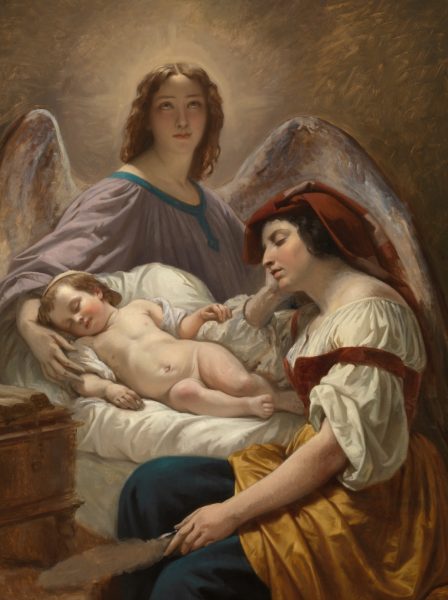
By Stephen P. White
“Angel of God, my sweet companion, do not forsake me neither by night nor by day. Guard me while I rest, do not leave me alone, for I am your child.” Amen.
I don’t know how many times in my life I have prayed these words. Undoubtedly, many thousands. It was one of the first prayers I learned, part of the nighttime routine of my childhood, and I myself have taught it to my children when praying the bedtime prayers. It is not just a prayer for going to bed, of course, and it is fitting to repeat it frequently at any hour of the day or night. If any additional incentive were needed, the pious recitation of this venerable prayer carries a partial indulgence.
The prayer itself is surprisingly ancient, originating at least in the 11th or 12th centuries. The veneration of angels, of course, is much older, as even a superficial reading of both the Old and New Testaments shows. The particular devotion to guardian angels, whose feast we celebrate today (October 2), dates back to the early centuries of the Church. St. Basil the Great taught in the 4th century that “each of the faithful has a guardian angel who protects, guards, and guides him throughout his life.”
Pope St. John XXIII (whose devotion to angels may have had something to do with his baptismal name, Angelo) exhorted the faithful to pray often to their guardian angels. “Each of us is entrusted to the care of an angel,” he said, “That is why we must have a lively and profound devotion to our guardian angel, and we must repeat frequently and confidently the beloved prayer that we learned in the days of our childhood.”
For many of us, the Guardian Angel Prayer is so closely associated with childhood that it is sometimes easy to associate devotion to angels with childishness, an error all the more common because of the saccharine images of guardian angels that are often found in Catholic kitsch. But guardian angels are not the spiritual equivalent of Lassie.
The Catechism reminds us, quoting St. Augustine, that: “Angel is the name of their office, not of their nature. If you seek the name of their nature, it is ‘spirit’; if you seek the name of their office, it is ‘angel’: by what they are, ‘spirits’; by what they do, ‘angels.’” In Greek, angel means messenger.
The center of the angelic world, this world of serving spirits and messengers, is none other than Christ himself, because, as the Catechism continues, “They are his angels… They belong to him because they were created through him and for him.”
Immortal beings, pure intellect and will, who eternally contemplate the face of the Father (Mt 18:10) and who serve Christ the Lord perfectly should not be taken lightly. That is, real guardian angels are not at all like the bumbling—though endearing—Clarence from It’s a Wonderful Life. They are creatures, yes, but not bumbling and not human.
Not human, and also superior to humans. Translations of Psalm 8 differ, but the author of the Letter to the Hebrews quotes the psalm this way: “What is man that you are mindful of him, or the son of man that you care for him? You made him for a little while lower than the angels.” (emphasis added).
St. Thomas Aquinas wondered if angels are more the image of God than man, to which he replied: “We must admit that, absolutely speaking, angels are more the image of God than man, but that in certain respects man is more like God.”
The mystery of the Incarnation sheds full light on the implication of the Imago Dei in the human creature, but the magnificence of the angels, in their closeness to the Most Holy Trinity, remains intact.
The Church explicitly warns against a childish view of angels. In an interesting (though little-read) document from the then Congregation for Divine Worship and the Discipline of the Sacraments, the faithful are warned against certain “deviations” in popular piety regarding angels. One of those deviations occurs:
when the daily events of life, which have little or nothing to do with our progress on the path to Christ, are interpreted schematically or simplistically, even in a childish way, attributing all failures to the Devil and all successes to guardian angels. The practice of assigning names to holy angels should be discouraged, except in the cases of Gabriel, Raphael, and Michael, whose names are contained in Sacred Scripture.
Our guardian angels serve and protect us, not because we are their masters, but because the Lord commands them to do so. Certainly we must not assign them names—with the exceptions mentioned—as if they were pets or imaginary friends.
Another deviation against which the Church warns occurs:
when, as sometimes happens, the faithful allow themselves to be carried away by the idea that the world is subject to demiurgic struggles, or to an incessant battle between good and evil spirits, or between angels and demons, in which man is at the mercy of superior forces and is helpless before them; such cosmologies have little relation to the true evangelical vision of the struggle to overcome the Devil, which requires moral commitment, a fundamental option for the Gospel, humility, and prayer.
The spiritual combat is real, without a doubt. But we are not helpless semi-spectators caught in a struggle that is beyond our power to participate.
We must never take lightly the inestimable value of having been placed under the protection and personal guidance of so powerful a helper and guide as our guardian angels. In them we find a consolation that reminds us of God’s love for us, a sober warning about the seriousness of the spiritual life, and a magnificent reminder of the glory of the Creator, which shines forth in the manifold goodness of all creation—visible and invisible alike.
About the author
Stephen P. White is executive director of The Catholic Project at The Catholic University of America and a fellow in Catholic Studies at the Ethics and Public Policy Center.