


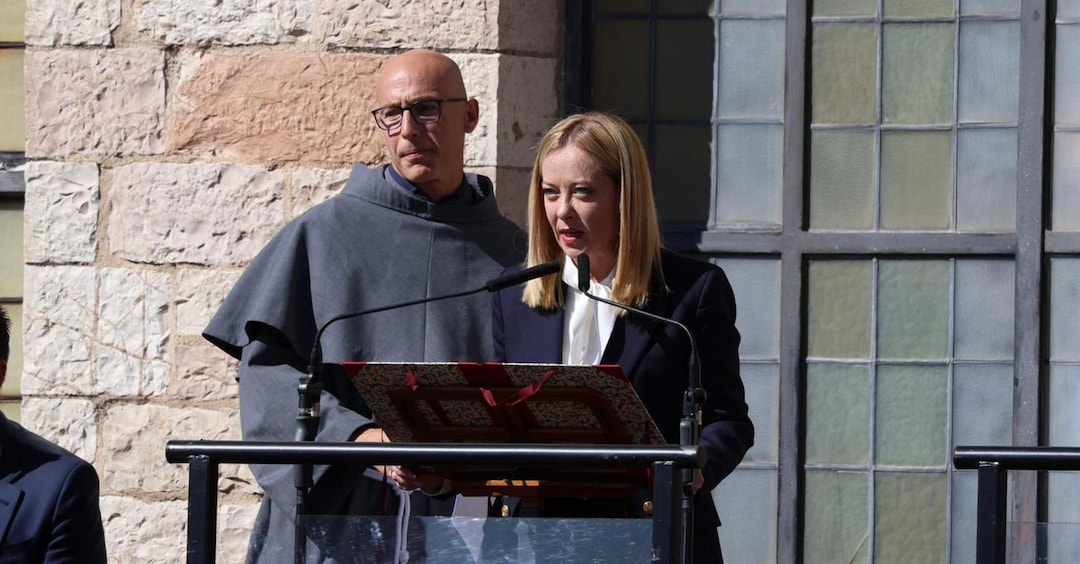
The President of the Council of Ministers of Italy, Giorgia Meloni, participated in the ceremony of the feast of Saint Francis of Assisi, patron saint of Italy, where she delivered a speech with a spiritual and patriotic tone in which she reclaimed the figure of the saint as a symbol of national identity, dialogue, and peace. Below is the full text translated into Spanish.
Giorgia Meloni’s Speech on the Feast of Saint Francis
So, good morning to everyone.
I greet, I greet Your Eminences, Cardinal Artime, Cardinal Simoni. I recall that Saint Francis also taught respect: respect in listening, respect in understanding one another, respect in understanding the reasons of others.
I greet Monsignor Sorrentino, I greet Monsignor Cibotti, Friar Trovarelli, the general and provincial ministers of the Franciscan families, the custodian of the Sacred Convent of Assisi, Friar Marco Moroni, President Proietti, President Marsilio, Mayor Stoppini, Mayor Biondi, all the mayors, the authorities present, and the many people I see in this square. In my life, I have been to Assisi on several occasions, but this is the first time I have participated in the celebrations of Saint Francis as the patron saint of Italy, and it is undoubtedly an honor for me; but above all, it is a great emotion, because I know how deeply rooted this commemoration is in the heart of the Italian people.
A strong, authentic, visceral devotion, which is clearly seen in the faces of so many people, of the faithful who are here today; which becomes solemn in the banners raised in this square; which shines in the light of the votive lamp that was lit a short while ago in the basilica; which burns thanks to the oil donated by Abruzzo on behalf of all the municipalities of Italy.
Today, the Italian people turn their gaze here, to the Little Poor Man of Assisi, the kindest, the most poetic, the most Italian of our saints, as defined by a philosopher and patriot like Vincenzo Gioberti. Because Saint Francis is one of the foundational figures of Italian identity—perhaps the principal one: he wrote the oldest poetic text in our literature, the Canticle of the Creatures, and those verses opened the path that guided Dante, Petrarch, Boccaccio; a path that made our language great and known throughout the world. A cultural mission that even today reveals its strength, its uniqueness.
Saint Francis left his indelible mark on art, poetry, theater, culture, science, and his spirituality has attracted and fascinated generations of Italians, inspiring some of the greatest men of whom our nation can be proud.
They were Franciscan tertiaries: Giotto, Alessandro Manzoni, Christopher Columbus, Alessandro Volta, and so many others alongside them. Saint Francis embodied the sum of that genius that makes our people a unicum admired and appreciated in the world. In the heart of the rock, he gave origin to the nativity scene: the sweetest and deepest universal representation of a God who became a Child and came into the world, into the world, to teach men what men had not known before Him: forgiveness, and even love for the enemy.
However, Saint Francis was not a dreaming troubadour, but a man of action, quick almost to the point of being precipitate in the tasks he undertook or the commitments he made. He did not love half-measures, half-truths, subterfuges. He was demanding, as saints are: men and women as normal as they are radical in the value of their choices. Saint Francis was an extreme man, but not an extremist. He gave the example of poverty, but not of misery, which he and his brothers always fought against.
And in the name of that poverty, he reminded us all that, in the end, nothing is truly ours: neither our children, nor the people we love, nor our goods, nor our body; everything is a gift. The precious inheritance of a God who loves us in our imperfection.
He reminded man that he is the custodian of creation and that life, in all its forms, is entrusted in a special way to the responsibility and care of men. Because, as Pope Leo recently reminded us, we are nothing other than solicitous administrators of that house, so that no one irresponsibly destroys the natural goods that speak of the goodness and beauty of the Creator, nor much less submits to them as a slave or worshiper of nature.
In the letter to the rulers of the peoples, Saint Francis exhorts those who have governmental responsibilities not to measure themselves only by consensus, but to take into account, in their actions, the broader horizon of meaning. It is an invitation that shakes and unsettles; that does not give political indications, but stirs hearts and leaves no one indifferent.
Saint Francis was a man of peace, of dialogue, of encounter. He aroused peace within and beyond the confines of Assisi, carrying his message where no one else had dared. Unarmed with anything except his faith and his meekness, he did not hesitate to risk his own life in order to meet the sultan and promote with him that dialogue in truth and mutual respect that even today represents a model. Because Saint Francis teaches us that we must try to speak with everyone, even with those who may seem like adversaries or even enemies. Where dialogue ends and the patience of the relationship with those who are different, whom you do not like or who do not think like you, runs out, there the seed of violence germinates and the virus of war spreads. A message that is fully relevant today.
Saint Francis lived in stormy times, as stormy as ours. The third world war fought «in pieces,» evoked by Pope Francis, is being consumed in a frightening way. There are 56 ongoing conflicts in the world, the highest number since the end of World War II. Peace, dialogue, diplomacy seem no longer able to convince and prevail, and the use of force prevails on too many occasions, replacing the force of law.
And yet, this scenario, apparently dark and irreversible, cannot and must not push us to surrender, to give up, that is, to the idea that there is no other option but war. Only that peace—as Saint Francis always reminds us—does not materialize when it is invoked, but when it is built with commitment, patience, courage: it is reached by laying one brick after another, with the strength of responsibility and the effectiveness of reasonableness.
This is what we hope is happening in these hours in Palestine, in that land that Saint Francis wanted to know and that marked him deeply. The American peace plan, already approved by Israel, shared by European States, by many Islamic States, by the Palestinian National Authority, thanks to the mediation of some Arab countries—particularly Qatar, to whom I believe we all must be grateful—could also be accepted by Hamas. This would mean finally returning to peace in the Middle East, seeing the sufferings of the Palestinian civilian population cease, seeing the release of the Israeli hostages held for already two very long years. A light of peace tears through the darkness of war, and we all have the duty to do everything in our power so that this precious and fragile opportunity succeeds.
And I am proud of the contribution to dialogue that Italy has been able to make: in the front line in humanitarian support to the Palestinian population and, at the same time, a credible interlocutor for all the actors involved, without falling into the trap of frontal confrontation that many invoked—often more out of interest than conviction. This is the vision that has always characterized Italy’s identity, its action on the global stage, and that allows us to be recognized as privileged interlocutors and builders of peace, humanity, solidarity. It is our tradition and the furrow in which this Government also operates.
Saint Francis was a bridge between West and East, a man who, by making himself small, called everyone to true greatness. Assisi, Umbria, and the Italy that today gathers in his name offer the truest image of what we are: men and women endowed with two sources of knowledge and love, reason and faith. Because, if you do not know who you are, you cannot contribute anything to the dialogue between cultures. If you do not know or recognize yourself, you cannot love the other nor can you make yourself loved. This is the culture of respect in which we believe and which we continue to promote.
It is all these teachings—and many others that could be cited—that have made Saint Francis that explosion of life that led the Italians to choose him as their patron.
A year ago, from this loggia, a free and powerless poet—as he himself defined—made a lyrical and powerful appeal, as is his wonderful style. Davide Rondoni asked politics to reflect on the figure of Saint Francis, to recover his deepest meaning, to reintroduce October 4 into the list of national holidays; and, as you know, that appeal did not fall on deaf ears. As had not happened for a long time, the words of a poet resonated in Parliament, and Parliament transformed those words into a law of the State. The legislator chose to return to Saint Francis his heritage, his message, his charisma in the public and civil dimension of this nation. Not a whim or even a waste of money—as some claimed—but a choice of identity, an act of love for Italy and its people.
And to me, personally… to me, personally, I like to see that vote of Parliament as a homage also to the first pontiff who chose the name of Francis in the year in which he has returned to the Father’s house.
Next year, we will not only celebrate October 4 as a national holiday, but we will also celebrate the eighth centenary of the birth into heaven, the birth into heaven of the Little Poor Man of Assisi. We will do so being able to count on the valuable work elaborated by the National Committee for the celebrations, also with the support of the Government, and we have worked to build innovative initiatives capable of leaving lasting traces over time.
Among all, the project to digitize the library of the Sacred Convent; the dedication to Saint Francis of the new Ponte dell’Industria in Rome; the activities aimed at the youngest that will be carried out in Egypt and other African nations within the framework of the Mattei Plan; up to the involvement of the network of cultural institutes abroad, to make our saint even better known in the world.
Dear friends, today we celebrate a man who left everything to find everything. A saint who taught the world the joyful simplicity of love. An Italian who forged the identity of an entire people. But we do not do it because he needs us; we do it because it is we who need him. May Saint Francis help our Italy.