


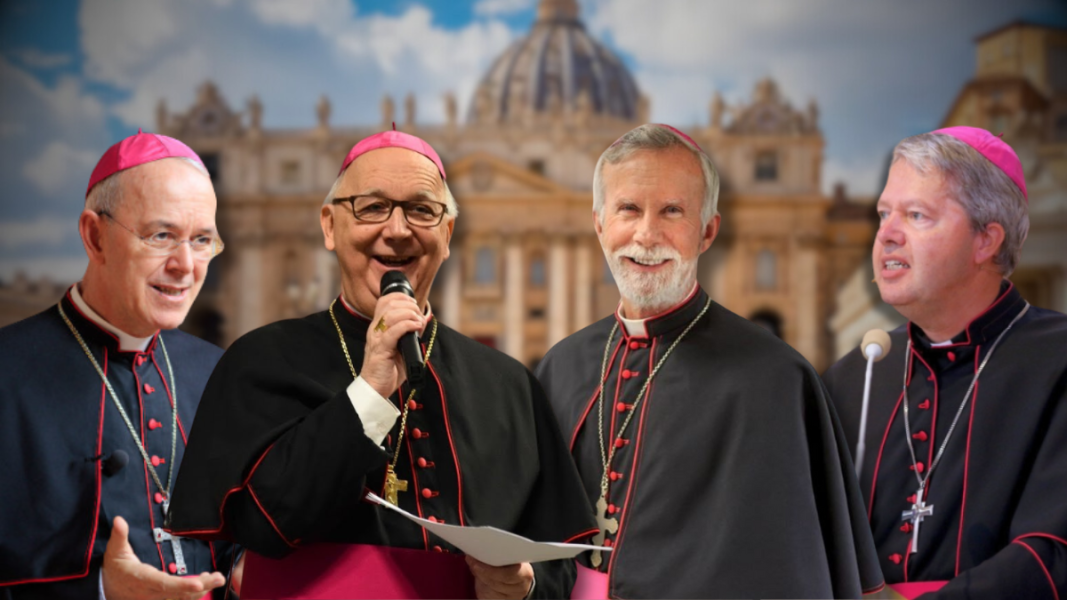
Four Catholic bishops will lead this Saturday a global act of reparation following the entry of a thousand LGBT activists into St. Peter’s Basilica on September 6, as part of a jubilee pilgrimage. The event will take place during the Catholic Identity Conference, which will be held from October 3 to 5 in Pittsburgh (United States), and will be broadcast live.
The Act of Reparation
According to Edward Pentin, journalist and speaker at the conference, the “Global Act of Reparation for the ‘Abomination of Desolation LGBTQ+ in St. Peter’s’” will include specific prayers of reparation and will be followed by the recitation of the Holy Rosary. It will be led by Monsignor Athanasius Schneider, auxiliary bishop of Astana (Kazakhstan); Monsignor Marian Eleganti, emeritus auxiliary bishop of Chur (Switzerland); Monsignor Robert Mutsaerts, auxiliary bishop of ’s-Hertogenbosch (Netherlands); and Monsignor Joseph Strickland, emeritus bishop of Tyler (United States).
An act of reparation is a prayer, devotion, or action intended to offer spiritual compensation for grave offenses against the sacred. In this case, the goal is to restore respect and reverence toward St. Peter’s Basilica.
The LGBT Pilgrimage in St. Peter’s
On September 6, nearly 1,000 LGBT activists identifying as “Catholics” participated in a jubilee event, crossing the Holy Door of the basilica. They carried crosses with rainbow colors, clothing with slogans and advocacy symbols, and presented themselves as a group promoting the recognition of “homosexual rights” in the Church.
The event was listed in the official Jubilee calendar, with prior knowledge of the Vatican organizers. Despite the controversy generated, the Holy See has not issued public statements nor responded to requests to reconsecrate the temple.
Reactions from Bishops and Experts
In an interview on September 10, Monsignor Schneider described what happened as an “unprecedented act” and referred to it in Gospel terms as an “abomination of desolation in the holy place.” The prelate noted that the organizers and participants showed no signs of repentance and that passing through the Holy Door under those conditions constituted “a kind of profanation.”
Professor John Rist, an expert on St. Augustine, recalled that the saint repeatedly condemned “the sin of Sodom as an abomination” and opined that he would have considered what occurred as a betrayal of Christ.