


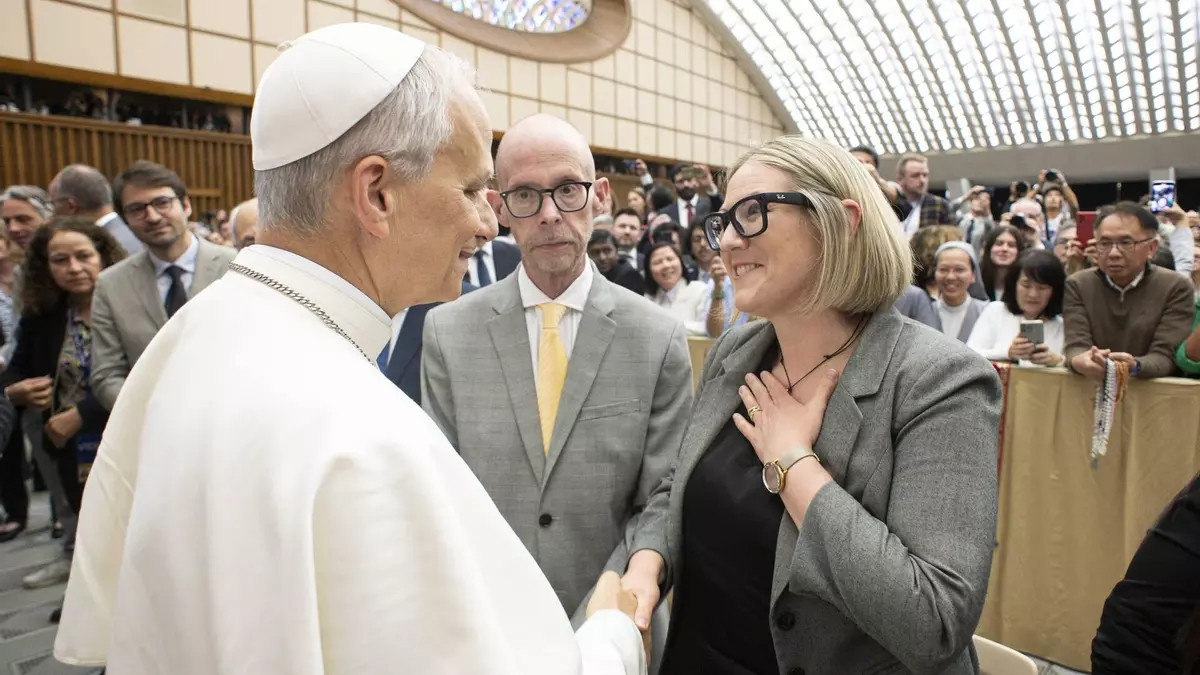
The American journalist Elise Ann Allen, Rome correspondent for Crux and author of the book-interview León XIV. Ciudadano del mundo, misionero del siglo XXI (Debate), has granted an interview today to Religión en Libertad to present the work in which the Pope participates as the main interlocutor. In it, Allen has once again emphasized several times a concept that had already sparked debate: the “for the moment” with which the Pope referred to the Church’s teaching on controversial issues such as the ordination of women or sexual morality.
A Pope without labels, according to Allen
Allen rejects attempts to pigeonhole León XIV as a “second Francis” or as a “traditionalist hero.” She states that the new Pontiff wants to continue Francis’s legacy on issues such as synodality, social justice, or care for creation, while opening new priorities in areas such as artificial intelligence and the search for unity in a context of ecclesial and political polarization.
The key to “for the moment”
One of the central points of the interview is the doctrinal question. Allen conveys that the Pope has no intention of modifying the Church’s teaching “in the short term,” but insists that this decision must be understood through the lens of “for the moment”.
Thus, regarding the female diaconate, she notes that León XIV does not close the door, although he considers that prior issues must first be addressed. Similarly, on matters of sexual morality and marriage, she emphasizes that the Pope considers a change “certainly unlikely in the near future,” but hints that, in the longer term, everything would depend on the evolution of attitudes within the Church.
Continuity in study, not in changes
Allen recalls that the last Popes have maintained study groups on these topics without modifying the doctrine, and understands that León XIV will follow that line: fostering a greater attitude of openness and welcome toward women and LGBTQ+ Catholics, without immediately translating it into normative changes.
Open interpretation
In any case, the fact that the journalist—now elevated to a kind of spokesperson for papal thought after her book-interview—insists on this temporal nuance forces us to ask whether we are facing a warning, a veiled threat, or simply a linguistic resource.
The truth is that the clarity of the Church’s teaching should not depend on a “for the moment”, but on fidelity to the deposit of faith received.
These are some excerpts from Allen’s interview:
I don’t think we should overinterpret what’s behind this statement, at least not for now.
I think Pope Leo was very clear in his intention to maintain the Church’s doctrine as it is, and he won’t review it soon. However, he is someone very open, so there are certain issues he might consider, but much further in the future.
»I think Pope Leo will succeed in changing attitudes, which, according to him, is much more important than changing doctrine. If the Church does not have a mature and healthy attitude toward a given topic, whether it’s the ordination of women or the welcome of LGBTQ+ Catholics, it’s impossible to consider such a major change. Given the deep divisions on many of these issues inside and outside the Church, this change in attitude will likely be a long-term project. So we shouldn’t rush to dictate what Pope Leo might or might not do, also because it’s impossible to judge a future decision with today’s criteria, but for now I would say don’t expect too many changes.
I think that, for the moment, Pope Leo has no intention of changing the doctrine, but as we know, the understanding of a doctrine can change, and its expression or implementation could also change, although that doesn’t mean the doctrine itself will change. And I think having that expectation would be a mistake.
»Pope Leo is in no hurry, he is taking his time and will listen and reflect well before making any decision.
I think we can expect that his approach to certain issues and doctrines might change, but the essence will probably remain the same.