


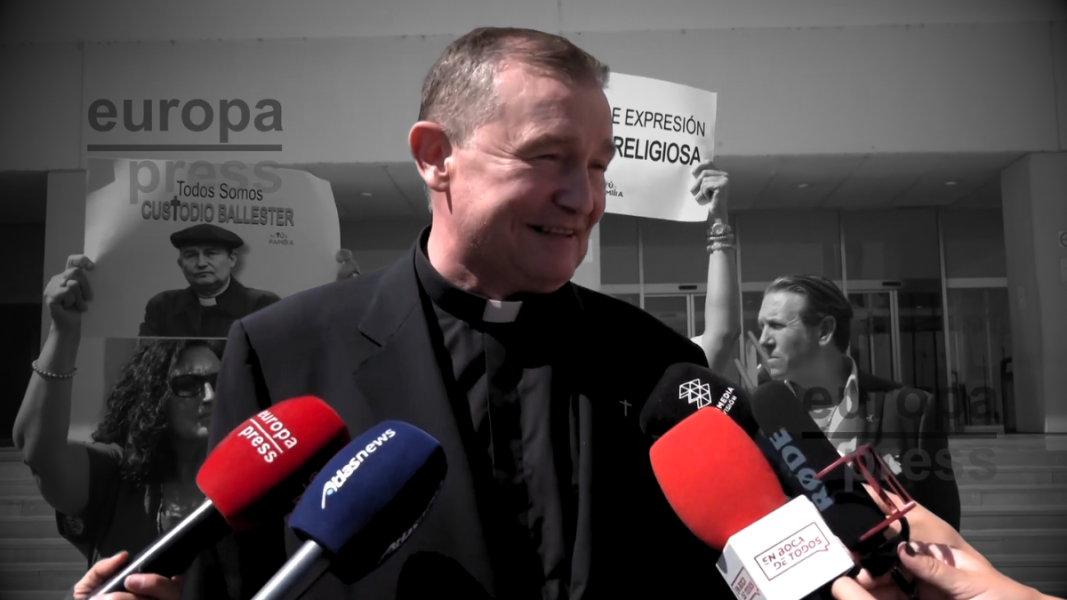
The First Section of the Provincial Court of Málaga has set the trial for sentencing in the case where the Prosecution requests three years in prison for Father Custodio Ballester, accused of a hate crime for his critical statements toward Islam. The same penalty is also requested for the priest Jesús Calvo and four years for Armando Robles, director of Alerta Digital, along with the closure of the portal, as reported by Europa Press.
The public prosecutor’s office argues that articles and programs disseminated between 2016 and 2017 constitute incitement to hatred against migrants and Muslims. The private prosecution, brought by the association Musulmanes contra la Islamofobia, insists that the messages “demonize an entire group” and generate hostility.
Custodio Ballester: “I’m calm; I’ve said what I had to say”
Upon leaving the courtroom, Fr. Custodio appeared before the media with serenity:
“This is a kind of final exam. There has been a court, an oral exam, and now I’m waiting for the grade. I’ve answered what I had to answer. Therefore, I’m calm.”
The priest recalled that his words were given in a specific context, in an interview addressing the issue of jihadism in Catalonia, as recorded in the police transcripts. “I don’t regret it,” he insisted.
In an ironic tone, Fr. Custodio denounced the disproportion of the accusation:
“If we were in Afghanistan or Pakistan, the Prosecution would have asked for the death penalty. Here in Spain, thank God, they’ve asked for three years; so I truly appreciate it.”
For him, what is at stake is freedom of expression:
“This thing they call a hate crime is leading to self-censorship, so that only the official discourse comes out. It seems there’s a narrative that we all have to repeat like parrots. There is freedom to think: you and I too.”
A process that questions freedom of expression
The Prosecution argues that the contents, far from legitimate criticism, “exceed freedom of expression.” However, the defenses remind that the statements were directed at radical jihadism and illegal immigration, not all Muslims, and speak of a “political trial.”
The prison requests are based on the application of Article 510 of the Penal Code, which typifies incitement to hatred as a crime. A provision increasingly used in Spain against critical voices and which, according to jurists, is becoming an instrument to impose a single way of thinking.
Support for Fr. Custodio and criticism of judicial persecution
At the doors of the City of Justice in Málaga, about fifty people gathered in prayer to support the accused. In Madrid, the Association of Christian Lawyers delivered more than 27,000 signatures requesting the withdrawal of the accusation against Father Custodio.
In addition, a manifesto signed by the former Supreme Court magistrate Javier Borrego and supported by nearly a hundred jurists denounces the injustice of the process and the expansive use of the hate crime. “Denouncing radical jihadism cannot be a reason for judicial persecution,” added the Observatory for Religious Freedom in a statement.
A case with political and religious implications
What began as a debate about Islam and European cultural identity has ended in a criminal process with 8 years of wear and tear that pits the warning about jihadism against a “hate” criminal offense that, more and more, threatens religious freedom and freedom of conscience in Spain, and which, it seems, is only for some.