


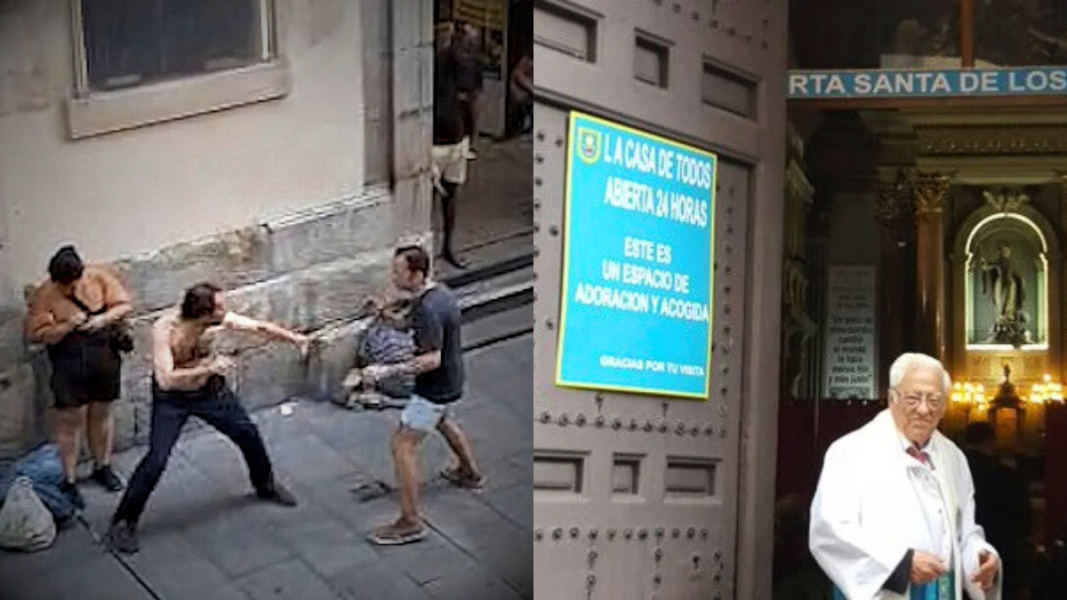
Neighbors: “This has become an anarcho-church”
According to the report from El Mundo on September 30, 2025, residents speak of daily fights, drug dealing, robberies, threats, and sexual scenes in the middle of the public street. Some neighbors, who prefer anonymity for fear of reprisals, claim to have been heckled or even threatened with bladed weapons. “This is not a church, but an anarcho-church,” declared the doorman of a building to the same newspaper.
The president of the Chueca Neighborhood Association, Esteban Nieto, explained to El Mundo that the service generates a “call effect” that worsens the situation, as many of the people served suffer from drug addiction or psychiatric disorders without specialized care. “This is not a help project; it’s a hotbed of problems,” he lamented.
Father Ángel: “It’s not the jungle, they need to be pampered”
The priest defended his work in statements, assuring that the parish is “a calm pool” and that the poor “are saints.” He admitted, however, that there may be isolated incidents, but “like in any Madrid neighborhood.” A few days later, interviewed again by the same newspaper, he clarified: “There are no gunshots or stabbings here.”
According to his figures, between 300 and 400 people come every day for coffee and sandwiches, many referred by the Red Cross, Samur Social, or the City Council itself. “Poverty has tripled. If before we gave 150 breakfasts, now it’s 300,” he stated.
The improvised solution: eliminate midday meals
The controversy, which escalated after the complaints published by El Mundo, forced the priest to react with immediate measures. As he himself confirmed a day later, he decided to eliminate the distribution of midday meals and hand out the sandwich along with the breakfast. The idea is to prevent people from staying in the Hortaleza Street area for more hours and reduce conflicts.
That same day, cleaning around the parish was intensified, and users were warned that they could not stay at the door after receiving breakfast, under penalty of losing their mid-morning coffee.
City Council and Archdiocese, in the spotlight
Neighbors demand that both the Madrid City Council and the Archdiocese stop “washing their hands” and take measures. They consider that the parish is breaching urban planning and heritage conservation regulations, as the temple is protected as a Cultural Interest Asset but has been altered with pantries, improvised dining rooms, and even televisions.
Auxiliary Bishop Vicente Martín met with residents on September 18, showing his desire for understanding, but the archdiocese maintains that the management of San Antón corresponds to Father Ángel.
A provisional solution with questions
The elimination of meals seeks to calm the neighborhood’s spirits, but it does not solve the underlying problem: the lack of professional and structured care for people who, in many cases, suffer from severe addictions and mental illnesses. Father Ángel insists that he will not close the doors of San Antón. The neighbors, for their part, fear that the measure will be insufficient and demand a firm response from civil and ecclesiastical authorities.