


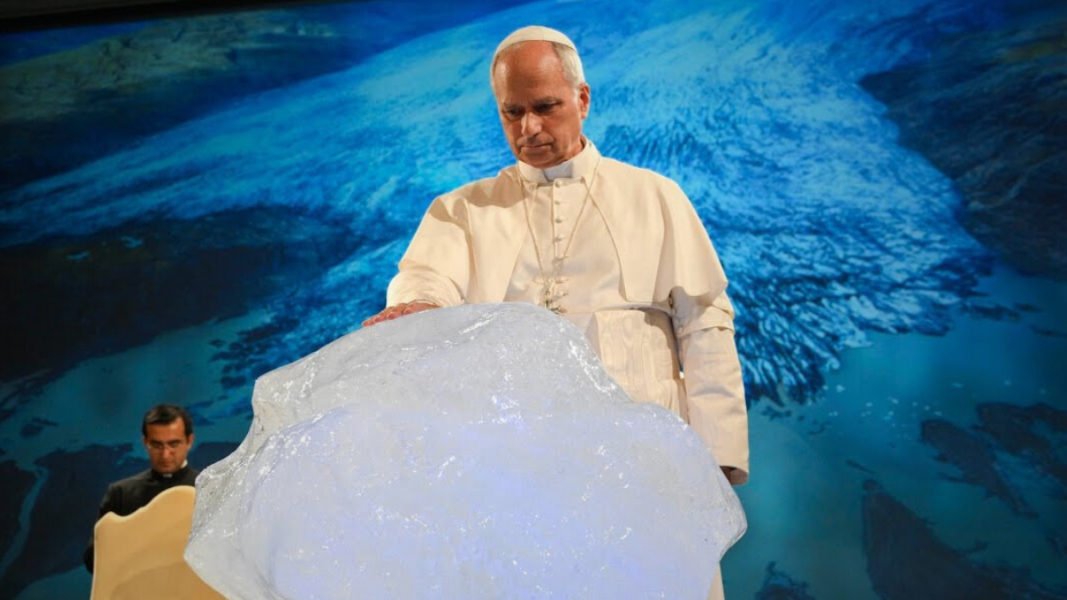
At the conference Raising Hope for Climate Justice, held in Castel Gandolfo for the tenth anniversary of the encyclical Laudato Si’, Leo XIV delivered a speech centered on the call for “ecological conversion.” The Pope praised Francisco’s legacy, thanked the work of the Laudato Si’ Movement, and highlighted the impact of this initiative in universities, international forums, and political debates.
Ecological conversion and political pressure
Leo XIV emphasized that the challenges identified a decade ago are “even more relevant today” and require a transformation of both personal and community lifestyles. He did not limit himself to spiritual language: he encouraged the faithful to actively participate in political life and to “pressure governments” to adopt stricter environmental regulations.
The speech insisted that individual faith or good intentions are not enough, but that global political structures are necessary. Summits such as COP30 in Brazil or the 2026 Water Conference were cited as spaces where the Church must be present.
Faith as integral ecology
In line with the encyclical Laudato Si’ and the exhortation Laudate Deum, the Pope explained that faith cannot be separated from the care of creation. Affirming that “we cannot love God if we despise his creatures,” thus expanding the horizon of Christian life to the stewardship of the environment. Spirituality, in this framework, is redefined as an ecological commitment.
Leo XIV’s final question
Leo XIV closed his message with a question: “God will ask us if we have cultivated and cared for the world He created, and if we have cared for our brothers and sisters. What will we answer?”.
The Church’s tradition has always reminded us that man is the administrator of creation, but also that his ultimate end is to love God above all things. St. John of the Cross expressed it with a clarity that spans the centuries:
“At the evening of life, you will be examined in love.”
That love is not measured in international regulations or UN conferences, but in charity toward God and toward our neighbor —which well includes creation, but in its due natural order— which is equally given to us by Him.
Blessing to the block of ice
At the end of his words, Leo XIV imparted a blessing to the large block of ice, turned into a symbol of the fight against climate change. The act, received with applause, was presented as a sign of respect toward creation. Gestures speak for themselves.
We leave below the full message of Leo XIV:
Dear sisters and brothers, peace be with you.
Before continuing with a few prepared words, I want to thank the two speakers who preceded me. And I would like to add that, in reality, today there is a hero of action among us: it is all of you, who work together to make a difference.
In commemorating the tenth anniversary of the Encyclical Laudato Si’ on the care of our common home, I cordially greet the organizers, speakers, participants, and all those who made the Raising Hope conference possible. I especially thank the Laudato Si’ Movement for having supported from the beginning the dissemination and application of Pope Francis’s message.
This Encyclical has deeply inspired the Catholic Church and many people of good will. It has proven to be a source of dialogue. It has given rise to reflection groups, academic programs in schools and universities, associations, and projects of various kinds on all continents. Many dioceses and religious institutes have felt called to act in the care of the common home, reprioritizing the poor and marginalized. Its impact has even reached international summits, ecumenical and interreligious dialogue, economic and business spheres, as well as theological and bioethical studies. The expression “care of the common home” has become part of academic, scientific, and political discourses.
The concerns and recommendations of Pope Francis have been valued and welcomed not only by Catholics, but also by many people outside the Church who have felt understood, represented, and accompanied in this concrete moment of history. His analysis of the situation (cf. chap. 1), the proposal of the paradigm of integral ecology (cf. chap. 4), the insistent call to dialogue (cf. chap. 5), and the invitation to address the root causes of problems and to “unite the entire human family in the search for sustainable and integral development” (n. 13) have awakened widespread interest. Let us give thanks to our Father in heaven for this gift inherited from Pope Francis! The challenges pointed out in Laudato Si’ are even more relevant today than ten years ago. They are challenges of a social and political nature, but above all of a spiritual nature: they call for conversion.
As in every anniversary of this kind, we remember the past with gratitude, but we also ask ourselves what remains to be done. Over the years, we have gone from understanding and studying the Encyclical to putting it into practice. However, what must we do so that the care of the common home and the listening to the cry of the earth and of the poor do not appear as mere passing fads or, worse still, as divisive issues? In tune with Laudato Si’, the Apostolic Exhortation Laudate Deum, published two years ago, warned that “some have chosen to mock” (n. 6) the increasingly evident signs of climate change, to “ridicule those who speak of global warming” (n. 7), and even to blame the poor for what affects them most (cf. n. 9).
In addition to disseminating the message of the Encyclical, it is now more important than ever to return to the heart. In Scripture, the heart is not only the center of feelings and emotions, but the place of freedom. Although it includes reason, it transcends and transforms it, influencing and integrating all aspects of the person and their fundamental relationships. The heart is the place where external reality impacts most strongly, where one seeks most deeply, where the most authentic desires are discovered, where ultimate identity is found, and where decisions are made. Only by returning to the heart can a true ecological conversion take place. We must move from accumulating data to caring; from environmental discourse to an ecological conversion that transforms personal and community lifestyles. For believers, this conversion is not different from the one that orients us toward the living God. We cannot love God, whom we do not see, while despising his creatures. Nor can we call ourselves disciples of Jesus Christ without sharing his gaze upon creation and his care for all that is fragile and wounded.
Dear friends, may your faith inspire you to be bearers of the hope that arises from recognizing God’s presence already at work in history. Let us remember how Pope Francis described St. Francis of Assisi: he “lived in simplicity and in wonderful harmony with God, with others, with nature, and with himself. He shows us the inseparability of the bond between concern for nature, justice for the poor, commitment to society, and inner peace” (Laudato Si’, 10). May each one of us grow in these four relationships—with God, with others, with nature, and with ourselves—through a constant attitude of conversion. Integral ecology is nourished by all these relationships. Through our commitment to them, we can grow in hope, living the interdisciplinary approach of Laudato Si’ and the call to unity and collaboration that flows from it.
We are one family, with one Father, who makes the sun rise and sends rain for all (cf. Mt 5:45). We inhabit the same planet, and we must care for it together. That is why I renew with force my call to unity around integral ecology and peace. It is encouraging to see the variety of organizations represented at this conference, as well as the wide network of entities that have joined the Laudato Si’ Movement and the Action Platform.
Furthermore, Pope Francis emphasized that “the most effective solutions will not come solely from individual efforts, but above all from great political decisions at the national and international level” (Laudate Deum, 69). Everyone in society, through non-governmental organizations and advocacy groups, must pressure governments to develop and apply more rigorous regulations, procedures, and controls. Citizens must assume an active role in political decision-making at the national, regional, and local levels. Only in this way will it be possible to mitigate the damage already caused to the environment. Local legislation will also be more effective if neighboring communities support the same environmental policies (cf. Laudato Si’, 179).
I hope that the upcoming United Nations international summits—the 2025 Climate Change Conference (COP 30), the 53rd Plenary Session of the World Food Security Committee, and the 2026 Water Conference—will hear the cry of the earth and the cry of the poor, of families, of indigenous peoples, of involuntary migrants, and of believers around the world. At the same time, I encourage everyone, especially young people, parents, and those who work in local and national administrations and institutions, to contribute solutions to the current “cultural, spiritual, and educational challenges” (Laudato Si’, 202), always striving tenaciously for the common good. There is no room for indifference or resignation.
I would like to conclude with a question that concerns us all. God will ask us if we have cultivated and cared for the world He created (cf. Gn 2:15) for the benefit of all and future generations, and if we have cared for our brothers (cf. Gn 4:9; Jn 13:34). What will our answer be?
Dear friends, I thank you for your commitment and gladly extend my blessing to all of you. Thank you.