


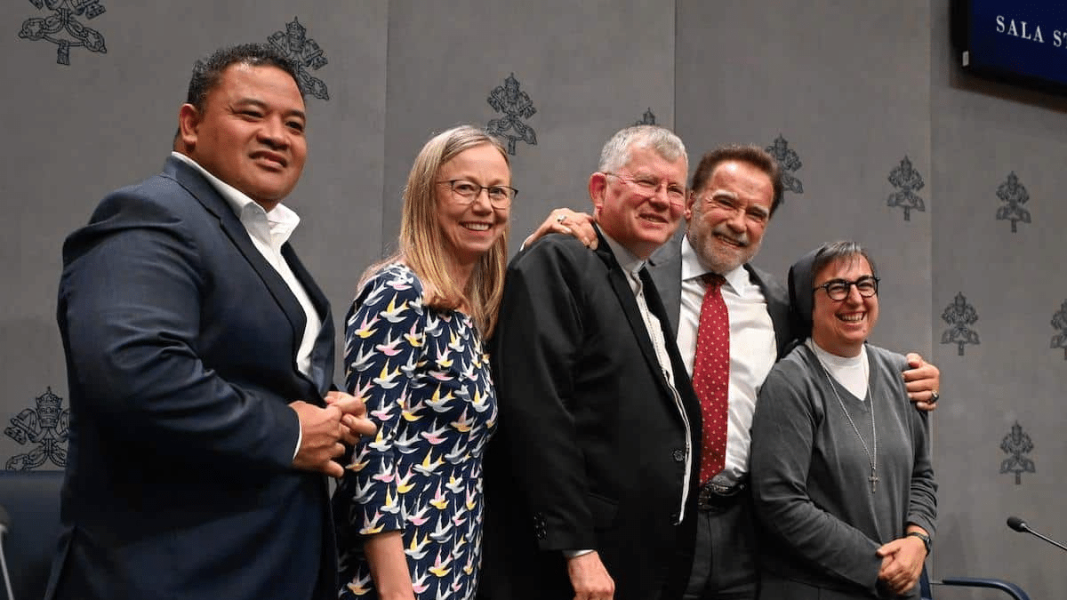
This Tuesday, September 30, the press conference prior to the start of the “Raising Hope on Climate Change” meeting took place. The executive director of the Laudato Si’ Movement, Lorna Gold, announced the launch of “Laudato Si’ 10”, a plan of commitments intended to be presented at the next COP30 as “Peoples Determined Commitment”. As she explained, it is a “collective” project, parallel to official national plans, that seeks to influence the Global Ethical Stocktake, the global balance of climate measures linked to the Paris Agreement.
The central event will take place in Castel Gandolfo, in the so-called “Borgo Laudato si’”, where the participation of Leo XIV along with 35 religious leaders is expected. The conference is being organized jointly by the Dicastery for Integral Human Development, Caritas Internationalis, CIDSE, the UISG, the Focolare Movement and the Ecclesial Networks Alliance.
Between Spirituality and Political Environmentalism
Cardinal Jaime Spengler, Archbishop of Porto Alegre, insisted on the need to “recover the capacity to venerate the earth” and warned about “the point of no return”. The mystical-poetic tone mixed with the language of climate emergency, in line with what Leo XIV himself defined as a “crisis of trust”. Spengler went so far as to say that at the next summit “statesman-like decisions” are needed to save the planet.
From the organizing dicastery, Sister Alessandra Smerilli stated that the tenth anniversary of Laudato si’ “is not a milestone, but a new beginning”. In her speech, she listed social and ecological challenges such as climate change, biodiversity loss and forced migrations, emphasizing that “the future of the planet is not just a matter for governments, but for every person and community”.
Activism at the Heart of the Vatican: Crusaders for the Environment
Among the guests, Arnold Schwarzenegger, former governor of California and promoter of environmental policies, stood out. In his own style, he defended the idea of turning Catholics into “environmental crusaders” and appealed not to expect anything from governments, but from individual initiative. He compared the climate cause to historical movements such as women’s suffrage or the fight against apartheid.
“There are 1.4 billion Catholics in the world, 200,000 parishes, and about 400,000 priests. Imagine the communication power that comes from having so many believers involved. Every Catholic can be an environmental crusader and help us end pollution. I experienced it firsthand as governor of California, when we were in a disastrous situation. The key was not talking, but acting. We cannot limit ourselves to speeches; we must move to action.”
The intervention by the Environment Minister of Tuvalu, Maina Talia, was even more dramatic: she described how a global average temperature increase of more than 1.5 degrees means “the difference between life and death” for her small island nation.
Environmentalism and Diversion of Priorities
The presentation of this “people’s plan” in the name of the encyclical Laudato si’ shows how the Vatican, under Leo XIV, maintains the line of instrumentalizing ecological discourse as a platform for global projection. Instead of centering the message on the moral and spiritual crisis of the West, the Holy See seems to insist on international climate forums that, far from the Church’s salvific mission, prioritize the political language of the UN.
That the Church commits to the care of creation is consistent with traditional doctrine; but turning that legitimate concern into a sociopolitical program of collective commitments, coordinated with NGOs and international lobbies, runs the risk of diluting the proclamation of the Gospel in a merely earthly agenda. Christian hope, which is founded on Christ’s redemption, cannot be reduced to “climate plans” or alliances with media figures of secular environmentalism.
The commemoration of the ten years of Laudato si’ should be an occasion to remember that man is not saved by recycling plastics, but by embracing Christ and his Church. The defense of creation is part of the divine mandate, but it cannot replace the proclamation of the Truth and the defense of human dignity from faith.