


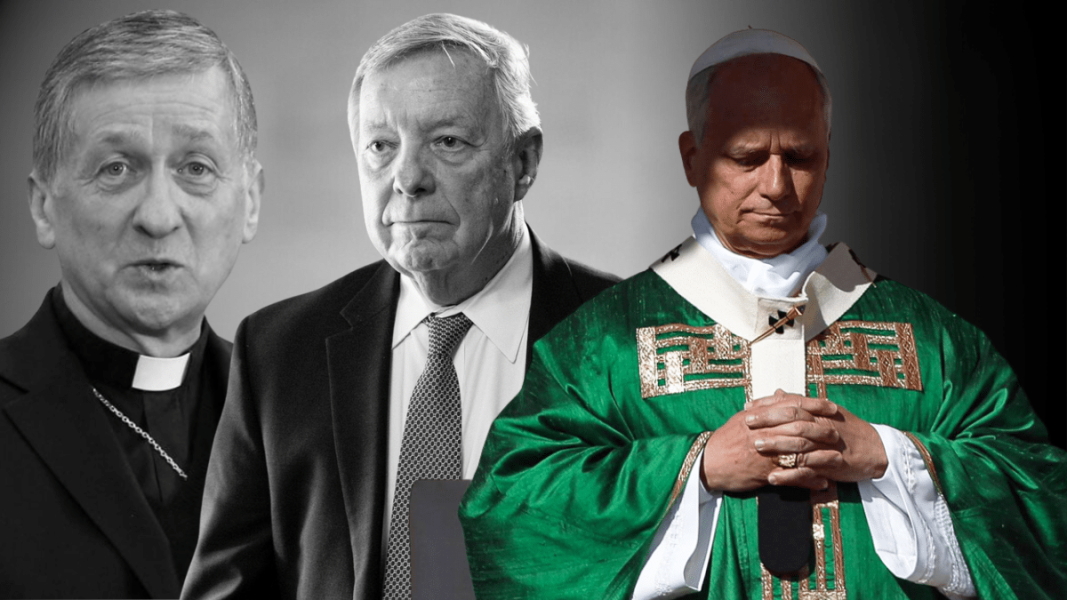
Following the controversy generated by the award that would be given on November 3 to Democratic Senator Dick Durbin for his trajectory in favor of migrants in the United States, in the face of pressure from bishops and the faithful and the controversial statement by Leo XIV, this Tuesday, September 30, the senator himself announced that he will not receive it. The decision was announced through an official statement from Cardinal Blase Cupich, published on the Archdiocese of Chicago’s website, in which the prelate justifies the recognition despite Durbin’s openly contrary positions to the Church’s teaching on life.
He informed me today that he has decided not to receive an award at our Keep Hope Alive celebration. Although this news saddens me, I respect his decision.
— Card. Blase Cupich
Statement by Cardinal Blase J. Cupich, Archbishop of Chicago, on the Keep Hope Alive award
September 30, 2025
Senator Durbin informed me today that he has decided not to receive an award at our Keep Hope Alive celebration. Although this news saddens me, I respect his decision. But I want to make it clear that the decision to award him was specifically in recognition of his singular contribution to immigration reform and his unwavering support for immigrants, which is so necessary in our days.
However, it would be negligent of me not to take this opportunity to share some additional thoughts, which I offer as his pastor.
Looking back on my 50 years as a priest and 27 years as a bishop, I have seen how divisions within the Catholic community have dangerously deepened. These divisions damage the unity of the Church and undermine our witness to the Gospel. Bishops cannot simply ignore this situation, because we have the duty to promote unity and help all Catholics embrace the Church’s teachings as a coherent whole.
The tragedy of our current situation in the United States is that Catholics find themselves politically homeless. The policies of neither political party perfectly reflect the breadth of Catholic teaching. Moreover, surveys tend to show that, with regard to public policies, Catholics themselves remain divided along partisan lines, just like all Americans. This stalemate has become more entrenched over the years and our divisions undermine our call to bear witness to the Gospel.
The controversy of the last few days points to the depth and danger of such a stalemate. Some would say that the Church should never honor a political leader if he promotes policies diametrically opposed to critical elements of Catholic social doctrine. But the tragic reality in our nation today is that there are virtually no Catholic public officials who consistently pursue the essential elements of Catholic social doctrine, because our party system does not allow it.
Total condemnation is not the way forward, as it closes dialogue. But praise and encouragement can open it, by asking recipients to consider how to extend their good work to other areas and issues. More broadly, a positive approach can keep hope alive that it is worthwhile to speak with one another—and collaborate with each other—to promote the common good. No one wants to dialogue with someone who treats them as an absolute moral threat to the community. But people will relate to those who recognize that they are making some contribution to a common effort.
It should concern us all that the present stalemate continues to significantly hinder the Church’s efforts to promote human dignity across the full range of issues. In fact, the child in the mother’s womb, the sick and elderly, the migrant and refugee, the one condemned to death, those already suffering the consequences of climate change and generational poverty will continue to be at risk if we, as Catholics, do not begin to speak to each other respectfully and work together. That includes listening. This way of being Church, of being human, one might even call it synodal. And this is the path, beautifully traced by our dear and late Holy Father, Pope Francis, that can lead all Catholics to embrace the fullness of our teachings. Such witness would undoubtedly serve society by building the common good.
My hope was that our Keep Hope Alive celebration would serve as an invitation to Catholics who strongly defend the vulnerable on the border between the United States and Mexico, to reflect on why the Church defends the vulnerable on the border between life and death, as in cases of abortion and euthanasia. Similarly, it could be an invitation to Catholics who tirelessly promote the dignity of the unborn, the elderly, and the sick, to expand the circle of protection to immigrants who are currently facing an existential threat to their lives and those of their families.
Both groups are Catholic, regardless of where they stand on this spectrum, and all need to remember that we are not a single-issue Church. Ideological isolation all too easily leads to interpersonal isolation, which only undermines Christ’s desire for our unity.
It is also important to make it clear that it would be wrong to interpret decisions regarding the Keep Hope Alive event as a softening of our position on abortion. We firmly affirm what the Catechism of the Catholic Church makes clear: «From its beginning, the Church has affirmed the moral evil of every procured abortion. This teaching has not changed and remains unchangeable.» Likewise, there should be no doubt about our duty to advocate for laws that protect human life, as well as for the Church’s right to the free exercise of religion.
Catholic bishops responded heroically when the right to life of the unborn was denied by the Supreme Court decisions in 1973. That right to life still must be defended without compromise. Another issue—the matter of immigration—has long been inadequately addressed by our nation, but also one in which we, the bishops of the United States, have invested our energy and resources.
Thirty years ago, St. John Paul II preached a homily in our nation in which he vigorously defended the rights of the unborn, the elderly, and people with disabilities, and quoted the poem inscribed on the base of the Statue of Liberty. He asked: «Is today’s America becoming less sensitive, less compassionate toward the poor, the weak, the stranger, the needy? It must not be so! Today, as in the past, the United States is called to be a welcoming society, a culture of hospitality. If America were to shut itself up in itself, would this not be the beginning of the end of what constitutes the very essence of the ‘American experience’?» We need to hear these prophetic words at this moment in the life of our nation.
This leads me to make a proposal to move forward. I believe it would be worthwhile to organize some synodal gatherings so that the faithful can experience listening to each other respectfully on these issues, always remaining open to maturing more fully in their common identity as Catholics. Perhaps our Catholic universities can be of help. As I think about how such gatherings might be carried out, I welcome suggestions.
We can move forward if we keep hope alive.