


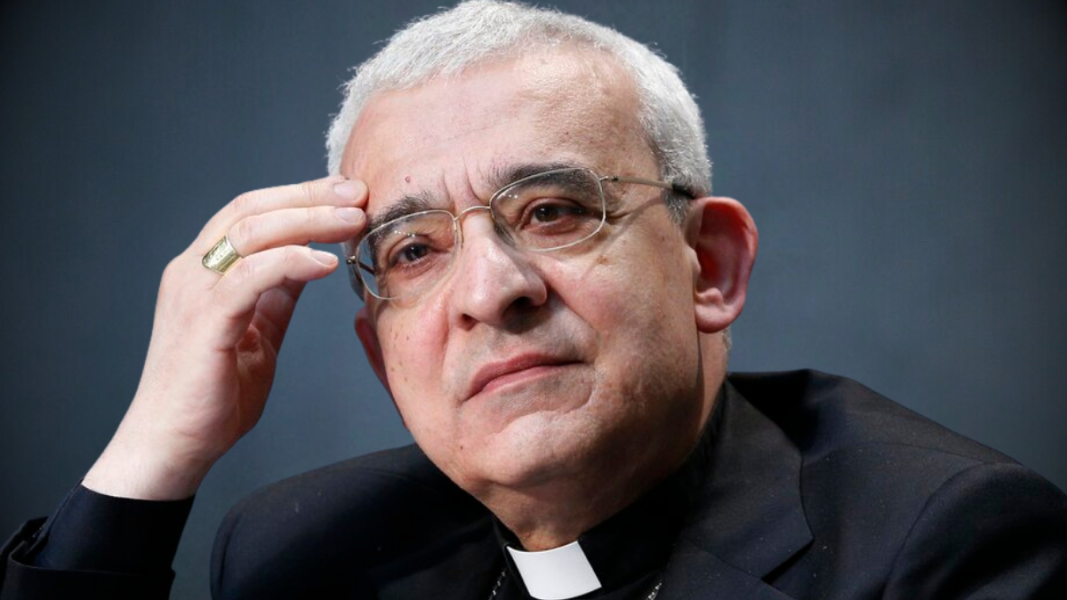
Last September 26, the Holy See announced the appointment of Monsignor Filippo Iannone, O. Carm. as the new prefect of the Dicastery for Bishops and president of the Pontifical Commission for Latin America. The prelate will assume the role next October 15, 2025, after having served as prefect of the Dicastery for Legislative Texts.
The choice of Iannone, a canonist with a long track record, underscores the Pontiff’s decision to place an expert in canon law at the head of the Congregation for Bishops, at a time when the Church faces crucial challenges in matters of justice and discipline.
On the occasion of this appointment, we are republishing an interview published by Vatican News in October 2024, in which Monsignor Iannone offered key insights into canonical procedures in the fight against abuses and other critical situations in ecclesial life.
Interview with Monsignor Filippo Iannone:
The fight against abuses is a constant concern in the Church, especially in recent years. The topic has also arisen in the hall where the Synod meets and continues to be monitored by the media. We spoke with Archbishop Filippo Iannone, prefect of the Dicastery for Legislative Texts, to delve deeper into some aspects related to the procedures that are applied.
Can you tell us where we stand from the point of view of current laws? Are they effective?
Certainly, this is a topic at the center of the attention of the entire Church, as the Pope continually repeats, and therefore it could not fail to appear, in some way, in the interventions of the Synod members. The canonical legislation for the repression and punishment of abuse crimes against minors and vulnerable adults has been modified in recent years, taking into account the experience accumulated over time, the various suggestions coming from local Churches and from people committed at different levels in the fight against this phenomenon, and above all as a result of the meeting of the presidents of the Episcopal Conferences from around the world with the officials of the Roman Curia, convened by Pope Francis and held in the Vatican in February 2019.
Canonical criminal law has been revised, the new motu proprio Vos estis lux mundi was promulgated, which establishes “at the universal level the procedures to prevent and combat these crimes that betray the trust of the faithful,” and the norms followed by the Dicastery for the Doctrine of the Faith in the trial of offenses reserved to its competence have been reviewed.
In all normative texts, greater emphasis has been placed on the good of the persons whose dignity has been violated and on the will to hold a “fair process” in respect of the fundamental principles of the legal system. Among other things, the obligation to report to ecclesiastical authorities by priests and consecrated persons in case of knowledge of possible abuses has been established.
As for the effectiveness of the norms, it is difficult to give a global judgment, because it would be necessary to know all the related data. Based on my personal experience, I would say yes, they are effective. In any case, I want to recall the words of Pope Francis: “Although much has already been done, we must continue to learn from the bitter lessons of the past to look toward the future with hope.”
Is a priest dismissed from the clerical state excommunicated?
No! Canonical tradition distinguishes two types of penalties applicable to all the faithful, clerics and laity: censures and expiatory penalties. Among the expiatory penalties applicable to a cleric (deacon, priest, or bishop), the most serious and also perpetual one is dismissal from the clerical state. It is applied, as is easy to deduce, in the presence of particularly serious crimes. In simpler terms: the priest dismissed from the clerical state is not excommunicated, but he can no longer exercise sacred ministry, although he can receive the sacraments under the same conditions as the other faithful.
Can you explain how the eventual remission of an excommunication occurs? Are there fast procedures for it? What subjects are involved?
Excommunication, which canon law includes among the censures, is the penalty by which the baptized—who has committed a crime (among them: profanation of the Eucharist, heresy, schism, abortion, violation of the sacramental seal by the priest) and remains contumacious (that is, disobedient)—is deprived of certain spiritual goods, until he ceases to remain in that state and is absolved.
The spiritual goods, or those linked to them, from which the penalty can deprive, are those necessary for Christian life, mainly the sacraments. Excommunication has a strictly “medicinal” purpose, aimed at the redemption and spiritual healing of the affected person, so that, repentant, he may again receive the goods from which he was deprived (salus animarum suprema lex in Ecclesia —the salvation of souls is the supreme law in the Church).
Therefore, to obtain remission, it must be demonstrated that this purpose has been achieved. There are no pre-established time limits. The necessary requirement is that the subject has truly repented of the crime and has offered adequate reparation for the scandal and damage caused, or at least has seriously committed to making such reparation.
It is obvious that the assessment of this circumstance must be made by the authority competent for the remission of the penalty, with a pastoral spirit, taking into account the disposition of the subject and the social impact that such a decision may have.
Could you explain the difference between excommunication and what are called “expiatory penalties”?
In addition to the censures we have spoken about, canonical tradition knows and provides for another type of penalties, called expiatory, whose specific purpose is the expiation of the crime. Consequently, their remission is not linked solely to the repentance or pertinacity of the offender (that is, to his obstinacy), but mainly to the personal sacrifice lived with a reparative and corrective purpose.
These entail the deprivation, for a determined, indeterminate, or perpetual time, of certain rights enjoyed by the subject (for example, the prohibition to exercise or the deprivation of an office or charge), without preventing access to spiritual goods, in particular to the sacraments.
In recent weeks, various press articles have offered different interpretations about canonical procedures related to reserved offenses. Can you explain what these procedures are and how they are applied?
We are talking about offenses that, due to their gravity in matters of faith or morals, are judged exclusively by the Dicastery for the Doctrine of the Faith. The procedure followed by the Dicastery can be of two types: of a so-called “administrative” nature or of a judicial nature.
In the case of the administrative process, once the procedure is concluded with the extrajudicial penal decree, the convicted person has the possibility to challenge the act by appealing to the College of Appeals, established expressly in the same Dicastery. The decree of this College is final.
In the case of a judicial criminal process, after the various degrees of trial have been exhausted, the sentence becomes res judicata (res iudicata), so it becomes enforceable.
In both cases, the convicted person can request restitutio in integrum (that is, the restoration of his original condition) always from the Dicastery for the Doctrine of the Faith. It is also possible to request a review in the form of grace; in this case, the procedure is ordinarily carried out by the Supreme Tribunal of the Apostolic Signatura, but it can also be entrusted to other bodies.
Given the reserved nature of this type of communications, it is the Secretariat of State that coordinates the various instances and sends the eventual decisions for the execution of the provisions adopted.