


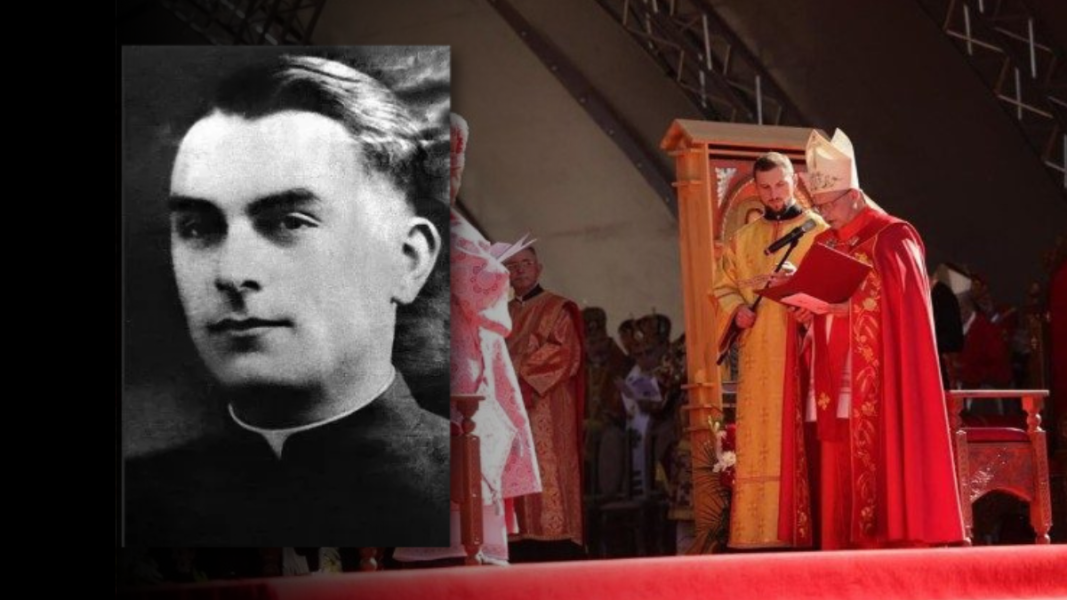
On Saturday, September 27, in the village of Bilky (Ukraine), the Greek Catholic Church celebrated the beatification of Father Petro Oros, a priest murdered in 1953 for remaining faithful to his ministry and refusing to join the Orthodox Church controlled by the Soviet regime.
The ceremony was presided over by Cardinal Grzegorz Ryś, Archbishop of Łódź and representative of Pope Leo XIV, in the presence of faithful who for decades have venerated the memory of the new blessed.
A life marked by fidelity
Petro Oros was born in 1917 in Transcarpathia, into a family with a strong Greek Catholic tradition. He was ordained a priest in 1942 and exercised his ministry in a context of religious persecution. In 1949, the Soviet authorities banned all pastoral activity, closed temples, and demanded that priests join a Church subservient to the State.
Father Oros refused to betray his vocation. He continued to celebrate the liturgy in secret, confessing in hiding, and encouraging the faithful who rejected renouncing their faith.
The martyrdom in 1953
On the night of August 27, 1953, the eve of the Assumption, he confessed and celebrated the liturgy for hours. The parishioners noticed the presence of a suspicious man, but he remained with his community.
The next day, he was arrested by NKVD agents. On the way to the village of Zarichchia, near a crucifix that still exists, he begged for mercy: «Vi prego, lasciatemi andare». The agents replied: «Pray, because for you it is over». He then knelt, consumed the Eucharist he was carrying with him, and was executed with a shot in the back. His assassin later boasted of having received 500 rubles as a reward.
A memory recovered after decades of silence
For nearly forty years, the location of his burial was unknown. Only after the legalization of the Greek Catholic Church in 1992 were his remains located, exhumed, and deposited in Bilky, where they have become a destination for pilgrimages.
Pope Francis officially recognized his martyrdom in 2022, but the beatification was postponed several times due to the war in Ukraine and then by his death in April 2025. With the election of Leo XIV, the date of the celebration could finally be set.
A timely testimony
The Bishop of Mukachevo recalled during the ceremony that Father Oros “was neither a politician nor a soldier, but a priest faithful unto death”. His example, he added, is a sign of hope for Ukrainians who today suffer from the war and for every Christian called to bear witness amid persecution.
The beatification of Petro Oros was not only an ecclesial event but also a reminder that the freedom and dignity of the person are upheld by fidelity to God, even at the cost of life.
Source: Vatican News